
Last Updated on November 1, 2026 6:41 pm by INDIAN AWAAZ
Zakir Hossain, Dhaka
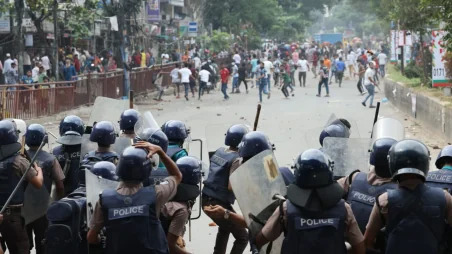
Labour unrest intensified across Bangladesh’s garment industry on Sunday (November 1), with more than 100 factories suspending operations, police vehicles and installations set ablaze, and security forces using tear gas, sound grenades and water cannons to disperse workers demanding a minimum monthly wage of Tk 30,000.
The fresh violence followed Saturday’s clashes and factory shutdowns, when around 30 factories in Ashulia suspended production. Workers are demanding more than double the existing minimum wage of Tk 12,500, citing rising living costs.
In Dhaka’s Mirpur area, hundreds of garment workers blocked the Mirpur-10 intersection around 9am, paralysing traffic in surrounding areas.
Clashes erupted around 11.15am when police attempted to clear the roads. Protesters hurled stones, prompting police to fire tear gas and sound grenades, deploy water cannons and charge demonstrators with batons.
A police vehicle was set ablaze beneath the Mirpur-11 metro station. Several police personnel were injured, while a journalist was also hurt during the unrest.
Mirpur Division deputy commissioner Hasan Mohammad Naser Rikabder said protesters had refused repeated requests to clear the roads.
“We then dispersed them,” he said, adding that several protesters had been detained.
Police eventually restored traffic at Mirpur-10, although roads towards Mirpur-11 and Mirpur-12 remained affected. The clashes also caused panic among commuters, including schoolchildren and parents.
In neighbouring Gazipur, workers blocked the Dhaka-Tangail Highway at Konabari, Chandra, Safipur and Mouchak, disrupting traffic for hours.
A police box was torched in Konabari, while fires broke out at three locations in Kaliakair’s Palli Bidyut area, including a factory warehouse. Firefighters initially struggled to reach the sites because of road blockades.
Gazipur Industrial Police superintendent Mohammad Amjad Hossain confirmed that 45 factories had declared holidays by Sunday afternoon.
Five platoons of Border Guard Bangladesh (BGB) personnel were deployed at sensitive locations, with security arrangements scheduled until November 7.
Meanwhile, workers blocked roads in Savar’s Ashulia and Hemayetpur areas, including the Dhaka-Aricha Highway. More than 50 factories in Ashulia reportedly suspended operations.
Industry sources told journalists that over 100 factories across Gazipur, Savar and Mirpur had declared holidays, although authorities had not released a consolidated official figure.
Government forms wage board: Amid the escalating unrest, Labour and Employment Minister Ariful Haque Choudhury announced the formation of a six-member wage board on Sunday to determine revised garment workers’ wages.
The announcement followed discussions with workers and factory owners, including the Bangladesh Garment Manufacturers and Exporters Association (BGMEA) and Bangladesh Knitwear Manufacturers and Exporters Association (BKMEA), the country’s two major apparel industry bodies.
The board, chaired by senior judge Sheikh Ashfaqur Rahman, includes representatives of employers, workers and an independent academic.
Its members include garment workers’ leader Babul Akhter, BGMEA director ABM Shamsuddin and Dhaka University professor Mosleh Uddin Ahmed.
The minister urged workers to return to factories, saying their demands would be considered through the new wage-setting process.
However, the government has not approved the proposed Tk 30,000 minimum wage, and no deadline for announcing revised salaries has been confirmed.
Labour representatives say rising food, housing, transport and healthcare costs have made existing wages inadequate.
Factory owners have warned that prolonged disruption could affect production, export shipments and payments from international buyers.
Some officials and industry representatives have alleged outside involvement in the unrest, but no evidence establishing those claims has been made public.
Bangladesh’s garment sector employs around four million workers and generates more than 80% of the country’s export earnings, making the continuing unrest a significant challenge for the government and export-dependent economy.