
Last Updated on October 31, 2026 8:06 pm by INDIAN AWAAZ
Zakir Hossain/ Dhaka
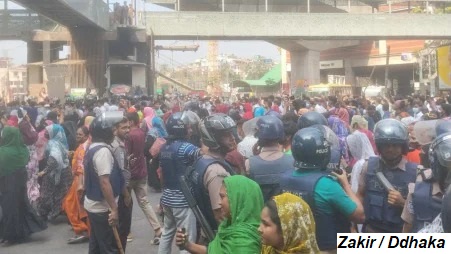
Labour unrest rocked Bangladesh’s garment industry on Saturday (October 31), forcing around 30 factories to suspend operations as workers demanding a minimum monthly wage of Tk 30,000 ($242.18) clashed with police and blocked major roads in Dhaka, Ashulia and Gazipur.
The protests have raised concerns over production disruptions in Bangladesh’s export-dependent garment sector, one of the world’s largest apparel manufacturing industries.
In Ashulia’s Kathgara industrial area, workers from Naim Knitwear stopped production before taking to the streets. Demonstrations spread to neighbouring factories, with protesters allegedly throwing bricks and stones and damaging windows.
Ashulia Industrial Police superintendent Mohammad Mominul Islam Bhuiyan confirmed the shutdowns.
“The situation is not very good at the moment. Workers are stationed at different locations. We are continuing our efforts to persuade them. So far, around 30 garment factories have declared a holiday,” he said.
Other reports put the number of affected factories at 25.
Six police officers and several workers and passers-by were reportedly injured. Police used tear gas and sound grenades to disperse protesters near the Abdullahpur-Baipail road in Nischintapur. Three suspected crude bombs were also recovered near the New Age factory.
Highway blockades disrupt traffic: In Gazipur, workers blocked the busy Dhaka-Tangail Highway near Chandra and Kaliakair, causing traffic congestion stretching nearly two kilometres.
Industrial Police superintendent Mohammad Amjad Hossain said workers from 10 to 12 factories were protesting, prompting several establishments to suspend operations.
Hundreds of workers also blocked roads at Mirpur-10, Mirpur-11, Mirpur-12 and Proshika intersection in Dhaka.
Pallabi Police Station officer-in-charge Mohammad Jalal Uddin said demonstrations began around 10.45am, severely disrupting traffic.
Workers demand higher wages: Protesters are demanding an increase in the minimum monthly wage from Tk 12,500 to Tk 30,000, clearance of unpaid salaries, an end to arbitrary dismissals and removal of alleged employment blacklists.
Bangladesh last revised garment workers’ minimum wages in 2023, increasing them from Tk 8,000 to Tk 12,500. Despite subsequent increases in annual increments, workers say rising living costs have eroded their earnings.
Bangladesh Garments and Sweaters Workers Trade Union Centre leader Khairul Mamun said the government’s delay in forming a new wage board had fuelled frustration.
The demonstrations, which began on October 12, have since spread across Uttara, Mirpur, Ashulia and Gazipur.
Government announces wage board: Amid escalating protests, Labour and Employment Minister Ariful Haque Choudhury announced that a new wage board would be formed on Sunday (November 1), following discussions with workers and factory owners, including representatives of the Bangladesh Garment Manufacturers and Exporters Association (BGMEA) and Bangladesh Knitwear Manufacturers and Exporters Association (BKMEA), the country’s two major apparel industry bodies.
“The decision has been taken to announce the wage board tomorrow. Workers’ representatives have also submitted a list of their nominees to the board. The announcement will be published in the gazette tomorrow,” he said.
The minister urged workers to resume duties, assuring them their legitimate demands would be considered. Factory owners reportedly agreed to a three-year wage-board tenure instead of five years.
The ministry also directed manufacturers to clear outstanding salaries.
However, the proposed Tk 30,000 minimum wage has not been approved.
Bangladesh Garment and Industrial Workers Federation general secretary Babul Akter welcomed the announcement and proposed implementing revised wages from December, enabling workers to receive higher salaries in January.
“For the sake of the country, the industry and your jobs, please return to work,” he appealed.
The minister also alleged that outside groups were attempting to exploit workers’ grievances, although the claim remains unverified.
Concerns over exports: Bangladesh earned approximately $38.7 billion from garment exports during the 2025-26 financial year, accounting for more than four-fifths of merchandise export earnings.
India is an important textile supplier to Bangladesh, exporting cotton yarn, fabrics and related products worth approximately $2.05 billion during India’s 2025-26 financial year.
Repeated shutdowns could disrupt production and delivery schedules, although their immediate impact on exports remains unclear.