
Last Updated on October 29, 2026 8:03 pm by INDIAN AWAAZ
By Huma
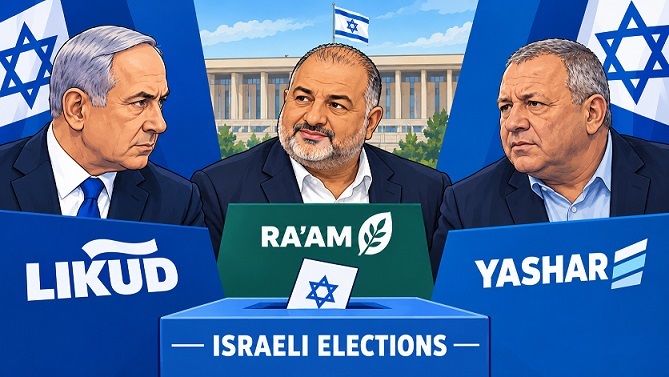
Israel’s latest election has uncovered a major contradiction at the heart of its parliamentary politics: Arab voters can influence the electoral outcome. However, the parties representing them may still be excluded from the government that emerges. Record participation among Palestinian citizens of Israel, including Bedouin communities, has strengthened Arab representation in the Knesset. However, removing Prime Minister Benjamin Netanyahu requires more than votes. It requires Jewish-led opposition parties to accept Arab lawmakers as legitimate political partners.
With roughly 90 per cent of votes counted (as on Thursday Oct 29, 2026), Netanyahu’s bloc was projected to hold around 53–54 seats in the 120-member Knesset, while the opposition led by former military chief Gadi Eisenkot had approximately 48–49. The Arab-led parties were projected to win 19 seats, an all-time high. Although these figures left Netanyahu short of the 61 seats required for a parliamentary majority, they did not automatically establish an alternative government.
Therefore the main question is not whether Arab voters have political influence, but whether Israel’s opposition is prepared to convert that influence into governing power.
Electoral strength without political acceptance
Reportedly, Arab and Bedouin turnout reached extraordinary levels, with Rahat approaching 80 per cent. Overall national turnout stood at approximately 78 per cent, the highest since 1999. The mobilisation challenged the supposition that Palestinian citizens would remain politically disengaged or that their participation could be taken for granted.
Former Israeli ambassador Daniel Shek described the development as “the rise and the revival of the Arab vote”, adding that “you cannot disregard such a large portion of the electorate in the calculations for Israeli politics”.
The figures underline his point. Nineteen seats give Arab-led parties substantial parliamentary weight. Combined with the opposition’s projected strength, their support could potentially create a majority exceeding the 61-seat threshold. Yet parliamentary arithmetic is not the same as political agreement.
Netanyahu has rejected reliance on Arab-led parties, describing such a government as “a shame and a disgrace”. Eisenkot, meanwhile, has also faced pressure from potential coalition partners who insist that a future government should comprise only Zionist parties.
This hesitancy creates the major hindrance to removing Netanyahu. Arab parties may supply the numbers required for a majority, but their support becomes ineffective if opposition leaders refuse to negotiate with them.
The reasons on why the opposition may hesitate, extend beyond personal rivalries. The October 7, 2023, Hamas-led attack, which killed approximately 1,200 people in Israel according to Israeli figures and led to the taking of hostages, profoundly altered Israeli politics. Security concerns, public trauma and distrust towards political movements perceived as insufficiently aligned with Israel’s national identity have shaped the debate over Arab participation in government.
Eisenkot’s military background and his campaign stress on security make cooperation with Arab parties politically complicated. His prospective partners, including Naftali Bennett and Avigdor Liberman, have also expressed opposition to relying on Arab-led parties to govern.
For these politicians, accepting Arab support could carry electoral costs among voters who regard the participation of Arab parties as unsuited with their conception of a Zionist government. They may be concerned that opponents would characterize such a deal as a threat to national security, especially as the aftermath of the October 2023 attack is still a hot topic in the public debate.
However, this position creates a strategic contradiction. If the opposition’s principal objective is to replace Netanyahu, excluding parties that could provide the necessary parliamentary majority significantly narrows its options.
As Palestinian political analyst Ahmed Najar argued, the obstacle is “ideological”. The disagreement is not necessarily about whether Arab lawmakers have been elected legitimately, but whether their parties should be permitted to exercise governing power.
The 19 projected seats also conceal differences within Arab politics. The Joint List, comprising Hadash, Ta’al and Balad, represents a range of left-wing, civic equality and Palestinian nationalist positions. Its leaders have offered to help replace Netanyahu, although their willingness to enter a government directly may differ from that of other Arab politicians.
Ra’am, led by Mansour Abbas, follows a more pragmatic approach. It prioritises improvements in public security, housing, infrastructure, municipal funding and social services for Arab communities. Its participation in the Bennett-Lapid coalition in 2021 confirmed that an independent Arab-majority party could join an Israeli government.
Those examples matters because it weakens the argument that cooperation is institutionally impossible. Ra’am’s experience also shows the compromises involved: participation can deliver practical benefits, but it can create tensions between immediate community needs and broader Palestinian political demands.
The Joint List and Ra’am therefore cannot automatically be treated as a single negotiating bloc. Their positions on Palestinian national rights, relations with Zionist parties and participation in government differ. Even if both oppose Netanyahu’s continuation in office, they may disagree over the terms on which they would support an alternative administration.
Interestingly, the exclusion of Arab parties has consequences beyond coalition negotiations. Palestinian citizens constitute roughly one-fifth of Israel’s population and possess the right to vote in national elections. Yet their elected representatives frequently encounter resistance when seeking a role in government.
Honaida Ghanam, director general of the Palestinian Forum for Israeli Studies, described the barrier as “a political veto” rooted in a system that treats Arab citizens as unacceptable governing partners.
The criticism raises a fundamental question: what is the value of electoral representation if the parties elected by a substantial minority of citizens are routinely excluded from governing calculations?
Nevertheless, the political picture is not entirely uniform. Yair Golan, leader of the Democrats, has urged his allies to abandon their refusal to cooperate with Arab parties. “We must no longer accept Netanyahu’s racist division between Jewish votes and Arab votes,” he wrote on X.
Such positions demonstrate that opposition to excluding Arab representatives exists within Jewish Israeli politics itself. Whether that position can prevail over security concerns, ideological commitments and coalition calculations remains uncertain.
The election has also been accompanied by allegations concerning possible foreign funding for voter-mobilisation groups targeting Arab citizens. Election Committee chief Justice Noam Sohlberg reportedly asked the Shin Bet to investigate what he described as “serious suspicions”. The material provided also states that police had found no evidence so far.
These allegations must remain distinct from established findings. Without verified evidence, they cannot demonstrate that Arab turnout was improperly influenced or that the election result was illegitimate.
Meanwhile, Netanyahu’s opponents face several possible outcomes: an opposition government supported by Arab parties, a broader unity arrangement, defections between parliamentary blocs or another election. Each carries political costs. Another election could prolong Netanyahu’s caretaker premiership, while a unity government could bring together politicians who disagree on major policy questions.
The election demonstrates that Arab voters can substantially influence Israel’s political future. Electoral strength does not automatically produce governing authority.
The decisive factor is whether Eisenkot and his prospective partners are willing to negotiate with Arab parties despite ideological disagreements and anticipated electoral backlash. Arab politicians, for their part, must decide whether supporting an alternative government would deliver meaningful gains on public safety, equality and community investment, and whether the coalition’s wider policies would be acceptable.
Netanyahu’s continued political viability therefore rests partly on a paradox: his opponents may possess enough combined parliamentary strength to replace him, but they may be unwilling to cooperate with the parties whose votes make that outcome possible.
Until that contradiction is resolved, Arab voters may shape the election decisively without determining who ultimately governs Israel.
Huma is a senior journalist and defence expert