
Last Updated on October 30, 2026 1:03 am by INDIAN AWAAZ
By Our Correspondent / NEW DELHI
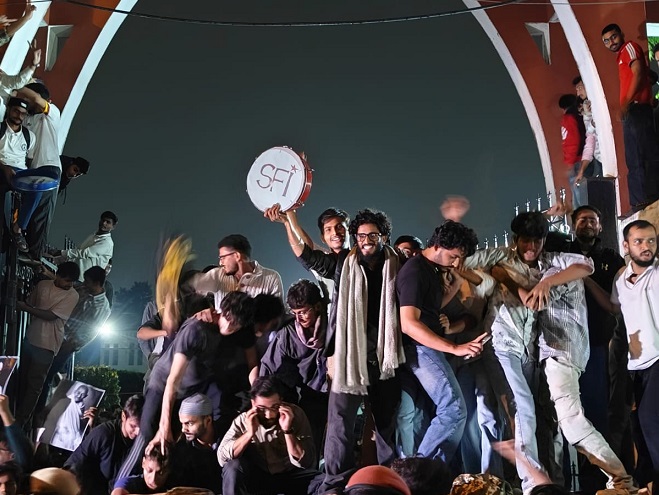
Students of Jamia Millia Islamia on Thursday after the university administration agreed to set a timeline for restoring the elected students’ union, bringing an end to an 18-day hunger strike and sustained protests on the campus. The breakthrough came with the administration committing to approve and implement the union’s constitution by May 15, 2027, and conduct elections within six weeks of the commencement of the next academic session.
The university also agreed to revoke disciplinary action taken against students in connection with the agitation, including show-cause notices, suspensions, rustication orders and campus bans. The decision addressed two of the protesters’ principal demands: the restoration of an elected students’ body and the withdrawal of punitive action linked to their participation in the movement.
Following the announcement, the university directed the protesting students to end their agitation with immediate effect. The students, who had been pressing for a clear commitment on union elections, called off their hunger strike and protest.
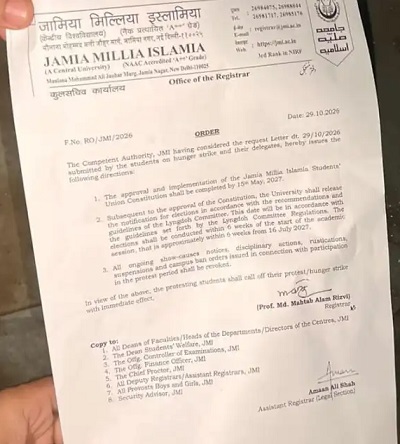
In an order dated October 29, 2026, the Office of the Registrar fixed May 15, 2027, as the deadline for approving and implementing the Jamia Millia Islamia Students’ Union (JMISU) Constitution. It further stated that elections would be held within six weeks of the start of the next academic session, scheduled to commence on July 16, 2027.
The order stated: “All ongoing show-cause notices, disciplinary actions, rustications, suspensions and campus ban orders issued in connection with participation in the protest period shall be revoked.”
Directing the protesters to end their agitation, the administration said: “The protesting students shall call off their protest/hunger strike with immediate effect.”
For the students, the announcement marked a significant development after more than two weeks of protests and hunger strikes demanding the restoration of an elected representative body. The administration’s written commitment provided a formal timeline for a process that had remained unresolved for years.
A Long-Standing Demand for an Elected Union
The demand for the restoration of the Jamia Millia Islamia Students’ Union has been a longstanding issue on the campus. The union has remained defunct since 2006, leaving students without an elected university-wide representative body of the kind they have been seeking to restore.
Students have argued that an elected union is necessary to represent their concerns on academic matters, campus facilities, student welfare and other issues affecting university life. They have also pressed for a constitution that would establish the framework for elections and the functioning of the union.
The latest agitation gathered momentum around the demand for a clear, time-bound commitment from the administration. The students wanted the university to move beyond assurances and establish a definite schedule for approving the constitution and holding elections.
The hunger strike continued for 18 days, accompanied by protests on the campus. The movement intensified pressure on the administration to respond formally to the demands and address the disciplinary proceedings initiated against students involved in the agitation.
The October 29 order has now provided a defined timetable for the next steps. It also addresses the students’ concerns about disciplinary action by explicitly committing the university to revoke measures imposed in connection with participation in the protests.
Timeline Agreed, but Students’ Original Deadline Was Earlier
While the announcement prompted celebrations among the protesters, the timeline approved by the administration differs from the schedule sought by the students.
The protesters had demanded that the union constitution be approved by December 20, 2026, and that an election notification be issued within 15 days. The administration’s order instead sets May 15, 2027, as the deadline for approving and implementing the constitution, with elections to follow within six weeks of the next academic session’s commencement.
The difference means the restoration process will take several more months. The university’s commitment nevertheless establishes specific milestones against which students can assess progress.
The next stage will involve completing the constitutional process and preparing for elections in accordance with the announced schedule. The administration’s adherence to the deadline, along with the implementation of its decision to revoke disciplinary action, will be central to determining how the agreement translates into practical outcomes.
For the students, ending the agitation marks the conclusion of the immediate protest, but the restoration of the union will depend on the completion of the promised steps.
The developments at Jamia also bring renewed attention to the role of elected student bodies in university governance and the mechanisms through which students can raise collective concerns. The students’ movement had focused on securing a formal commitment rather than accepting an open-ended assurance.