
Last Updated on November 7, 2026 11:43 pm by INDIAN AWAAZ
Ahead of memoir launch, Congress leader expresses optimism about party’s prospects, alleges lack of level playing field
Staff Reporter / New Delhi
Congress Parliamentary Party chairperson Sonia Gandhi has said that people are increasingly recognising what she described as the damage caused to India’s democracy, constitutional institutions and social fabric during the 12 years of BJP rule, expressing confidence that the country would welcome a return to what she called proper governance.
In an interview with The Hindu, published on Saturday, ahead of the November 10 launch of her memoir Belonging: A Journey of Love, the 79-year-old Congress leader said the restoration of democratic institutions would require considerable time and collective efforts by political parties, even after the present government leaves office.
“Over the last twelve years great damage has been done to the fabric of our country, our democracy and our institutions,” she said, adding that people were beginning to feel restless and recognise the consequences.
However, Gandhi said she remained optimistic about India’s political future and believed that people would welcome a return to proper governance.
Responding to a question about the Congress’s decline as India’s dominant political force following its defeats in the 2014, 2019 and 2024 Lok Sabha elections, she said she was “not so pessimistic” about the party’s prospects.
She argued that the Congress and other Opposition parties had not enjoyed a level playing field since the BJP came to power in 2014. She accused the ruling establishment of exercising excessive influence over institutions, particularly the Election Commission, as well as mainstream media, while using money power and religion for political advantage.
Despite these challenges, Gandhi said the Congress had demonstrated resilience and continued to fight for constitutional values across the country. She also expressed confidence that the party’s prospects were improving through cooperation with like-minded political groups.
Sonia Gandhi reflects on Emergency
In the same interview, Gandhi also discussed the circumstances surrounding the imposition of the Emergency by her mother-in-law and former Prime Minister Indira Gandhi between 1975 and 1977.
She referred to the deteriorating political and law-and-order situation at the time, including violent protests, attacks on government offices and public transport, widespread unrest and calls for bureaucrats and members of the armed forces to disobey official orders.
Gandhi said that, looking back, the circumstances leading to the Emergency needed to be understood in their historical context. However, she also acknowledged the curtailment of democratic rights during that period.
She pointed out that Indira Gandhi eventually called the March 1977 general election, allowing the issue to be resolved through the democratic process. Sonia Gandhi further said that the former Prime Minister had subsequently publicly expressed regret and apologised for the excesses committed during the Emergency.
Congress raises election concerns
The Congress leader’s remarks come amid the party’s continuing campaign against alleged electoral irregularities and its criticism of Chief Election Commissioner Gyanesh Kumar over the Special Intensive Revision (SIR) of electoral rolls.
The party has accused the Election Commission of failing to ensure a level playing field and has raised concerns over alleged manipulation of electoral rolls, a charge it describes as ‘vote chori’. It has also advocated a return to paper ballots.
Gandhi referred to a report in The Indian Express detailing 14 recorded objections over a period of 10 months by Election Commissioners Sukhbir Singh Sandhu and Vivek Joshi to decisions and orders concerning the SIR exercise under Kumar.
She argued that developments surrounding the Election Commission had increased public awareness about electoral transparency and accountability. However, allegations of electoral manipulation remain contested and have been a subject of political debate.
Gandhi maintained that the Congress was continuing its political struggle despite what she described as pressure on its leaders and workers, adding that the party was working with other like-minded organisations to improve its electoral prospects.
Asked about Prime Minister Narendra Modi’s political journey and what the Congress could learn from his rise, Gandhi acknowledged that he had emerged from a different ideological background but questioned the need for her party to draw lessons from the Rashtriya Swayamsevak Sangh (RSS).
She cited former Prime Minister Manmohan Singh and Congress president Mallikarjun Kharge as examples of leaders who had risen to prominent positions through different routes within the Congress.
Gandhi also said that political compromises were sometimes unavoidable, but asserted that neither she nor her party had ever compromised with the BJP or the RSS and would not do so in the future.
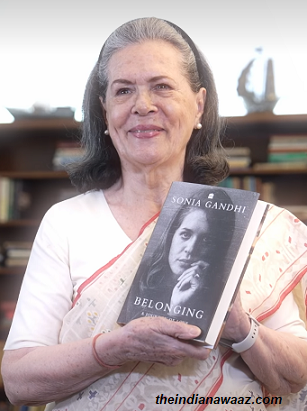
Her interview comes ahead of the worldwide release of Belonging: A Journey of Love on November 10. The memoir, published by HarperCollins India, traces her personal journey from Italy to India, her relationship with former Prime Minister Rajiv Gandhi, her association with the Nehru-Gandhi family and her eventual entry into public life and politics.
Describing the book as more than a personal love story, Gandhi said it also reflected how her attachment to Rajiv Gandhi’s family gradually developed into a deep sense of belonging to India.
BJP counters Sonia’s remarks, invokes Emergency
Gandhi’s comments triggered a sharp response from the BJP, with Union Law Minister Arjun Ram Meghwal questioning her criticism of the government’s democratic record and asking whether she had forgotten the Emergency imposed by the Congress government in 1975.
Meghwal recalled that thousands of opposition leaders were imprisoned during the Emergency and journalists faced restrictions on their freedom. He argued that the period represented a serious setback to democratic rights and said Prime Minister Narendra Modi had strengthened India’s democratic standing.
The Union minister also referred to Modi’s description of India as the “mother of democracy”.