
Last Updated on November 8, 2026 12:12 am by INDIAN AWAAZ
By S. N. Verma
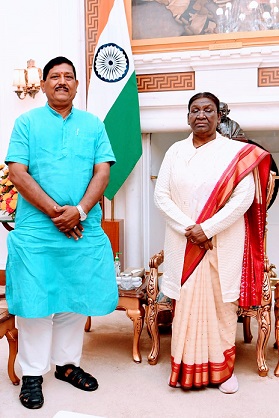
At a time when acts of selfless service are increasingly rare, Badri Mishra, a resident of Puri in Odisha, stands out as an inspiring example of compassion, commitment and perseverance. For nearly five decades, he has dedicated his life to serving humanity—performing the last rites of unclaimed and abandoned bodies, donating blood more than 160 times, educating underprivileged children and nurturing trees. His remarkable work has earned him several sobriquets, including ‘Vriksha Manav’ (Tree Man) and ‘Prakriti Bandhu’ (Friend of Nature). His contributions have also brought him recognition at the highest levels, including an invitation from President Droupadi Murmu to Rashtrapati Bhavan.
Approaching 70, Mishra shows little sign of slowing down. His journey of social service, which began nearly 50 years ago, has continued despite serious personal and financial hardships. He says he lost his government job around 22 years ago due to political vendetta. The loss left his family struggling financially, forcing him to take up different forms of manual work to make ends meet. He worked in blacksmith workshops, paddy fields and timber depots, among other places. Yet, even with limited resources, he continued to spend his hard-earned money on social causes—planting trees, donating blood, helping with cremations and providing free education to 1,103 disadvantaged children.
A modern-day Harishchandra
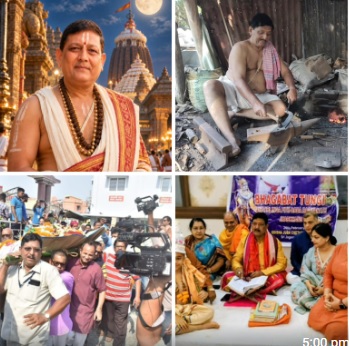
Mishra has earned a reputation as a modern-day Harishchandra for his unwavering commitment to ensuring dignity in death. He has so far performed the last rites of around 1,520 bodies at Puri’s cremation ground. These include unidentified and unclaimed bodies, as well as those whose final rites he undertook using his own Aadhaar card when necessary.
Beyond performing cremations, he helps poor and needy families arrange the documents and formalities required for the last rites of their loved ones. He also extends financial assistance whenever possible.
The turning point came in 1974, when a friend of his died and no one came forward to help with the funeral. Mishra took responsibility for the last rites himself. The experience left a lasting impression on him and strengthened his resolve to ensure that no one is denied a dignified farewell simply because they have no family or resources.
His commitment was tested during some of the worst disasters to strike the region and the country. During the devastating super cyclone that hit Odisha in 1999, when many people were afraid to approach the bodies of the dead, Mishra stepped forward to perform their last rites. He also helped cremate victims of the 2001 Gujarat earthquake and the 2015 Nepal earthquake. During the COVID-19 pandemic, when fear and uncertainty kept many people away from the bodies of those who had died, he once again took responsibility for conducting their final rites.
A lifeline for patients in need of blood
Mishra’s service to humanity extends beyond the cremation ground. He has donated blood more than 160 times, helping thalassaemia patients and countless people in need of transfusions. For many families, his timely contribution has meant the difference between life and death.
In a further expression of his commitment to public welfare, Mishra has pledged his own body to a medical college in Cuttack for medical education and research after his death. Inspired by his decision, hundreds of young people have also come forward to pledge their bodies to medical institutions.
His contribution has been recognised through numerous awards and honours, including the Dadhichi Award and Utkal Ratna, presented by the state government and various organisations.
Taking Odisha’s spiritual heritage across India
Mishra is also deeply committed to preserving and promoting Odisha’s cultural and spiritual traditions. He has worked to take the Odia Bhagabata, written by the 15th-century saint-poet Atibadi Jagannath Das, to people across the country. Through visits to villages and different states, he has helped establish Bhagabata Tungis—community spaces where people gather to read and discuss the sacred text.
So far, he has been instrumental in setting up 10 such centres in different parts of India, including Lucknow in Uttar Pradesh, Somnath in Gujarat and Baidyanath Dham in Jharkhand. His efforts have earned him the affectionate title of ‘Bhagabata Purusha’.
His creative contributions are equally noteworthy. Mishra has served as a storyteller for the Odia film Ajira Rebati and has composed 834 songs. His work in music and culture has also been recognised with the Odisha Sangeet Natak Akademi Award.
Five decades of planting trees
Environmental protection is another major pillar of Mishra’s work. Over the past 50 years, he has planted more than 1.24 lakh saplings, earning widespread recognition as ‘Vriksha Manav’ and ‘Prakriti Bandhu’.
What makes his environmental campaign particularly remarkable is that it has largely been sustained through his own limited earnings and personal resources, without financial assistance from government or non-government organisations. He has planted trees in villages, educational institutions, religious centres, public spaces and along national highways, while encouraging students and young people to take an active role in protecting the environment.
Mishra began his plantation drive in 1976 at Dr. Lord Jagannath Samant Chandrasekhar College, inspired by the institution’s leadership. What started as an initiative on a college campus gradually developed into a lifelong mission.
A significant milestone came in December 2017, when he crossed the mark of one lakh saplings planted. The achievement was recorded during a plantation programme at the Prayas Divyang Teaching Institute in Odisha’s Kendujhar district. Rather than treating the milestone as the culmination of his efforts, Mishra continued his campaign with renewed determination.
His environmental work has also reached beyond Odisha. He has planted saplings at several religious, spiritual and historical sites across the country, including Somnath, Pushkar, Sabarmati, Baba Baidyanath Dham, Ayodhya and Haridwar.
In recognition of his sustained contribution to environmental protection, Mishra received the NALCO Navratna Samman in 2018. The Odisha government has also honoured him with the Rajya Samaj Sevi Samman, Gachha Manisha Samman and Prakriti Bandhu Samman. He has additionally received the ‘Punashcha Prithvi’ award from Union Environment Minister Bhupender Yadav.
Badri Mishra’s life is a reminder that meaningful social change does not always require wealth, institutional backing or public office. It can begin with a simple decision to help someone in distress—and grow into a lifelong commitment. Whether he is ensuring a dignified farewell to the forgotten, donating blood to save a life, educating poor children or planting a sapling, Mishra continues to demonstrate that service to humanity and nature is best measured through consistent action.
The writer is an independent journalist and columnist.