Last Updated on November 28, 2026 2:34 pm by INDIAN AWAAZ
Vaiko alleges judicial overreach; Left party calls directive shocking and anti-federal, urges secular forces to unite
By Our Correspondents / Chennai / NEW DELHI
The Supreme Court’s directions in the Thiruparankundram Karthigai Deepam controversy have triggered sharp criticism from several political parties in Tamil Nadu, with the Marumalarchi Dravida Munnetra Kazhagam (MDMK), Dravida Munnetra Kazhagam (DMK) and the Communist Party of India (Marxist) (CPM) questioning the court’s intervention and warning that the dispute could aggravate communal tensions.
MDMK General Secretary Vaiko on Saturday accused the Supreme Court of exceeding its jurisdiction by directing that the ceremonial lamp be lit at the Deepathoon stone pillar atop Thiruparankundram Hill in Madurai. He argued that the directive went against the secular foundations of the Constitution and disrupted a religious practice followed at the site for centuries.
Speaking to reporters, Vaiko said secularism was one of the fundamental principles of the Constitution and alleged that the court’s verdict had interfered with the established tradition at Thiruparankundram.
“For centuries, a particular practice has been followed at Thiruparankundram, but the Supreme Court verdict has violated that practice. Nowadays, Hindutva forces have raised their hands in the Supreme Court,” he alleged.
The DMK also questioned the rationale behind shifting the traditional location of the Karthigai Deepam ceremony to the disputed stone pillar, located close to the Hazrat Sultan Sikandar Badhusha Auliya Dargah.
DMK spokesperson TKS Elangovan said the demand sought to change a long-established Hindu religious practice rather than protect it. He also questioned the timing of the proposed lighting, pointing out that November 28 was not the actual day of the Karthigai Deepam festival.
“Today is not Karthigai Deepam. Who cares about it? On that day, the Deepathoon is lit at the place where it has traditionally been lit for a hundred years. They want to change the tradition followed by Hindus,” he said.
Accusing those behind the demand of acting against Hindu customs, Elangovan said, “They are against Hindu tradition and Hindu practices. They are anti-Hindu.”
The Tamil Nadu unit of the CPI(M) was equally critical of the Supreme Court’s directions, describing the order as shocking and contrary to the principles of federalism and the established system of administration of justice.
In a statement, CPI(M) state secretary P Shanmugam said it was unacceptable for the court to issue such sweeping interim directions when the main legal question in the case had not yet been finally decided. He urged the Chief Justice of India to take cognisance of the matter and ensure that the order was rectified.
The party expressed concern that the direction allowing devotees to light the lamp on the hill could create fresh tensions at a time when communal organisations were allegedly attempting to mobilise people around the controversy.
“At a time when communal organisations are already making attempts to incite frenzy among the people, the Supreme Court’s statement that everyone can light the lamp on the hill is bound to create tension,” the statement said.
Referring to the demolition of the Babri Masjid, the CPI(M) cautioned against ignoring the consequences of disputes involving religious places and communal mobilisation.
The party also termed the Supreme Court’s intervention anti-federal, arguing that an order delivered by sidelining an elected state government could establish an undesirable precedent.
Shanmugam further questioned the apparent lack of consideration given to the Places of Worship (Special Provisions) Act, 1991, which was enacted to preserve the religious character of places of worship as it existed on August 15, 1947, subject to the Act’s provisions and exceptions.
He said the law had been enacted after extensive deliberations to safeguard religious harmony and alleged that its principles and constitutional objectives had not been adequately considered in the court’s directions.
The CPI(M) said both the present and previous Tamil Nadu governments had maintained a consistent position on the Thiruparankundram issue. It called upon political parties across the state to unite against what it described as attempts to disturb communal harmony.
The party also urged the state government to consult legal experts and take appropriate legal steps. It appealed to secular and democratic organisations to mobilise public opinion in defence of social unity and constitutional secularism.
Supreme Court’s stringent directions
The political reactions came a day after the Supreme Court took a stern view of the failure to implement its earlier interim direction concerning the lighting of the Karthigai Deepam at the Deepathoon.
On November 27, the apex court directed that the ceremonial lamp be lit at the stone pillar atop Thiruparankundram Hill, allowing devotees to participate in the ceremony and ordering the deployment of the Central Reserve Police Force (CRPF) to ensure its smooth conduct.
The court had earlier found a prima facie case of wilful disobedience of its previous order and issued contempt notices to 15 officials, including the Tamil Nadu Chief Secretary, Director General of Police, officials of the Hindu Religious and Charitable Endowments Department, the Madurai District Collector and five temple trustees.
It also suspended the temple’s Board of Trustees, appointed two former Madras High Court judges as receivers to oversee its management and assigned security arrangements on the hill to the CRPF.
The controversy arose after the ceremonial lamp was lit at its traditional location near the Uchi Pillaiyar Temple on November 24, rather than at the Deepathoon, despite an earlier Supreme Court direction to light it at the disputed pillar.
The dispute has since expanded beyond the question of the location of a religious ceremony, raising wider political and constitutional questions concerning religious traditions, judicial intervention, federalism and the protection of communal harmony in Tamil Nadu.
What is the Dispute about
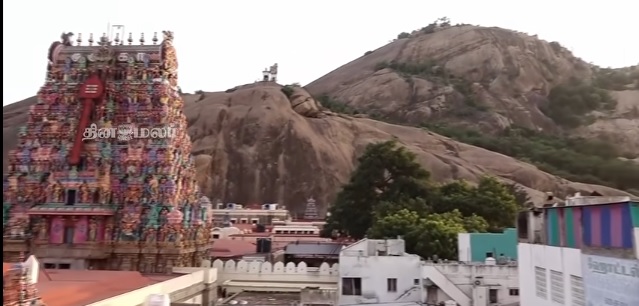
A hill in Tamil Nadu’s Madurai city, known as Thiruparankundram, is home to a famous Hindu temple and a Muslim dargah. The Sri Arulmigu Subramaniya Swamy Temple is situated on the northern side of the hill, while the Dargah of Hazrat Sultan Sikandar Badhusha Auliya stands near its summit. The hill also has ancient cave remains associated with Jainism, reflecting its diverse religious heritage.
The controversy centres on where the traditional lamp should be lit during the Hindu festival of Karthigai Deepam.
According to the temple’s established practice, the ceremonial lamp has traditionally been lit every year at the Deepa Mandapam near the Uchi Pillaiyar Temple, located at the foothills of Thiruparankundram.
However, last year, certain Hindu organisations demanded that the lamp also be lit atop the hill, on an old stone pillar known as the ‘Deepathoon’. The pillar is located approximately 50 metres from the Sikandar Badhusha Dargah. The demand subsequently became the subject of litigation.
The Hindu petitioners argued that lighting the lamp on the stone pillar was also part of an old religious tradition. The dargah management and other parties, however, contested this claim.
On November 20, 2026, the Supreme Court directed that the ceremonial lamp be lit on the Deepathoon on November 24 as well. A limited number of people were to be permitted to access the site through arrangements involving the temple authorities.
However, the lamp was not lit on the pillar on November 24. The temple administration instead conducted the traditional ceremony at its usual location.
The Madurai district administration subsequently stated that the temple’s trust committee had not granted permission for people to light the lamp at the disputed site. The petitioners, on the other hand, alleged that the administration had deliberately prevented the implementation of the Supreme Court’s order.
On November 27, the Supreme Court adopted a particularly stern approach to the matter and issued a fresh direction for the lamp to be lit on the disputed stone pillar on November 28.
The Court also suspended the temple’s trust committee and entrusted its management to two former judges of the Madras High Court. It directed that the security of both the temple and the dargah on the hill be placed under the responsibility of the Central Reserve Police Force (CRPF).
Furthermore, contempt notices were issued to the Tamil Nadu Chief Secretary, the Director General of Police, the District Collector and other officials concerned.
The Supreme Court also observed that it appeared the officials had acted on the instructions of their political masters.
Should religious faith be used to escalate such disputes?
An important question is why the demand to light the lamp at a new location, close to the dargah, has suddenly assumed such significance when the ceremony had been conducted at an established location for years.
The organisations that approached the courts maintain that they are seeking to restore an old Hindu tradition. However, the historical basis of this claim and the alleged religious right to light the lamp at the particular site remain contested.
Religious faith deserves respect and protection. But a religious demand that makes another community feel threatened can have serious consequences for social harmony.
Turning such disputes into issues of political and communal identity risks deepening religious polarisation. Should demands made in the name of protecting religious faith be allowed to fuel tensions between two communities? Is it necessary to create a fresh controversy near another community’s place of worship to uphold a religious tradition?