
Last Updated on November 7, 2026 12:33 pm by INDIAN AWAAZ
Sudhir Kumar / New Delhi
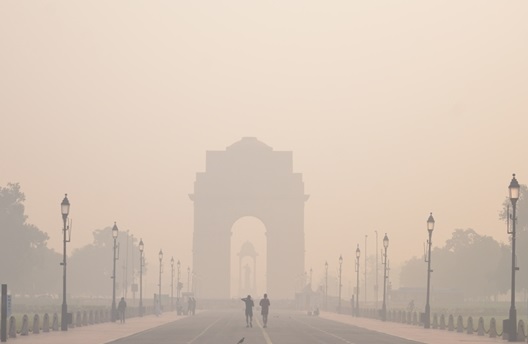
Delhi continued to struggle with hazardous air pollution on Saturday, a day before Diwali, with the city’s overall Air Quality Index (AQI) standing at 364 at 8 am, placing it in the ‘very poor’ category, according to Central Pollution Control Board (CPCB) data.
Although the reading showed a slight improvement from 389 recorded on Friday morning, pollution levels remained alarmingly high across several parts of the national capital. As many as 22 monitoring stations recorded AQI levels above 400, falling in the ‘severe’ category.
IIT Delhi recorded the highest AQI at 443, followed by Punjabi Bagh at 433 and Vivek Vihar at 424. Jahangirpuri registered 420, Rohini 418 and R K Puram 413. Another 29 monitoring stations reported readings above 300, while eight recorded levels above 200.
The pollution situation has prompted the Commission for Air Quality Management (CAQM) to invoke Stage III restrictions under the Graded Response Action Plan (GRAP) across Delhi-NCR. The decision came after the city’s average AQI reached 382 on Friday afternoon, amid concerns that unfavourable weather conditions could push pollution levels further into the severe category.
Areas in national capital that logged the worst air quality
- IIT Delhi – 443 (severe)
- Punjabi Bagh – 433 (severe)
- Vivek Vihar – 424 (severe)
- Jahangirpuri – 420 (severe)
- Rohini – 418 (severe)
- R K Puram – 413 (severe)
- Sirifort – 410 (severe)
- Bawana – 410 (severe)
- Dwarka Sector 8 – 409 (severe)
- North Campus, DU – 407 (severe)
- Alipur – 402 (severe)
- Mandir Marg – 397 (very poor)
- JNU – 390 (very poor)
- Aya Nagar – 382 (very poor)
- Commonwealth Sports Complex – 373 (very poor)
- IGI Airport (T3) – 339 (very poor)
The report uses the CPCB’s 8 am citywide reading of 364 and station-level figures for the same morning, rather than mixing them with later hourly readings.
Yesterday the Supreme Court today said imposing restrictions alone would not address the air pollution problem in Delhi-NCR and encouraged responsible celebrations during festivals, particularly Diwali. Chief Justice of India Surya Kant, during the hearing of a petition on the air pollution crisis in the National Capital Region (NCR), emphasised the need to revisit traditional customs and practices during festivals.
“Why don’t we revert to our original customs?” he said, adding celebrations should be accompanied by a sense of responsibility towards the environment.
Justice Bagchi observed that the issue was linked to the commercialisation of festivals too.
The bench said imposing additional restrictions and passing more orders would not necessarily resolve the problem. “No restriction is going to work. The more orders we pass, the more violations will multiply,” the Supreme Court said, underlining the need for behavioural change and greater awareness about pollution.