
Last Updated on August 10, 2026 11:18 pm by INDIAN AWAAZ
EARTHQUAKE IN COLOMBIA: THE NUMBER OF DEAD IN THE COUNTRY RISES TO 77 PEOPLE.
AMN / WEB DESK
At least 77 people were killed, and dozens of buildings collapsed in cities across western Colombia today after a powerful 7.4-magnitude earthquake struck the South American nation, trapping residents under debris and leaving many injured.
The earthquake reportedly forced people to evacuate their homes as far as the capital of Bogota. The US Geological Survey and Colombia’s counterpart reported that the epicentre was in San Jose Del Palmar, a community of about 4,800 people in the Choco region about 250 miles west of Bogota. The US Geological Survey said, it struck at a depth of 66 miles. The quake was also felt in neighbouring Ecuador.
The earthquake occurred at around 7:34 a.m. local time, according to reports citing Colombia’s seismic monitoring authorities. Reuters also confirmed that a magnitude 7.4 earthquake struck Colombia at 7:34 a.m. on Monday, with the epicentre in the San José del Palmar area of Chocó.
The initial assessment by Colombia’s National Unit for Disaster Risk Management (UNGRD) indicated that possible damage had been reported across nine municipalities in Chocó, eight in Caldas, two in Valle del Cauca and two in Risaralda, along with several municipalities in Quindío. Authorities were continuing to verify reports from local communities to establish the extent of damage to homes, public infrastructure and other facilities.
The strong tremor was felt across a wide area of Colombia. Reports indicated that the earthquake was also felt in neighbouring countries, including Ecuador.
Government activates emergency machinery
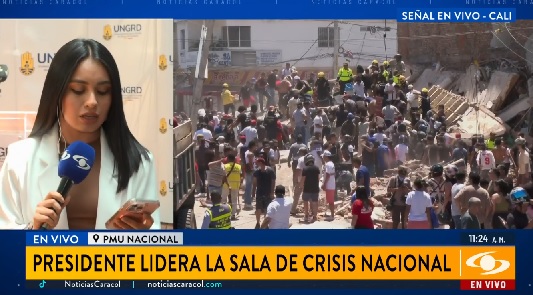
Following the earthquake, President Abelardo de la Espriella convened the National Committee for Disaster Management and took charge of coordinating the government’s response, working with acting UNGRD director Javier Pava Sánchez.
Pava Sánchez was overseeing the emergency response from the National Crisis Room, where officials were receiving reports from affected regions and coordinating assessment and rescue efforts.
The government’s monitoring and response operation also involved Vice President José Manuel Restrepo, Interior Minister Rodrigo Lara and Housing Minister Jaime Andrés Beltrán Martínez. The ministers were receiving updates from governors and mayors in areas affected by the earthquake.
Officials stressed that the initial damage figures remained preliminary and that assessments would continue as emergency teams reached affected communities and inspected buildings and infrastructure.
Damage assessment under way
The earthquake triggered emergency assessments across several departments, with authorities focusing on potentially affected residential areas, public buildings and critical infrastructure.
Early reports suggested that the impact was particularly significant in parts of Chocó and the country’s western and central regions. Colombian authorities continued to assess reports of structural damage and injuries as emergency personnel were deployed.
Reuters footage and reporting confirmed the occurrence of the strong earthquake and the widespread shaking across the country.
The U.S. Geological Survey (USGS) also recorded the earthquake as a major seismic event in the San José del Palmar area. Preliminary seismic information placed the event at considerable depth, which helped explain why strong shaking was reported over a broad geographical area.
Authorities urge continued caution
Emergency authorities were expected to continue monitoring the situation for possible aftershocks while conducting detailed inspections of damaged structures.
Given the scale of the earthquake and the number of municipalities reporting possible effects, officials were coordinating information from local governments before releasing a consolidated assessment of casualties and material damage.
The earthquake comes as Colombia’s disaster-management agencies maintain extensive monitoring systems because of the country’s exposure to seismic activity. The western part of Colombia, in particular, is located in a seismically active region.
For now, authorities are prioritising search and rescue operations, verification of reported damage, assessment of infrastructure and assistance to affected communities.
Officials are expected to provide further updates as field teams complete their inspections and more reliable information becomes available.