
Last Updated on August 23, 2026 5:03 pm by INDIAN AWAAZ
Mohammad Alamullah in UK
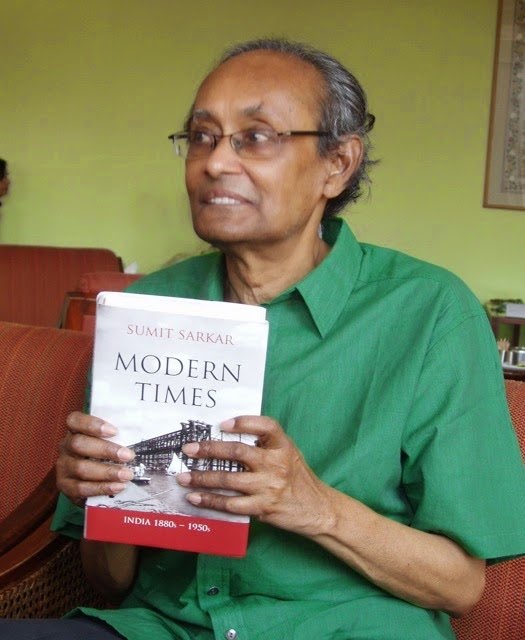
The death of eminent historian Sumit Sarkar (1939–2026) on August 13 has left a deep void in the world of Indian historiography. The news of his passing came as a profound shock, particularly to those who encountered his work not merely as academic scholarship but as a powerful intellectual influence.
Sarkar belonged to that rare category of scholars whose ideas could shape the thinking of generations, even without personal acquaintance. His books, research and penetrating questions challenged readers to examine India’s past with greater intellectual honesty and critical understanding. For many, his writings became an enduring part of their engagement with history and society.
His passing is particularly significant at a time when history has assumed an increasingly contentious role in public life. Events from the distant past are frequently interpreted through contemporary political and ideological lenses, while questions of religion, identity, citizenship and nationalism continue to dominate public debate.
In such an environment, the loss of a historian known for his rigorous scholarship, independent thinking and fearless approach is more than the departure of an eminent academic. It represents the silencing of an important intellectual voice whose work encouraged readers to question established narratives and examine history beyond political convenience.
I first encountered Sumit Sarkar when I enrolled as an undergraduate in the Department of History at Jamia Millia Islamia in New Delhi. Our teachers mentioned his name with great respect and awe. In the lectures and tutorials of our esteemed professors — Mushirul Hasan, G P Sharma, Rizwan Qaiser, P K Basant, Nishat Manzar, Javed Alam, Rajnish Kumar, Farhat Nasreen and others — the great names of history would come up, books would be discussed, and the ideas of different historians would unfold before us.
Perhaps we did not realise then that a name mentioned in passing by one of our teachers could one day become part of our own intellectual life. As students, many things seem merely part of an examination, but some names, with the passage of time, leave the pages of books and enter our lives.
Impartial Views
After leaving university, when I had the opportunity to read Sumit Sarkar again, I realised that our teachers had not mentioned him merely because he was a well-known historian. His importance also lay in the fact that, rather than looking at Indian history superficially, he tried to understand society in its different layers and presented his views impartially. Where were ordinary people behind the great political events? What were the people’s own aspirations within these movements? What was the nature of the relationship between leadership and the people? Why do those people disappear from history without whom its real journey would not have been possible? Such questions are constantly present in his work. That is why reading Sumit Sarkar is not merely about reading India’s past; it is also about reflecting on the way history itself is written and understood.
With time, the name Sumit Sarkar came to mean more to me than simply a historian or the titles of some books. It became a symbol of a particular way of looking at Indian history objectively. While reading his well-known book Modern India 1885–1947, it became clearer that the history of the national movement is not merely the history of great Congress leaders, their speeches, resolutions and political strategies. Within that history are peasants, workers, students, women, the middle class, tribal communities, different religious groups, and those ordinary people whose names may not even appear in the margins of a major political event, but without whom the national movement loses its real significance.
This was precisely Sumit Sarkar’s strength. He neither presented the national movement as a complete and flawless narrative, nor denied its historical importance. He saw the complexities within it. For him, the more important questions were: What was the relationship between political leadership and the people? How did political slogans change when they entered the lives of ordinary people? And did people join a movement merely at the command of its leadership, or did their own political aspirations, experiences and motivations also shape the process?
Popular Politics
His book The Swadeshi Movement in Bengal, 1903–1908 is a testament to his deep interest in popular politics. In Popular Movements and Middle Class Leadership in Late-Colonial India, the same question emerges from another angle: how do popular movements and middle-class leadership influence one another? For Sumit Sarkar, the “people” in history were not a silent crowd being driven along behind political leaders. They had their own experiences, interests and aspirations. They did not merely accept political processes; they also transformed them in their own ways. That is why, in the history he narrated, there was room not only for great names but also for the countless people whom conventional political history often overlooks. In his work, history is always a story of living human beings, not merely of rulers, leaders and great events.
For me, Modern India 1885–1947 was therefore never merely a textbook. Even when reading Sumit Sarkar alongside great historians such as Bipan Chandra, one could feel a difference. Both understood the historical importance of colonial India and the struggle for independence, but their perspectives were different. In Bipan Chandra’s work, the political force of Indian nationalism and its anti-imperialist character are more prominent, whereas Sumit Sarkar repeatedly returned to the different sections of society, the distinctive momentum of popular politics, and the complex relationship between leadership and the people. For this reason, it would be more appropriate to see the two not as alternatives to each other but as complementary historians, whose works are better understood when read alongside one another.
Sumit Sarkar’s historiography helps us understand that the history of a nation is not simply the history of its great leaders. If the freedom movement becomes merely the story of a few great personalities, millions of people disappear from it — people who advanced history through their everyday lives, labour, protests, sacrifices and sometimes quiet resistance. He does not allow us to look at the events of the past merely by asking who won and who lost. He also compels us to ask: How did this event change the life of the ordinary person? Who saw hope in it? Who felt fear? And who paid its price? This is where history leaves the realm of a dry academic subject and becomes a human experience.
Reading Sumit Sarkar’s Writing Social History also gives one the sense that, for him, history was always connected with society. He did not look at history merely at the level of the state, government and major political decisions. Society, culture, religion, class, gender and the experiences of ordinary people were important parts of his historiography. His writing also provides a useful way of understanding Indian Muslims. Muslims are not present in Indian history only through Mughal emperors, forts, mosques and courts. They are also peasants, artisans, workers, poets, journalists, soldiers, teachers, students, freedom activists and ordinary citizens.
Different Perspectives
If Indian Muslims are viewed only through the mirror of medieval Muslim governments, a very large part of their modern history disappears. Sumit Sarkar’s social history helps protect us from precisely this absence. In his work, the ordinary person is not a spectator of history but a part of history. A political slogan may have one meaning when it is raised at a large public gathering, but when that same slogan enters the life of a poor peasant, worker or citizen, its meaning may change. The real difficulty of writing history is to be able to hear these different meanings. Perhaps one of Sumit Sarkar’s greatest qualities was precisely that he wanted to prevent these different voices within history from disappearing into a single national story.
But the aspect of Sumit Sarkar’s personality that comes most strongly to mind is his later intellectual thought, particularly his deep concern with Hindutva, communalism, historiography and the questions surrounding Indian nationalism. It would be unfair to his scholarly personality to describe him simply as a “pro-communist historian”. He was not a spokesperson for any particular organisation, religious group or political platform. Although his fundamental intellectual background was connected with the Marxist and Left traditions, he was, above all, a critical historian. He regarded Indian Muslims as an equal historical presence within Indian history and Indian nationalism.
In his thinking, the question of Muslims was not a matter of some separate religious concession; it was a question of Indian democracy and equal citizenship. When he considered the possible consequences of Hindutva politics and the danger of second-class citizenship for minorities, his concern extended far beyond Muslims. The fundamental questions became: Can a religious majority regard itself as the sole representative nation of the whole of India? Can a citizen’s loyalty be determined by his religion? Can the burden of centuries-old events be placed upon people living today? For Sumit Sarkar, these were not merely questions concerning Muslims; they were questions concerning the entire concept of Indian citizenship.
His concern about Hindutva was not a temporary political reaction either. In his well-known essay The Fascism of the Sangh Parivar, published in 1993 after the demolition of the Babri Masjid, he viewed the politics of the saffron brigade as a major threat to Indian secularism and democratic foundations. Babri Masjid was demolished on 6 December 1992, and Sumit Sarkar saw in the changes that followed in Indian politics the interrelationship between history, religious identity and political mobilisation. His concern was not limited to the demolition of a mosque. His question was: if political power, in the name of a religious majority, begins to present itself as the sole representative of the entire religious community, what happens to dissent, plurality and the civic status of minorities?
The ‘Othering’ of Indian Muslims
The term “fascism” in his writing was not used simply to establish a similarity between European history and Indian conditions, but to understand the dangers of a particular political process. For him, one of the problems was also the way in which Sangh Parivar politics uses history to construct contemporary political identities. A particular past is selected, a simple division between the oppressed and the oppressor is created within it, and present generations are then connected to that historical narrative. In this process, Muslims can be presented as a historical “other”, even though contemporary Muslims are not responsible for the policies or individual actions of some medieval ruler. Sumit Sarkar’s fundamental concern was precisely this: when the past is turned into an instrument of political revenge, it ceases to remain merely the past and becomes a continuing case against people living in the present.
This intellectual direction is also clearly visible in Beyond Nationalist Frames. The book contains his essays on the rise of the Hindu Right, historiography, the reconstruction of Hindu nationalist history, the relationship between religion and nationalism, and the political use of history. An important section of the book is titled Hindutva and History, while other sections include discussions such as The BJP and Nationalism and Christianity, Hindutva, and the Question of Conversion.
Reading this book makes it clear that Sumit Sarkar’s concern was not limited to any one political party. He regarded history as dangerous when it was removed from complex human experience and transformed into a straightforward, emotional and political story. For him, the task of history was not to settle accounts with people in the present in the name of the past, but to understand the past within its own circumstances, social structures and human experiences. Perhaps this is more important today in India than ever before, because history no longer exists only in universities and libraries; it is also present in election speeches, television debates, social media and everyday political conversations.
In understanding Sumit Sarkar’s thinking on the Babri Masjid issue, one point seems particularly important: He did not reduce the issue of Muslims to a separate “minority question”. For him, if a Muslim citizen is viewed with suspicion simply because his religion has been associated with a particular role in some historical debate in India, the problem does not remain confined to that Muslim. It affects the entire foundation of constitutional citizenship. Similarly, if a political force declares itself to be the sole representative of the entire Hindu society, the problem does not remain confined to Hindus, because the differences and diversity within Hindu society itself also begin to be suppressed beneath such a claim.
That is why describing Sumit Sarkar’s criticism of Hindutva merely as “support for Muslims” would also reduce his position far too narrowly. His fundamental question concerned the basis of Indian nationalism. Is a nation created by religion, or by a shared political and historical life? Can a citizen’s loyalty be determined by his religion? Can a person’s present citizenship be rendered suspect by connecting him to an event that happened centuries ago? In his view, being an Indian citizen should not require anyone to pass a religious test. That is why in his work, the question of the civic status of Muslims becomes a question about the health of Indian democracy itself.
Criticising Principle, Not the Party
Another aspect of Sumit Sarkar’s intellectual integrity is that his criticism was not confined to the RSS or the BJP. He was not a spokesperson for any group. For him, the standard was not allegiance to a particular camp but democratic, secular and egalitarian principles. That is why he also criticised the role of the Congress and questioned the political use of religious sentiments. To regard him merely as an anti-BJP historian would be to diminish his intellectual independence. He was a strong critic of Hindutva, but the standard of his criticism was principle, not party.
Similarly, his association with the Left did not prevent him from questioning its politics. This is why there was always room for disagreement in his intellectual life. He did not consider his own intellectual circle beyond criticism. Perhaps this is the mark of a great historian: that one applies the same standard to oneself as one applies to others. If a political force acts in the name of the people against the interests of the people, it should be questioned; if someone weakens civic equality in the name of nationalism, it should be questioned; and if someone uses religious sentiments for political gain in the name of secularism, that too should be questioned.
In Sumit Sarkar’s thinking, communalism was not something produced from only one side. He also examined how majoritarian communalism increases fear, insecurity and reaction within a minority. When a group is constantly made to feel that its citizenship is suspect, its loyalty is under question and its historical identity is being associated with the role of a historical enemy, the impact is not limited to politics; it begins to change the internal structure of society as well. Fear and insecurity can sometimes strengthen reactionary politics within the minority itself. In this way, communalism continues to create new ground for itself.
Perhaps this is why placing Sumit Sarkar’s thought into categories such as “anti-Hindu” or “pro-Muslim” amounts to refusing to understand his analysis. He was not making any religion the problem; he was making the political use of religion a problem when religious identity was set against civic equality. For him, the fundamental reality of Indian society was its plurality. Different religions, languages, castes, classes, regions and cultural traditions have lived alongside one another for centuries. The attempt to confine India within a single religious identity does not merely harm minorities; it also distorts India’s own historical reality.
Sumit Sarkar’s intellectual life, too, was not the story of a straightforward journey along a single ideology. His interest in the national movement and political history eventually led him towards debates in social history; he engaged in dialogue with the debates of Subaltern Studies; he reflected on theoretical questions of historiography; and later, Hindutva, communalism, history and contemporary Indian politics became increasingly prominent in his thinking. This change was not a sign of intellectual weakness but of the health of an academic life. A great intellectual does not carry all the ideas of his early years unchanged throughout his life. He changes with questions and looks at a changing age through new questions.
That is why Sumit Sarkar cannot be discussed simply within the two categories of praise and criticism. One may disagree with some of his interpretations; his Marxist background may be debated; questions may be raised about his relationship with Subaltern Studies; and one may disagree with his perspective on the national movement. Yet, despite all this, it is impossible to deny the scholarly importance of his work. Perhaps this is the mark of a great historian: even after his departure, discussion of his work does not end. Those who agree with him return to his work, and so do those who disagree with him.
As he bid adieu to this transient world, I am genuinely deeply saddened, because he has departed at a time when history is perhaps present in the political arena with greater intensity than at any previous stage of his life. The Mughal period, temples and mosques, historical figures, conversion, Partition and the events of independence are repeatedly connected with contemporary political questions. At times, it feels as though India is continuously fighting with its past rather than trying to understand it.
The Question of Accountability
People of the past are placed in the dock according to the standards of the present, and citizens living today are asked to be accountable for events that took place centuries ago. At such a time, Sumit Sarkar’s fundamental lesson appears both simple and profound: history cannot be understood by cutting it off from its context. Taking a king out of his own time and placing him in today’s political debate is not history. Turning a mosque or temple merely into a symbol of present-day religious identity is not history. Turning a historical event into an indictment against a citizen of today is not history either. History is a far more difficult discipline than this, because it requires us to understand people of the past within their own time.
Today, when Indian Muslims are living with questions concerning their citizenship, political representation, social security and future, there is a renewed need to read some of Sumit Sarkar’s writings. Not because he wrote in favour of Muslims, but because he connected the question of Muslims with the question of Indian democracy. He tried to understand the impact of majoritarian nationalism on the collective psychology of minorities, how fear changes political life, and how the weakening of civic equality affects the foundations of a democratic system. It is therefore natural to connect his concerns with the circumstances of today, although every historical period has its own particular complexities.
Sumit Sarkar’s thought does not remain confined to the field of history. It speaks to the questions of contemporary India. His writings remind us that protecting the rights of minorities is not the responsibility of minorities alone; it is also a democratic responsibility of the majority. The day civic equality becomes dependent upon the will of the religious majority, the fundamental spirit of democracy will begin to weaken.
Sumit Sarkar’s contribution to Indian historiography will continue to influence scholars, students and readers. His absence will be deeply felt in an era when an informed and critical understanding of India’s past remains more important than ever.
—Mohammad Alamullah is a UK-based academic, author, and journalist, holding two Master’s degrees from Swansea University, UK, and Jamia Millia Islamia. He has authored three books: A Brief History of Muslim Majlis Mushawarat, Few Days in Iran, and Media: Paper to Screen — Scenarios, Problems and Possibilities. The views expressed are solely his own.