
Last Updated on November 14, 2026 9:02 pm by INDIAN AWAAZ
Our Correspondent / HYDERABAD
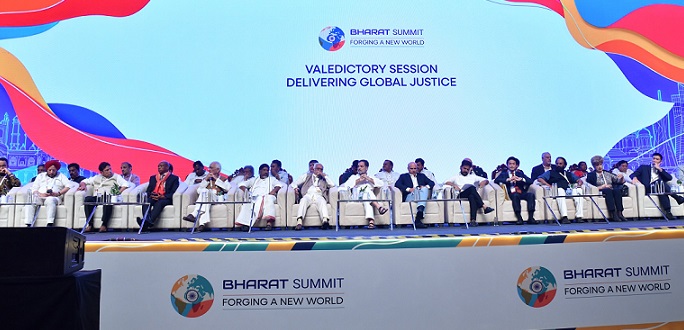
The second Bharat Summit 2026 concluded here on Saturday after two days of international deliberations on democracy, social justice, economic equality, climate change, technological disruption and the need for a more inclusive global order.
More than 1,000 delegates from around 70 countries, including political leaders, policymakers, academics, activists and representatives of international organisations, participated in the November 13-14 summit hosted by the Telangana government and organised by Samruddha Bharat under the leadership of Chief Minister A. Revanth Reddy.
Held at the Hyderabad International Convention Centre (HICC) and HITEX, the summit featured international plenary sessions, thematic discussions, Telangana Rising panels, an exhibition and a concluding session. Discussions focused on democratic accountability, electoral integrity, economic opportunities, environmental justice, gender equality and responsible use of technology.
Day One: Global challenges and international cooperation
The first day, November 13, opened with discussions on strategic autonomy and the changing international order. Former External Affairs Minister Salman Khurshid, in a session moderated by Pushparaj Deshpande, highlighted the continuing relevance of the Non-Aligned Movement, national sovereignty and independent foreign policy choices. He also referred to the principle of Vasudhaiva Kutumbakam, or the world as one family.
A significant discussion examined artificial intelligence and what participants described as cloud capitalism. Moderated by Supriya Shrinate, the session explored the concentration of technological power, data privacy, the use of algorithms in public services and elections, employment disruption and the need for public oversight. Sridhar Babu highlighted Telangana’s efforts to move towards higher-value innovation and the importance of reskilling.
Economic justice and the need for a new economic deal for the world also featured in the programme, with a session moderated by Deepender Hooda.
Another discussion on youth and the politics of tomorrow, moderated by Krishna Allavaru, brought together international young representatives who called for greater youth participation in policymaking, with particular attention to employment, education, housing and political representation.
The session on South-South cooperation examined opportunities for collaboration among developing countries. Participants, including Anies Baswedan, Nurul Izzah Anwar and Joshua Osih, referred to the Bandung Conference, the Non-Aligned Movement, BRICS and the Group of 77 while emphasising practical cooperation in trade, housing, education, transport and local development.
Climate justice was another major theme. Participants discussed the impact of climate change on development and human rights and called for greater climate financing, adaptation measures and support for vulnerable communities.
A separate session on reforming multilateral institutions, moderated by Gaurav Gogoi, examined the need to make global institutions more accountable and effective. The programme also included discussions on gender justice and a feminist future.
Under the Telangana Rising programme, parallel discussions covered urbanisation, economic justice, social welfare and empowerment. Deputy Chief Minister Mallu Bhatti Vikramarka inaugurated the India and the World Expo, which showcased Telangana’s handlooms, handicrafts, traditional products and cuisine.
Day Two: Democracy, electoral integrity and media
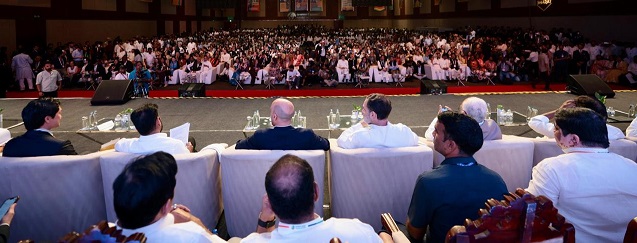
The second day, November 14, focused on democratic accountability, public participation and practical approaches to contemporary political and economic challenges.
A session on progressivism, citizenship and accountability brought together international speakers who stressed transparency, anti-corruption measures and public participation in policymaking. They also warned that declining public trust could weaken democratic institutions.
Another panel, titled Innovative Ideas for Progressives and moderated by Praveen Chakravarty, discussed practical responses to rising living costs, healthcare challenges, environmental protection, gig workers’ rights and regulation of artificial intelligence and data centres.
The future of media was also discussed in a session moderated by Pawan Khera. Participants, including Leonard Novy, Sangeeta Baruah Pisharoty, Francesco Lapenta and Frederico Assis, underlined the importance of public-interest journalism and stronger media institutions. They called for greater public trust and cooperation between public and private organisations, while expressing concern over the pressures facing local journalism.
Cooperative federalism emerged as another important subject. A panel moderated by Madhu Y. Goud included Telangana Minister N. Uttam Kumar Reddy, Chamala Kiran Kumar Reddy, Shilpi Neha Tirkey, Prof. Ganesh Devy and former IAS officer Aditi Mehta.
The discussion covered fiscal devolution, inter-state water disputes involving the Krishna and Godavari rivers, agricultural procurement, delimitation, tribal development, local-government funding and constitutional autonomy. Speakers highlighted the importance of equitable representation and financial resources for states and local institutions.
Electoral integrity was examined in a separate panel moderated by Nikhil Dey. Participants, including Prof. Mukulika Banerjee, Anjali Bhardwaj, Tara Rao and Prof. Muqtedar Khan, discussed concerns over reported electoral-roll deletions, transparency in the Special Intensive Revision process and the independence of the Election Commission. They emphasised citizens’ right to vote and the need to protect the integrity of electoral processes.
The Telangana Rising programme also featured discussions on youth participation in politics, sports development, skills and employment opportunities. Minister Mohammad Azharuddin encouraged young people to enter public life, while other speakers called for greater student representation and opportunities for emerging leaders.
A separate session explored Telangana’s cultural and social history, including folk traditions, social reform movements, historical evidence and the role of art in public life.
Telangana’s development vision
The summit also highlighted Telangana’s development ambitions under its 2047 vision, with discussions on innovation, investment, employment and balanced growth. Speakers stressed that economic development should translate into better opportunities for farmers, young people, women and underserved communities.
IT and Industries Minister D. Sridhar Babu also announced support for the Our World Institute in Hyderabad, proposed as an international policy think tank to promote sustained research and global policy dialogue. He invited delegates to participate in the Telangana Rising Global Summit scheduled for December.
The two-day gathering concluded with calls for the protection of democratic institutions, constitutional rights, economic equality, peace and reform of global governance. While no formal joint declaration or binding resolution was announced, the summit provided an international platform for exchanging ideas and discussing common responses to political, economic, social and environmental challenges.