
Last Updated on November 13, 2026 1:07 am by INDIAN AWAAZ
More than 1,000 government schools in Haryana are functioning with just one teacher. Behind this alarming statistic lies a larger question: how can we expect children to learn when the education system cannot ensure that there are enough teachers to teach them?
Dr. Richa Pandey
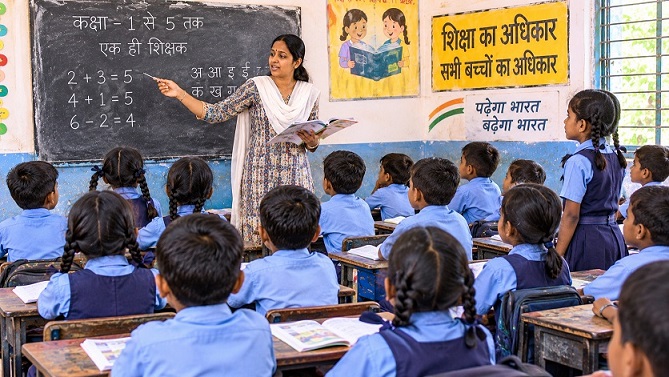
Imagine a primary school where one teacher is responsible for Classes 1 to 5. While some children are learning to recognise letters, others are solving mathematics problems or reading short passages. The teacher moves between different groups, maintains attendance records, manages administrative responsibilities and ensures that the school functions through the day. Every child needs attention, but there is only one person available to provide it.
This is the reality of 1,050 government schools in Haryana, according to education department data reported on November 11, 2026. Another 107 schools have fewer than 10 students. Ambala and Yamunanagar account for the highest number of single-teacher schools, with 189 and 186 respectively. Other affected districts include Mahendragarh, Sirsa, Bhiwani, Kurukshetra, Fatehabad, Rewari, Gurgaon, Palwal and Nuh1.
These figures are not merely an administrative concern. They raise a fundamental question about the quality of education children can receive when one teacher is expected to run an entire school.
When teaching becomes a struggle to divide attention
A school is more than a building with classrooms, textbooks and a timetable. It is a space where children need regular interaction, individual attention and opportunities to learn at their own pace. These needs are particularly important during the foundational years, when children develop their reading, writing and mathematical abilities.
In a single-teacher school, however, teaching often becomes an exercise in managing competing demands. While the teacher works with one grade, children in another may be asked to complete worksheets or study independently. Some may wait for help, while others may struggle silently with concepts they have not understood.
A child learning to recognise letters needs a different kind of attention from one who is already reading sentences. Similarly, children struggling with basic mathematics require individual explanations and practice. Effective teaching involves observing, responding, revisiting concepts and understanding individual learning needs. These are difficult responsibilities for one person managing several grades simultaneously.
The consequences can extend well beyond primary school. Children who do not develop foundational literacy and numeracy often carry these learning gaps into middle school, where teachers must address earlier difficulties while completing the prescribed syllabus.
This is not a question of teachers being unwilling or incapable. It is a structural problem. One person cannot provide the sustained attention that several groups of young learners require.
The problem of teacher deployment
One of the most concerning aspects of Haryana’s situation is the apparent mismatch between teacher availability and deployment.
The state has more than 30,000 Junior Basic Training (JBT) teachers, yet over 1,000 schools continue to function with a single teacher. Officials have acknowledged the need for rationalisation, which would involve moving teachers from schools with surplus staff to those facing shortages.
However, the rationalisation exercise and general transfer drive have reportedly remained pending for years. The transfer policy for JBT teachers has not been implemented for nearly a decade.
This raises an important question: what does it mean to have a large teaching workforce if teachers are not available where children need them most?
Teacher deployment is not simply an administrative exercise involving transfer lists and vacancies. It is an issue of educational equity. Families who can afford private schooling or additional tuition may find alternatives when government schools struggle. Families dependent entirely on neighbourhood government schools have far fewer choices. For their children, an understaffed school may be their only educational opportunity.
Teachers need support too
The burden of a single-teacher school also falls heavily on the teacher. Apart from teaching multiple grades, one individual may be responsible for attendance, records, online data entry, training programmes, inspections and other administrative duties.
When the only teacher is unwell or required to attend official training, the school may be left without regular instruction. This affects children’s learning and creates uncertainty for parents.
We frequently discuss teacher accountability, innovative pedagogy and improved learning outcomes. But accountability must be accompanied by institutional support. Teachers cannot be expected to deliver meaningful learning when the basic conditions required for teaching are absent.
What needs to change?
Haryana needs an immediate, time-bound assessment of staffing requirements at the school level. Enrolment, the number of grades, classrooms and available teachers must inform deployment decisions. Schools functioning with a single teacher should receive priority.
Teacher rationalisation must also be transparent, based on verified school-level requirements and implemented within a clear timeline. Recruitment must keep pace with retirements and vacancies. Temporary arrangements may offer relief, but they cannot replace a stable teaching workforce.
Equally important is the need to reduce non-teaching responsibilities. Teachers should be able to devote their working hours to children rather than spend a disproportionate amount of time on paperwork and administrative tasks.
India’s education policies speak of foundational learning, inclusive classrooms and child-centred pedagogy. But these aspirations cannot become reality without adequate teachers in schools.2
We cannot speak of individualised learning when one teacher has to divide attention across five grades. Nor can we hold teachers accountable for learning outcomes while overlooking the conditions in which they work.
The measure of a state’s commitment to education is not simply how many teachers it employs, but whether every school has enough teachers to give its children a fair chance to learn.

Richa Pandey is an education researcher and educator currently working with the Ravi J. Matthai Centre for Educational Innovation at IIM Ahmedabad. She holds a PhD in Education from the Tata Institute of Social Sciences (TISS), Mumbai. Her research interests include children’s literature,
educational equity, inclusion and learning.