
Last Updated on August 30, 2026 5:12 pm by INDIAN AWAAZ
By Staff Reporter / PATNA
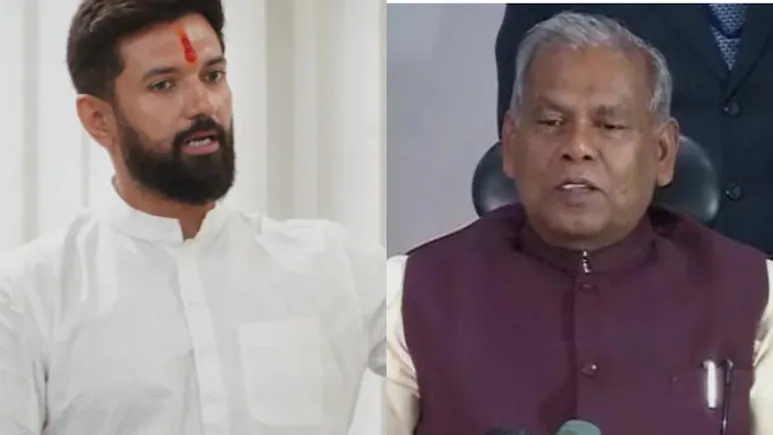
A fresh dispute over Scheduled Caste (SC) reservation has exposed sharp differences within Bihar’s ruling National Democratic Alliance (NDA), with Union ministers Chirag Paswan and Jitan Ram Manjhi taking opposing positions on whether reservation benefits should be redistributed through sub-categorisation.
Lok Janshakti Party (Ram Vilas) chief Chirag Paswan on Saturday demanded the resignation of Manjhi, founder of the Hindustani Awam Morcha (Secular), and his son Santosh Kumar Suman, a minister in the Bihar government, after the father-son duo advocated reviewing SC/ST reservation and creating a separate quota for the most deprived sections among Dalits.
Paswan argued that reservation is a constitutional safeguard created in response to centuries of caste-based discrimination and untouchability, and should not be treated merely as an economic policy subject to periodic review. He also warned that creating a sub-category within the Scheduled Castes could create divisions within the community.
“If they want such changes, they should first resign from their ministerial positions and then raise the issue in Parliament,” Paswan said.
The dispute, however, is not over whether reservation should continue. Manjhi and Suman have stressed that they are not opposed to reservation, but want its benefits to reach Dalit communities they believe remain among the most disadvantaged.
Manjhi, a prominent Dalit leader from Bihar and an advocate of targeted welfare, cited the Supreme Court’s 2024 ruling that allowed states to create sub-classifications within Scheduled Castes, subject to constitutional safeguards and empirical data.
“It is a fact that among Dalits, some castes are relatively more vulnerable and deserve targeted welfare,” Manjhi said, hitting back at Paswan and arguing that the LJP(RV) chief had misunderstood their position.
Suman also sharpened the attack, stressing that a “quota within quota” was fundamentally different from introducing a creamy-layer concept. He pointed to communities such as Musahars, Bhuiyas, Nats and Doms, arguing that some face discrimination even within the Scheduled Caste category.
The disagreement has echoes of an older political fault line in Bihar. Paswan’s position broadly reflects that of his late father, Ram Vilas Paswan, who had opposed the creation of a separate “Mahadalit” category during Nitish Kumar’s earlier tenure as chief minister.
Manjhi, meanwhile, has accused the Paswan camp of seeking to preserve the dominance of relatively better-off Dalit groups.
The JD(U), a key NDA ally in Bihar, has sought to cool the controversy. State minister Shrawon Kumar said reservations were provided under the Constitution and there should be no dispute over the principle of quotas.
The row comes at a politically sensitive time, highlighting the competing approaches within Bihar’s NDA over Dalit representation: Paswan stresses community-wide unity, while Manjhi and Suman argue for targeted benefits for the most deprived groups.