
Last Updated on August 23, 2025 12:24 am by INDIAN AWAAZ
Staff Reporter / New Delhi
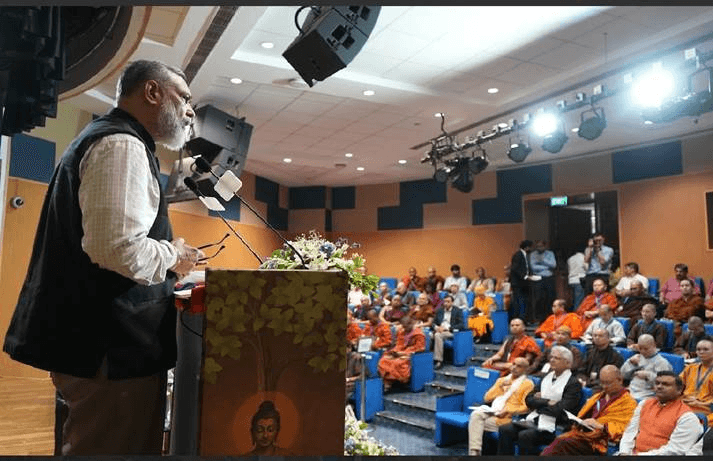
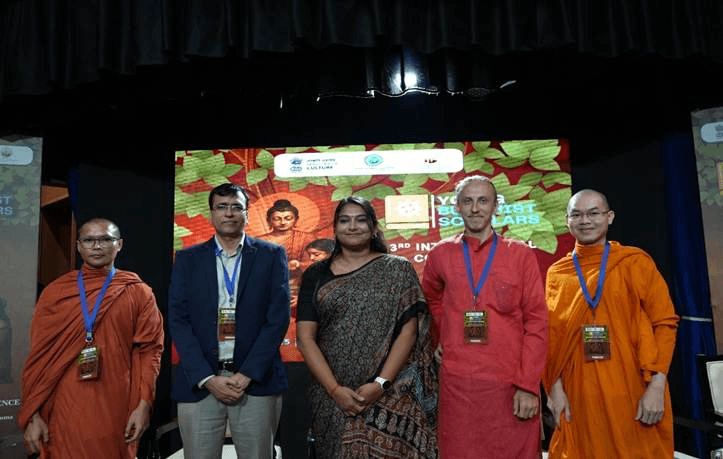
The International Buddhist Confederation (IBC), under the aegis of the Ministry of Culture, Government of India, in collaboration with the Dr. Ambedkar International Centre (DAIC), successfully hosted the 3rd International Conference of Young Buddhist Scholars (ICYBS) at the Nalanda Auditorium, DAIC, New Delhi. This year’s theme, “Wisdom Transmission in Buddha Dhamma in the 21st Century”, focused on how the timeless teachings of the Buddha can be carried forward in an increasingly complex and interconnected world.
Global participation and dialogue
The conference brought together an impressive gathering of young scholars, professors, monks, and dignitaries from Russia, Vietnam, Cambodia, Sri Lanka, Myanmar, Taiwan, and India. Discussions explored the contemporary transmission of Buddha Dhamma—rooted in compassion, mindfulness, and ethical conduct—through digital innovations, intercultural dialogue, inclusive education, and individual practice.
Opening session: Commitment to wisdom continuity
The event began with mangalacharan (invocation), followed by a welcome address from Shartse Khensur Jangchup Choeden Rinpoche, Secretary General of IBC. He underscored the organization’s mission of nurturing young minds and preserving the sacred flow of wisdom, known as Citta Santati (continuity of consciousness).
A special presentation by Yeshi Dawa, Senior Researcher at the 108 Peace Institute, focused on the role of compassion in helping youth cope with growing mental health challenges. A documentary film showcasing the Holy Relic Exposition in Vietnam, which drew over 17.8 million devotees earlier this year, was also screened, highlighting the enduring global resonance of Buddhist traditions.
Five pillars for youth development
In his remarks, Shri Abhijit Halder, Director General of IBC, emphasized five essential components for the younger generation—mindfulness, impermanence, compassion, self-realisation, and environmental responsibility. He stressed that these values must become guiding principles for youth as they navigate modern life and its challenges.
Keynote speaker Prof. K. T. S. Sarao praised IBC for preferring the term Buddha Dhamma over Buddhism, arguing that the phrase better captures the universal and ethical spirit of the teachings. He highlighted its relevance in ethical global governance, where moral responsibility and compassion must guide international decision-making.
Education and sustainability in focus
Shri Rana Pratap Singh, Vice-Chancellor of Gautam Buddha University, the Chief Guest of the event, urged that the principles of Buddha Dhamma be integrated into modern education systems, including science curricula. Such integration, he said, would nurture happiness, ethical leadership, and sustainable living for future generations.
Panel discussions on ethics, AI, and youth engagement
Four thematic panels explored diverse subjects:
- Emperor Ashoka’s model of governance and its relevance today.
- Traditional knowledge transfer through the Guru-Shishya relationship.
- The role of Buddha Dhamma in shaping ethical Artificial Intelligence.
- Strategies for engaging youth through education, digital platforms, and Sangha-led initiatives.
These sessions highlighted the adaptability of Buddhist wisdom to modern contexts, including pressing global challenges like climate change, technology, and mental health.
Closing and reaffirmation of Buddha Dhamma’s relevance
The conference concluded with a Vote of Thanks by Prof. Ravindra Panth, Head of Academics Division at IBC, who reiterated the importance of preserving the continuity of consciousness (Citta Santati) through collective practice, scholarly study, and intergenerational commitment.
The 3rd ICYBS reaffirmed that the wisdom of Buddha Dhamma remains deeply relevant in shaping ethical futures, addressing contemporary global challenges, and guiding humanity along a path of compassion, mindfulness, and sustainable living.