
Last Updated on December 19, 2025 11:29 pm by INDIAN AWAAZ
International Human Solidarity Day – 20 December 2025
Lalit Gargg—
International Human Solidarity Day is observed every year on 20 December. It was proclaimed by the United Nations General Assembly in 2005 with the primary objective of creating awareness about the importance of solidarity in promoting poverty eradication, sustainable development, and unity in diversity, so that global challenges can be addressed collectively. While observing this day, the focus remains on themes such as “Solidarity through Innovation and Technology,” “Youth-led Solidarity,” and “Solidarity for the Sustainable Development Goals.”
The world today is passing through a strange and paradoxical phase. On the one hand, science, technology, and communication have transformed the entire planet into a small village; on the other, distances between human beings, poverty, illiteracy, distrust, and hostility are steadily increasing. War, terrorism, violence, racism, religious extremism, and economic inequality have cast a serious shadow on the very purpose of human civilization. In such times, International Human Unity and Solidarity Day is not only an inspiration for building an egalitarian social order rooted in renewed human values, but also an opportunity for self-reflection and self-correction for humanity as a whole. The core spirit of this day is clear: poverty must be eradicated, development must reach the last person, and a human being must first be recognized as a human being—only thereafter by nation, religion, language, color, or ideology. At a time when the world is increasingly fragmenting into camps and blocs, reawakening the consciousness of “human first, and human always” has become the greatest necessity of our age.
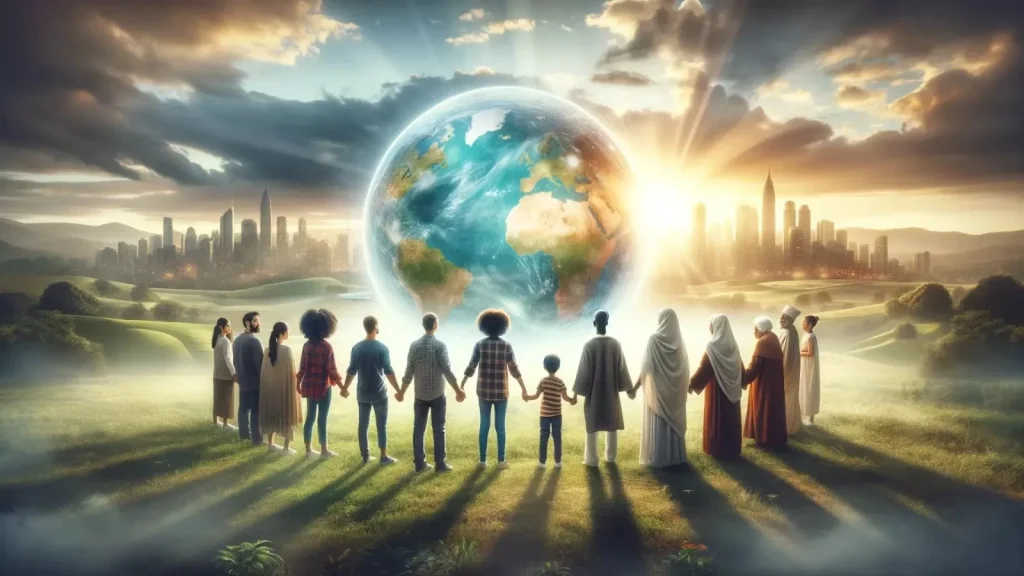
Indian thought, centuries ago, gave the timeless maxim “Vasudhaiva Kutumbakam”—the world is one family. Today, this idea is not only relevant but more essential than ever. It does not merely signify that the Earth is one family; it also implies that the happiness, suffering, dignity, and existence of every member of this family are equally important. Unfortunately, the modern world has reduced this profound philosophy to a beautiful slogan. In practice, national interest, sectarian interest, and personal gain are often placed above human interest. As a result, innocent children are scorched in the fires of war, ordinary citizens live under the shadow of terror, and millions are forced to survive below the line of hunger and deprivation due to economic exploitation. Human Solidarity Day reminds us that as long as human vision remains narrow, peace will remain nothing more than a distant dream.
Today’s wars are not fought only on borders; they are also waged in ideas, information, and mindsets. Somewhere hatred is spread in the name of race, somewhere violence is justified in the name of religion, and somewhere aggressive nationalism suppresses the gentle voice of humanity. Terrorism is the most lethal manifestation of this distorted mentality—it recognizes neither religion nor human values. In such an environment, talking about peace may appear idealistic or impractical to some. Yet history bears witness that violence has never provided a lasting solution. The protection of existence is possible only through peace, dialogue, and coexistence. Human Solidarity Day is an effort to re-establish this truth in the global conscience.
In its Millennium Declaration, the United Nations General Assembly identified solidarity as one of the fundamental values of international relations in the twenty-first century. According to this principle, those who are least affected or least benefited must receive greater support from those who are more privileged. In the context of globalization and rising inequality, strengthening international solidarity has therefore become indispensable. The United Nations firmly believes that promoting a culture of solidarity and sharing is essential to fighting poverty. Through initiatives such as the establishment of the World Solidarity Fund for Poverty Eradication and the proclamation of International Human Solidarity Day, the concept of solidarity has been advanced as a crucial element in the fight against poverty and in ensuring the participation of all stakeholders.
Human solidarity does not merely mean extending help during times of crisis; it means embracing sensitivity, compassion, equality, and empathy in everyday life. When we move past the suffering of war-affected people in other countries as just another news headline, our humanity dies a little. When refugees are seen as a burden and the pain of poor nations is ignored, the idea of global unity becomes hollow. The message of human solidarity is that blood shed anywhere wounds the entire humanity, and tears shed anywhere symbolize our collective failure. This day teaches us that diversity is not our weakness but our greatest strength. Languages may differ, modes of worship may vary, yet human suffering, hope, and dreams are fundamentally the same everywhere.
In this age of violence and war, speaking the language of peace requires courage. Peace is not merely the silence of weapons; it is trust born out of justice, equality, and respect. As long as deep economic inequalities persist in the world, as long as the development of some nations is built on the exploitation of others, genuine human unity cannot be achieved. Therefore, Human Solidarity Day also demands social and economic justice. It reminds us that prosperity is meant not only for consumption but for sharing, and that power is meant not for domination but for protection.
Today, there is an urgent need for education, media, and politics to promote the values of human unity. Children must be taught from an early age that understanding another’s pain is not a weakness but the greatest strength. A sense of global citizenship must be nurtured among youth, enabling them to see themselves not merely as citizens of one nation, but as responsible members of the entire human family. Technology should be used not to spread hatred, but to enhance dialogue and understanding. Only then will this day transcend being just a date on the calendar and become a living inspiration for life.
Solidarity does not signify only governmental cooperation; it encompasses the welfare of all people. The United Nations actively promotes human rights and social development initiatives aimed at building an equitable world where everyone has access to opportunities for growth. This commitment reflects a deep faith in universal progress, with solidarity as its foundation. The concept of solidarity itself forms the bedrock of the United Nations’ mission. Collective security is a principle that encourages cooperation among nations. The UN Charter emphasizes that member states should strive to maintain international peace and security through cooperation, enabling nations to unite against threats such as armed conflict and terrorism. Recognizing the interconnected nature of global challenges, the United Nations advocates international cooperation to address issues like poverty, hunger, and climate change. Solidarity manifests through partnerships that promote the sharing of resources and strengthen the efforts of every nation.
Ultimately, International Human Unity and Solidarity Day call us back to a simple yet profound truth: the greatest identity of a human being is being human. If we can preserve this identity, the dark nights of war, terror, and violence will begin to fade on their own. By translating the spirit of Vasudhaiva Kutumbakam into practice, we can build a world where existence is guided not by fear but by trust; where power resides not in weapons but in compassion; and where future generations remember us as a humanity that chose unity over division.