
Last Updated on July 22, 2025 7:17 pm by INDIAN AWAAZ
Zakir Hossain From Dhaka
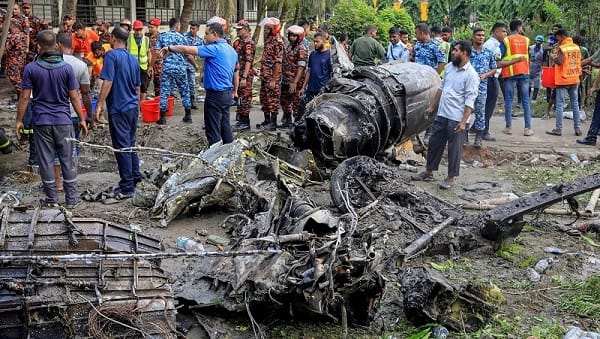
The death toll from Monday’s tragic crash of a Bangladesh Air Force training aircraft into Milestone School and College in Dhaka’s Uttara area has climbed to 31, according to the Inter-Services Public Relations (ISPR).
Among the deceased, 16 died at the Combined Military Hospital (CMH), 10 at the National Institute of Burn and Plastic Surgery, two at Lubana General Hospital, and one each at Dhaka Medical College Hospital, Uttara Adhunik Medical College Hospital, and United Hospital. The ISPR also reported that 165 others sustained injuries—many with severe burns—and urged the public not to fall for misinformation regarding casualty numbers.
The crash of the F-7 BGI fighter jet just 12 minutes after takeoff has sparked widespread grief and raised serious concerns over aviation safety in populated areas. Most of the victims were students, including young children, teachers, and bystanders on the school premises.
India Offers Cross-Border Medical Support: In a gesture of solidarity, the Indian High Commission in Dhaka formally offered to arrange critical medical treatment in India for the injured. In an official statement, the mission said, “The Indian High Commission has today formally written to the Government of Bangladesh asking for information on any critical medical support that may need to be arranged in India.”
The High Commission assured full facilitation for swift cross-border coordination, following Prime Minister Narendra Modi’s message expressing condolences and offering assistance.
High Court Orders Inquiry, Compensation: The Bangladesh High Court on Tuesday ordered the government to form a technical committee within seven days to investigate the crash. The committee is tasked with identifying the cause, detecting any defective aircraft, and submitting recommendations for future prevention.
Additionally, the court directed the government to ensure the best possible treatment for the injured, both at home and abroad, and to implement fire safety measures in educational institutions nationwide. The court also instructed authorities to include students’ names, blood groups, and guardians’ phone numbers in ID cards for emergency situations.
In response to a writ petition, the court issued a rule asking why the government should not be ordered to ban defective and training aircraft operations over populated areas. The bench also questioned why Tk 5 crore should not be given as compensation to each family of the deceased and Tk 1 crore to each injured person.
Global Condolences Pour In: India led the international outpouring of grief, with Prime Minister Modi expressing deep condolences. The Indian High Commission has lowered its flag to half-mast in memory of the victims.
From the UK, Minister for the Indo-Pacific Catherine West said she was “deeply saddened,” while UK High Commissioner Sarah Cooke noted, “Our thoughts are with those affected and with the emergency services responding.” The Vatican’s Ambassador to Bangladesh, Archbishop Kevin Randall, conveyed “heartfelt condolences and assurances of prayers,” in a letter to Chief Adviser Muhammad Yunus.
The Catholic Bishops’ Conference of Bangladesh (CBCB) also issued a statement urging the government to ensure proper treatment for the injured and support for the bereaved. Chinese Foreign Minister Wang Yi, in a message to Bangladesh’s Foreign Adviser, expressed “deep condolences and heartfelt sympathies” and wished the injured a swift recovery. The United Arab Emirates (UAE) also extended condolences through its Ministry of Foreign Affairs, standing in solidarity with Bangladesh and praying for the speedy recovery of the wounded.
As the country mourns one of its worst aviation disasters involving civilians, the tragedy has underscored the urgent need for safety reform, oversight, and accountability in military flight operations over densely populated areas.