
Last Updated on October 28, 2026 6:14 pm by INDIAN AWAAZ
By Wasi Imam / NEW DELHI
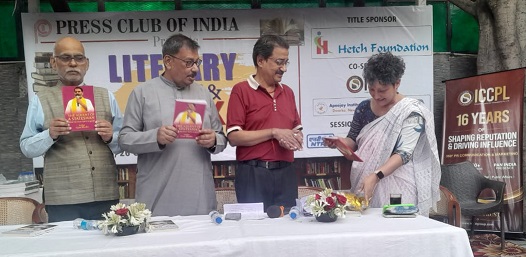
Bihar’s development challenges, governance priorities and the role of political leadership in shaping the state’s future came into focus at the launch of The Advent of a Statesman: Bihar Has Never Had It So Good, authored by journalist and columnist Gyan Bhadra, at the Press Club of India in New Delhi on October 25.
The book was unveiled during the three-day Literature Festival and Book Fair organised by the Press Club of India from October 24 to 26. Sangeeta Barooah Pisharoty, festival convenor and president of the Press Club of India, formally launched the publication in the presence of journalists, publishers and members of the media fraternity.
Veteran journalist Gautam Lahiri, president of the Federation of Press Clubs and former president of the Press Club of India, was among those present.
The launch was followed by a panel discussion examining the book’s arguments on Bihar’s development trajectory, political leadership and governance. Abhay N. Jha, an independent journalist and former special correspondent of the Assamese daily Asomiya Pratidin, was the chief panellist.
The discussion addressed some of Bihar’s longstanding socio-economic challenges, including declining educational standards, inadequate healthcare infrastructure, agricultural distress, rural hardship, migration and the difficulties confronting women in rural areas. These concerns framed a broader debate on the state’s development priorities and the effectiveness of political leadership in addressing structural problems.
A key question raised during the discussion was whether the book’s title, The Advent of a Statesman, presented an overly optimistic assessment of Bihar’s political leadership. Panellists also questioned whether a single leader could bring about a fundamental transformation in a state grappling with complex and deeply rooted challenges.
Responding to these questions, Bhadra explained that the title reflected the perspective advanced in his book. He maintained that an assessment of Bihar’s progress must consider both the changes achieved and the challenges that remain unresolved.
On the question of leadership, Bhadra stressed that sustainable development could not be the achievement of one individual alone. While political leadership could set priorities, mobilise public support and guide institutional processes, lasting change required effective administration, sound economic policies, private investment, civil society participation and active citizen engagement.
He argued that the relationship between political leadership and institutional capacity was particularly important for Bihar, where improvements in education, healthcare, agriculture, employment and rural livelihoods demand sustained and coordinated efforts.
The discussion moved beyond an assessment of an individual leader to examine the wider questions of institutional reform, inclusive growth and governance. It also highlighted the need to evaluate political promises against tangible improvements in people’s lives.
The event provided a platform for journalists and readers to engage with the book’s arguments and debate the opportunities and challenges that will shape Bihar’s developmental future.