
Last Updated on September 11, 2025 1:46 am by INDIAN AWAAZ
AMN / WEB DESK
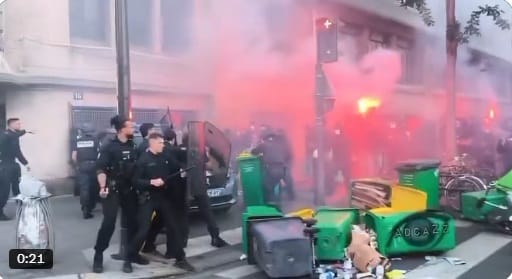
France witnessed another day of turmoil on Wednesday as protesters clashed with police in Paris and several other cities, just a day after President Emmanuel Macron appointed Sébastien Lecornu as the new Prime Minister.
As per the media reports, demonstrators clashed with police, blocked roads and set fires in Paris and other cities. Interior minister Bruno Retailleau said that a bus was set ablaze in Rennes, the capital city of Brittany administrative region. He also said train services in the southwest were halted after damage to a power line.
At the heart of the protests is anger over proposed austerity measures designed to cut France’s 43 billion-euro deficit. Former Prime Minister François Bayrou, who resined on Monday after losing parliamentary confidence vote on Monday, had announced measures like cutting public holidays and freezing pensions, resigned shortly after the defeat. Yesterday, Macron appointed Sébastien Lecornu, his loyal defence minister, as the new prime minister who is the fourth in just 12 months.
Protest organisers argued that Bayrou’s resignation did not change their grievances. As per the media reports, the rapid changes at the top underscored widespread discontent. Opposition parties accused the president of ignoring voter frustration by choosing another loyalist.
Demonstrators under the banner of the “Block Everything” movement blocked roads, lit barricades, and engaged in confrontations with security forces, demanding relief from rising living costs and denouncing government austerity. Police responded with volleys of tear gas, making 473 arrests nationwide by 5 p.m., including 203 in Paris alone.
According to the Interior Ministry, about 175,000 people joined the protests, though hardline trade union CGT estimated participation at 250,000. Despite not fully achieving its declared goal of paralyzing the country, the movement created widespread disruptions across urban centers.
The government had deployed an exceptional 80,000 police officers to maintain order. Outgoing Interior Minister Bruno Retailleau reported 50 operations to clear blockades on highways, ring roads, and depots. He condemned the unrest as a “hijacking by the radical ultra-left” but praised security forces for preventing nationwide paralysis.
“The blockaders did not block France,” Retailleau declared after a crisis meeting chaired by Prime Minister Lecornu. He further noted the growing involvement of high school students, signaling a risk of escalation in coming weeks.
Observers see the protests as a severe early test for Lecornu, who steps into office amid mounting economic frustrations and political fragility following François Bayrou’s resignation. Analysts warn that unless the government offers tangible relief measures, the movement could evolve into a long-term standoff reminiscent of the 2018–19 Gilets Jaunes protests that shook France’s political landscape.
With Macron’s approval ratings under pressure, Lecornu now faces the challenge of balancing fiscal constraints with public anger over declining living standards.