
Last Updated on October 9, 2025 12:49 am by INDIAN AWAAZ
Staff Reporter
The Royal Swedish Academy of Sciences has decided to award the 2025 Nobel Prize in Chemistry to Susumu Kitagawa, Richard Robson and Omar M. Yaghi “for the development of metal–organic frameworks.
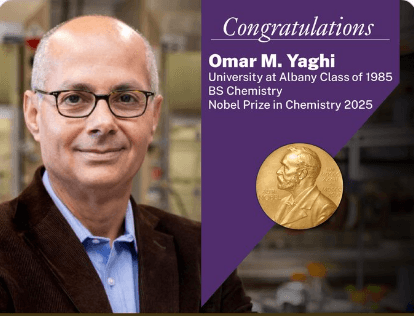
Omar M. Yaghi, born to a Palestinian refugee family from the village of al-Masmiyya in Gaza, has been awarded the Nobel Prize in Chemistry. Raised in a one-room home in a refugee camp in Amman, Jordan, without electricity, he transformed a life.
Omar Yaghi was born in Amman, Jordan, in 1965 to parents who were refugees from Palestine.
When Swedish Academy spoke to him he shared his story: “I grew up in a very humble home, we were a dozen of us in one room, sharing it with the cattle that we used to raise. I was born in a family of refugees, and my parents could barely read or write. My father finished sixth grade and my mother couldn’t read or write. It’s quite a journey. Science allows you to do it. Science is the greatest equalising force in the world. Smart people, talented people, skilled people exist everywhere. That’s why we really should focus on unleashing their potential through providing them with opportunity.”
Today Yaghi shared the 2025 Nobel Prize in Chemistry with Susumu Kitagawa and Richard Robson for their work developing metal–organic frameworks.
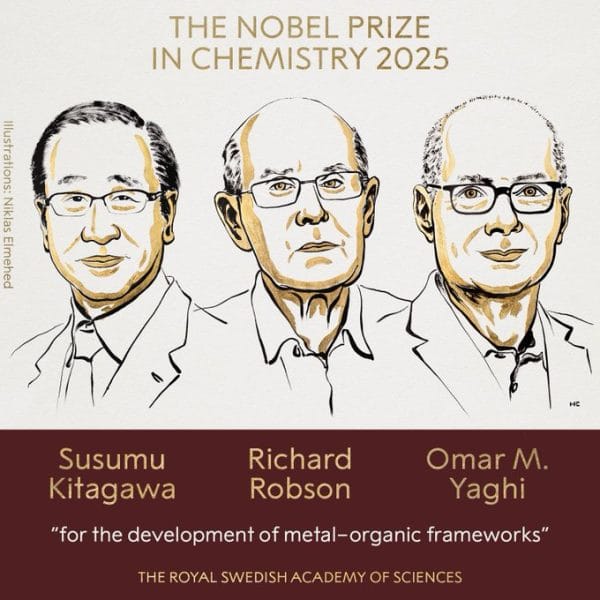
Three scientists from the US, Japan, and Australia have been conferred with the 2025 Nobel Prize in Chemistry today for developing the metal-organic frameworks. The laureates Susumu Kitagawa, Richard Robson, and Omar M. Yaghi created molecular constructions with large spaces through which gases and other chemicals can flow.
Mr Kitagawa is a professor at Kyoto University, Japan. Richard Robson is currently working as a Professor at the University of Melbourne, Australia. Yaghi is currently a professor at the University of California, Berkeley, US. The prize money of 11 million Swedish kronor will be shared equally between the laureates.