
Last Updated on October 2, 2025 6:57 pm by INDIAN AWAAZ
R. Suryamurthy
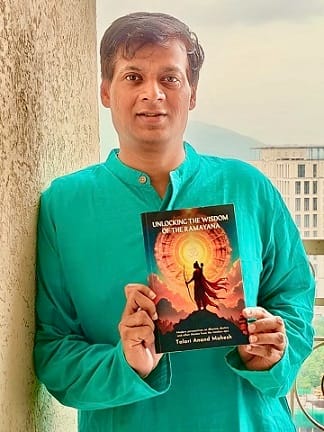
The Ramayana has been told as epic, scripture, poem, and play. Talari Anand Mahesh’s Unlocking the Wisdom of the Ramayana offers something different: a manual of life lessons extracted from India’s best-known story. Published by One Point Six Technologies in 2025, the book does not attempt to retell the tale. Instead, it identifies 40 episodes and distills them into reflections on leadership, ethics, and decision-making.
The format is deliberately simple. Each short chapter takes a moment from the epic—Rama’s exile, Ravana’s arrogance, Hanuman’s loyalty—and reframes it as a lesson for contemporary life. Mahesh writes in clear, uncluttered prose, targeting readers who may not have the time or patience for scholarly tomes. The book is closer to a handbook than a narrative, inviting readers to draw quick insights rather than immerse themselves in mythology.
A crowded tradition
The Ramayana is among the most retold stories in world literature. Valmiki’s Sanskrit original spawned countless regional versions, from Kamban’s Tamil Iramavataram to Tulsidas’s Ramcharitmanas. Modern interpreters, from novelist Ramesh Menon to translator Arshia Sattar, have kept the tradition alive. Against this backdrop, Mahesh’s book positions itself not as literature but as applied wisdom.
That approach gives the text immediacy. Rama’s obedience to his father is framed as a meditation on duty over convenience. Ravana is not demonized but analyzed as a case study in the dangers of unchecked ambition. Even Sita’s ordeal, often read through the lens of suffering, is presented as an exploration of resilience. The framing reflects the growing appetite for “ancient wisdom for modern living” that fills today’s book market.
Gains and gaps
Accessibility is the book’s strongest point. It avoids sermonizing and speaks in a direct, contemporary voice. For many readers, this may be their first step into the ethical dimensions of the Ramayana without having to wade through dense translations.
Yet the simplicity also narrows the canvas. The Ramayana has always been plural, with folk versions that invert the storyline or grant Sita more agency. Mahesh keeps to the mainstream narrative, leaving out these complexities. Scholars such as Romila Thapar and Sheldon Pollock have argued that the epic’s long history is tied to power and ideology. Those debates find little place here.
Unlocking the Wisdom of the Ramayana is unlikely to satisfy purists or academics. It is not an exhaustive commentary, nor a literary retelling. But as a gateway text—compact, readable, and pitched to a general audience—it serves its purpose. In a climate where the Ramayana is often reduced to politics, Mahesh reclaims it as a mirror for individual reflection.