
Last Updated on November 13, 2025 7:53 pm by INDIAN AWAAZ
Speakers at World Urdu Day event urge the community to take responsibility for protecting the mother
Andalib Akhter / New Delhi
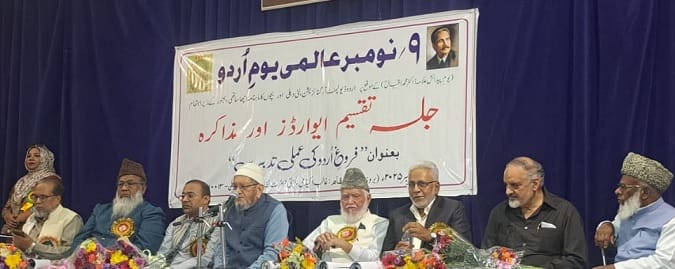
The Urdu Development Organization hosted a grand celebration of World Urdu Day on November 9 at Ghalib Academy here. Distinguished scholars, writers, and educationists participated in the event, emphasizing that Urdu is not the language of any one religion—it belongs to all Indians regardless of faith. The speakers urged the community to take active responsibility for preserving and promoting this rich linguistic and cultural heritage.
The national symposium, titled “Practical Measures for the Promotion of Urdu,” was presided over by noted Iqbal scholar Professor Abdul Haq, who stated that Urdu holds not only immense literary value but also constitutes a vital part of the nation’s cultural and religious heritage. He called for serious reflection on what concrete steps could be taken to ensure the language’s growth.
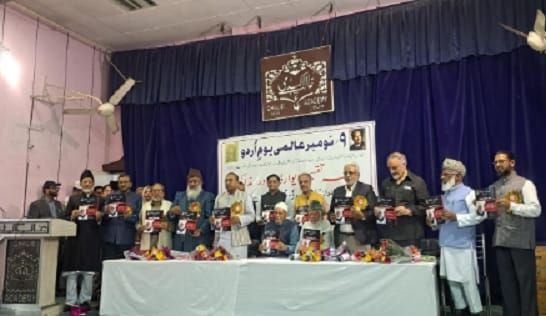
In his welcome address, Dr. Syed Ahmad Khan, head of the Urdu Development Organization, expressed concern over the decline in Urdu education and readership. He questioned why Urdu was disappearing from Urdu-speaking homes and lamented the fall in circulation of Urdu newspapers. Dr. Khan stressed that the expansion of Urdu-medium schools is essential for the language’s survival. “In states where Urdu-medium schools are more numerous, the language thrives. Unfortunately, in Delhi, some Urdu schools have closed down, which is alarming,” he said.
Eminent writer Professor Mohsin Usmani urged students to study Allama Iqbal and other classical Urdu poets and writers to enrich their literary understanding. Professor Akhtarul Wasey remarked that Urdu must be connected to the heart, not just treated as a means of livelihood. He added that instead of blaming others for Urdu’s decline, the community must introspect and take action.
Senior journalist Masoom Moradabadi said that Urdu’s crisis cannot be blamed solely on outsiders; community indifference has alienated Urdu from its own children in North India. He emphasized that Urdu education must begin at home to bring real change. Journalist Suhail Anjum, who conducted the program, said World Urdu Day is both a celebration and a moment for self-assessment. “Those who claim to love Urdu must demonstrate it practically—by reading Urdu, teaching it to their children, and subscribing to Urdu newspapers,” he said.
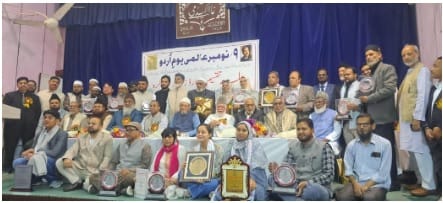
Other speakers, including Dr. Syed Farooq, Maulana Muhammad Rahmani, and Dr. Wasiul Haq Wasi (guest from Doha, Qatar), also addressed the gathering. Several personalities were honored with mementos, shawls, and certificates for their services to Urdu, while outstanding students of Classes 10 and 12 received encouragement awards.
As part of the event, a special magazine dedicated to the life and contributions of noted journalist Alam Naqvi was also released.
At the end of the event, a resolution was unanimously passed highlighting the grim state of Urdu education across India, especially in Uttar Pradesh, where despite thousands of primary schools, not a single Urdu-medium school exists.
The resolution demanded that the UP government lift restrictions on the establishment of Urdu-medium institutions and revive the Urdu Academy. It also urged parents to insist on Urdu instruction under the three-language formula and appealed to Urdu speakers to use the language in daily life—reading, writing, and supporting Urdu media and organizations.
The resolution concluded with a powerful reminder: “To lose Urdu is to lose our cultural identity. The struggle for Urdu is the struggle for our collective heritage.”