
Last Updated on November 11, 2026 12:00 am by INDIAN AWAAZ
Our Correspondent / New Delhi
Emphasising the need to preserve Urdu’s rich literary and cultural heritage, speakers at a World Urdu Day celebration in the capital called for concerted efforts to promote the Urdu script and encourage the younger generation to read and write the language rather than confining it to spoken communication.
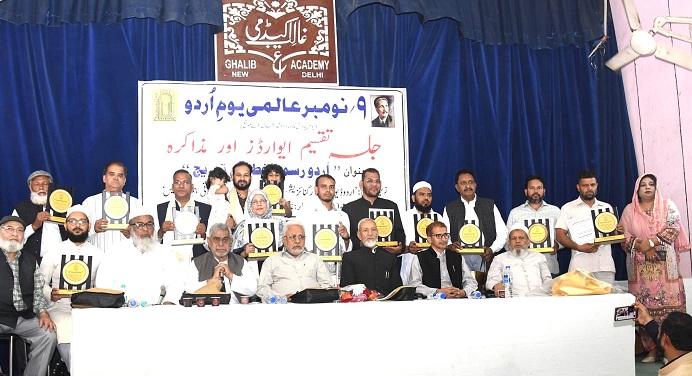
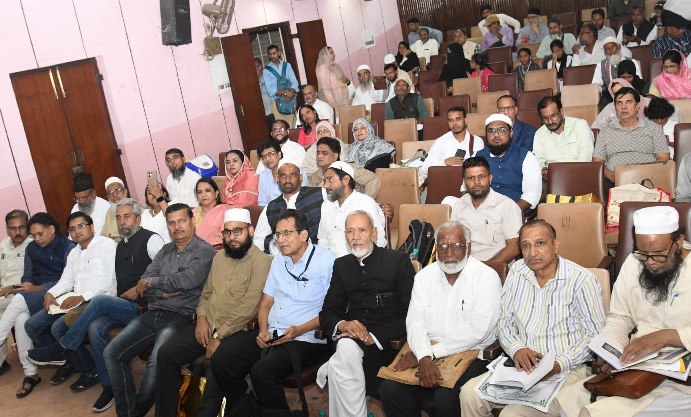
The event, organised jointly by the Urdu Development Organisation and the All India Unani Tibbi Congress at Ghalib Academy in Basti Hazrat Nizamuddin on November 9, marked the birth anniversary of renowned poet and philosopher Allama Muhammad Iqbal. Around 30 personalities from across the country, recognised for their contributions to Urdu language and literature, education, healthcare and social service, were honoured with mementoes, shawls and certificates.
The programme was presided over by noted scholar and litterateur Professor Abdul Haq and began with the recitation of the Holy Quran by Maulana Hakim Murtaza Dehlavi.
Professor Abdul Haq, in his presidential address, said it was the collective responsibility of society to familiarise the younger generation with the importance of Urdu. Describing it as an integral part of the country’s composite culture and identity, he said the language had made a lasting contribution to literature and intellectual traditions.
Referring to Allama Iqbal, he said the poet had conveyed universal messages through his poetry and helped Urdu gain international recognition. He also emphasised the depth of Urdu’s intellectual and literary legacy.
Addressing the gathering, Dr Syed Ahmed Khan, national president of the organising body, said promoting the Urdu script had become one of the most pressing needs of the time. He stressed that Urdu should not remain limited to speaking alone and that efforts must be made to develop the habit of reading and writing among children and young people.
He said the younger generation needed to be connected with the language so that it could retain its place as a living and vibrant part of India’s shared cultural heritage.
Speaking on the theme of promoting the Urdu script, noted writer Masoom Moradabadi said the development of the language required practical initiatives rather than merely organising commemorative events. He observed that Urdu could make sustained progress only when the younger generation developed a regular habit of reading and writing it.
He called upon educational institutions and social organisations to play a more active role in taking Urdu to young learners and creating opportunities for its wider use.
Tahseen Ali Asarvi stressed the importance of using newspapers, magazines, books and modern communication platforms to expand the reach of Urdu. He said children should be encouraged to learn the script and develop an interest in reading and writing so that the language could flourish among future generations.
Other speakers highlighted Urdu’s historical significance and its contribution to India’s cultural and intellectual life. They noted that the language had played an important role in literature, journalism, poetry, the freedom movement and social reform, while promoting values of harmony, tolerance and mutual understanding.
Dr Ariza Ahmed Khan, president of the Urdu Development Organisation, said the organisation had consistently worked to observe World Urdu Day on November 9 and promote awareness about the language. She appealed to Urdu lovers and literary organisations to organise meaningful programmes to encourage its growth and wider acceptance.
She also recalled the initiative taken in 1997 by eminent journalist Mahfoozur Rahman, who had proposed that Urdu, like Hindi, should have a dedicated day of observance. The initiative led to the adoption of November 9, the birth anniversary of Allama Iqbal, as Urdu Day. Over the years, the observance has gained wider recognition across the country and developed into an important literary and cultural occasion.
The programme featured special presentations highlighting the significance of World Urdu Day and recognised individuals for their contributions to education, literature, healthcare and social welfare.
The organisers said the preservation of Urdu was a shared responsibility and called for taking the language beyond literary gatherings and celebrations into homes, schools and everyday communication.
The event was made successful with the efforts of Dr Syed Ahmed Khan, Javed Akhtar, Imran Kannauji, Hakim Murtaza, Dr Ghayas, Dr Shakeel Ahmed and advocate Shah Zabi Qazi, among others.