
Last Updated on November 10, 2026 4:02 pm by INDIAN AWAAZ
– By Lalit Gargg
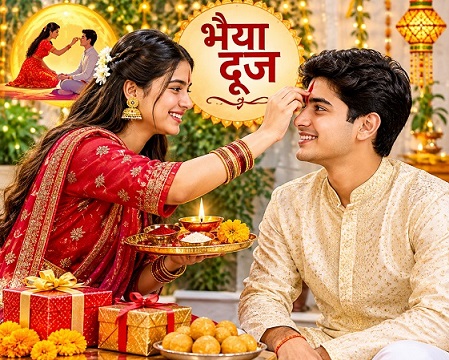
In Indian culture, festivals are not merely dates on a calendar; they are occasions to revive and reaffirm the values of life. Every festival carries a social, familial, spiritual, and cultural message. Bhai Dooj, celebrated as part of the five-day festival of Deepavali, is one such deeply affectionate occasion. It celebrates the sacred bond between a brother and sister and strengthens the ties of love, trust, protection, responsibility, and mutual respect. It is like a gentle shower of emotions on the parched soil of relationships, reminding us that the greatest wealth in life is not material prosperity, but the warmth of belonging and togetherness. Bhai Dooj is celebrated on Kartik Shukla Dwitiya, the second day of the bright fortnight of the Hindu month of Kartik. On this day, a sister applies a sacred tilak to her brother’s forehead, performs his aarti, and prays for his happiness, good health, long life, and prosperity. The brother, in turn, expresses his affection and commitment toward his sister. Though the ritual may appear simple, its deeper meaning is profound. It is not merely a celebration of one brother and one sister; it represents a larger cultural ideal of mutual respect, cooperation, compassion, and security within society.
The traditional story of Yama and Yamuna reveals the deeper spirit of this festival. Yamuna lovingly invited her brother Yama to her home. Yama accepted her invitation and, pleased with her affection and hospitality, granted her a boon. Since then, the day has also been celebrated as Yama Dwitiya. The true significance of this story lies not in miracles, but in the sensitivity of relationships. The affection of a sister and the responsibility of a brother create a bond of trust in which a person never feels completely alone in the face of life’s challenges. Our ancestors did not confine relationships merely to biological or blood connections. They infused them with a sense of duty, dignity, and responsibility. Therefore, Bhai Dooj reminds us that a brother’s responsibility toward his sister is not limited to giving her a gift. It means standing by her dignity, safety, freedom, and self-respect. Similarly, a sister’s affection is not confined to applying a tilak; it is also expressed through her prayers for her brother’s well-being, integrity, self-restraint, and good conduct.
In today’s rapidly changing social environment, the message of Bhai Dooj has become even more relevant. Families are becoming smaller, the pace of life is accelerating, and the digital world has opened countless avenues of communication. Yet, ironically, emotional distances often seem to be increasing. Relationships can sometimes become confined to messages, calls, emojis, and social-media greetings. At such a time, Bhai Dooj teaches us to live relationships not as a formality, but with genuine warmth and emotional involvement. Unfortunately, festivals too are increasingly influenced by consumerism and social display. Expensive gifts, elaborate celebrations, and social competition can sometimes overshadow the true spirit of a festival. “Lights may brighten a house, but only love can illuminate relationships.” The real meaning of Bhai Dooj lies not in the price of a gift, but in the richness of the heart. More important than how expensive a gift a sister receives is whether her brother truly listens to her, stands by her dignity, and holds her hand firmly in difficult times.
Across India, Bhai Dooj is celebrated through diverse regional traditions. It is known as Bhai Dooj, Bhai Beej, and Yama Dwitiya in different parts of the country, with Maharashtra, Gujarat, Bihar, and several other regions following their own distinctive customs. These variations reveal the beauty of India’s cultural diversity. As the familiar saying goes, “The water changes every few miles and the language every few leagues,” yet the underlying spirit of love and affection remains the same. Bhai Dooj also carries a profound message about respect for women. If a brother takes a vow to protect and respect his sister, that sentiment must extend to every daughter and every woman in society. Respecting one’s sister becomes meaningful only when the same respect is reflected in our attitude toward every woman. A society cannot claim cultural integrity if the sister at home is respected and the daughter outside remains unsafe. Such a contradiction is fundamentally inconsistent with the spirit of Indian culture.
As India moves forward with the aspirations of becoming a developed nation and a global leader, economic growth alone cannot be sufficient. The height of a civilization is not measured merely by the height of its buildings, but by the depth of its humanity. Sustainable and meaningful development requires strong families, a sensitive society, and ethical individuals. Festivals such as Bhai Dooj help preserve this invaluable cultural capital. Their message should also reach the soldiers guarding the nation’s borders. Many sisters have brothers who remain stationed far from home, even on festivals, protecting the country. For such brothers, the prayers of their sisters and the respect of the nation are perhaps the most meaningful tilak they can receive. The love expressed through Bhai Dooj becomes truly universal when it extends beyond our own brothers and sisters to everyone who dedicates their life to protecting the family, society, and nation.
Indian culture has never viewed women merely as objects requiring protection. It has upheld the ideal expressed in the ancient saying, “Where women are revered, there the divine resides.” Women such as Gargi and Maitreyi established their independent identity in the intellectual traditions of India. Rani Lakshmibai displayed extraordinary courage on the battlefield. Ahilyabai Holkar established an enduring example of governance and public welfare. Savitribai Phule lit the torch of women’s education. In modern India, women from Kalpana Chawla to countless scientists, astronauts, entrepreneurs, administrators, and professionals have demonstrated that talent knows no gender. Therefore, Bhai Dooj must become a bridge between the wisdom of our heritage and the consciousness of the present. Preserving culture is meaningful only when it enables life to move forward rather than holding it back. Tradition is not something that merely needs to be repeated; a living tradition is one that generates new meaning with changing times.
The spiritual significance of Bhai Dooj is equally important. The greatest insecurity in life is not always external; it often exists within us. Fear, anger, greed, ego, jealousy, and hatred weaken inner peace and disturb human relationships. From the perspective of Jain philosophy, true security does not come merely from external protection. It emerges from self-discipline, awareness, restraint, and inner awakening. When a person learns to protect himself or herself from inner passions and destructive tendencies, that individual becomes a source of peace and security for others as well. Seen from this perspective, Bhai Dooj is not merely a historical or traditional celebration of the brother-sister bond. It is a festival that elevates this sacred relationship toward deeper trust, harmony, compassion, and mutual goodwill.
Ultimately, Bhai Dooj teaches us that relationships do not become stronger by demanding love; they become stronger by fulfilling our responsibilities toward one another. Love does not diminish when shared—it grows. Trust does not weaken when given—it deepens. Therefore, this Bhai Dooj, let us not merely complete the ritual of applying tilak and exchanging sweets. Let us make a conscious commitment to respect, support, and care for one another. When self-interest gives way to dedication, formality gives way to genuine affection, and display gives way to values, Bhai Dooj becomes truly meaningful. Amid the lamps of Deepavali, this festival reminds us of a timeless truth: the light in a home does not come merely from electricity or lamps; it comes from the warmth of relationships. And a society whose relationships remain alive with love and values can never be plunged into darkness.