
Last Updated on July 7, 2025 1:01 pm by INDIAN AWAAZ
AMN / WEB DESK
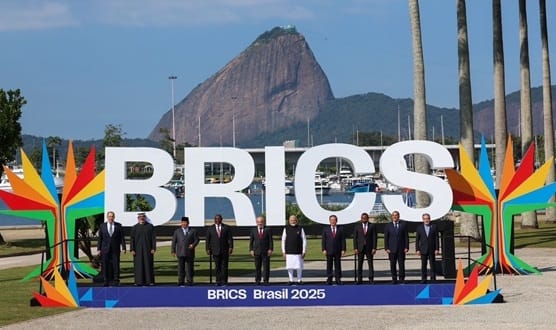
In a significant move, the Leaders’ Declaration at the ongoing BRICS Summit in Rio de Janeiro in Brazil, has condemned in the strongest terms the terrorist attack in Jammu and Kashmir on April 22, which killed 26 people.
The BRICS leaders have reaffirmed their commitment to combat terrorism in all its forms and manifestations, including the cross-border movement of terrorists, terrorism financing and safe havens. It has urged to ensure zero tolerance for terrorism and reject double standards in countering terrorism. More from our correspondent:
The issue of the menace of terrorism was raised by the Prime Minister during the BRICS summit when the session on Peace and Security came up. He thanked the member countries for strongly condemning the Pahalgam terror attack and who expressing solidarity with India.
He termed it as a direct attack on the soul, identity and dignity of India. He added that it was a blow not only to India but to the entire humanity. He urged zero tolerance for terrorism and further added that there should be no hesitation in imposing sanctions against terrorists.
He also reaffirmed that India stands for dialogue and diplomacy to resolve conflicts and achieve global peace. He invited the BRICS leader to India for the next summit to be held under its Chairmanship next year.
As the organisation of the Global South, the BRICS leaders called for special treatment for developing countries in a “rules-based, open, transparent, fair, inclusive, equitable, non-discriminatory, consensus-based multilateral trading system”.
The 126-paragraph statement by the leaders of 11 BRICS countries touched on a gamut of subjects from outer space to deep sea.
The leaders extended full support to India becoming the chair of BRICS next year and hosting the summit.
The declaration condemned the April 22 Pahalgam attack and demanded that the perpetrators and their supporters be brought to justice.
Although it did not name the terrorist group or its backers, it was a diplomatic win for India going against China, the protector of Pakistan, whose proxies carried out the attack.
On some contentious issues, the statement showed a measure of moderation to reach a consensus.
The statement “condemned” without naming the US or Israel, the attacks on the nuclear facilities in Iran.
It, however, expressed support for making the Middle East a nuclear-weapon-free zone. That would neutralise Iran’s nuclear ambitions and also Israel’s undeclared nuclear capability.
In a moderated tone, the statement expressed “grave concern” about the continued Israeli attacks on Gaza, while also calling for the release of hostages taken by Hamas, which it did not name.
For Ukraine, it reiterated suggestions for mediation and diplomacy.
But without naming Ukraine, in a sop to Moscow, it condemned “in the strongest terms” the attacks against bridges and railways infrastructure and civilians in Bryansk, Kursk, and Voronezh regions of Russia.
The leaders opposed the militarisation of outer space and welcomed the establishment of the BRICS Deep-Sea Resource International Research Centre in Hangzhou, China.
PM Modi Holds Bilateral Meetings with Malaysian, Cuban, and Vietnamese Counterparts on BRICS Summit Sidelines
LATER Prime Minister Narendra Modi engaged in a series of bilateral meetings on Monday with world leaders on the sidelines of the 17th BRICS Summit in Rio de Janeiro, Brazil. The meetings underscored India’s commitment to strengthening global partnerships and cooperation.
During his meeting with Malaysian Prime Minister Anwar Ibrahim on the sidelines of the summit, the two leaders reviewed the progress in bilateral relations since Ibrahim’s state visit to India in August 2024. They discussed trade and investment, defence, education, healthcare, tourism, and people-to-people contacts.
Modi thanked Ibrahim for his strong condemnation of the Pahalgam terror attack, emphasising the need for global cooperation against terrorism.
“We reviewed the ground covered in our bilateral relations, including the progress made since PM Ibrahim’s visit to India last year. Futuristic sectors like IT, renewable energy, and infrastructure are those where bilateral ties are growing strongly,” PM Modi said on X asserting: “Also discussed how to improve investment and trade relations between our nations.”
The two leaders also explored cooperation in the multilateral arena and regional security, with Modi congratulating Malaysia on its successful stewardship of ASEAN. They welcomed the prospect of strengthening the ASEAN-India Comprehensive Strategic Partnership.
PM Modi also met with Cuban President Miguel Diaz-Canel, discussing bilateral ties in economic cooperation, development partnership, fintech, capacity building, science and technology, disaster management, and healthcare.
Diaz-Canel expressed interest in India’s Digital Public Infrastructure and UPI, while Modi appreciated Cuba’s recognition of Ayurveda and offered support for integrating it into Cuba’s public health system.
“It was wonderful to meet President Miguel Díaz-Canel Bermúdez of Cuba. In our talks, we covered a wide range of subjects. Economic relations between our nations have a lot of potential to grow in the coming times,” PM Modi stated on his handle X.