
Last Updated on January 24, 2026 2:52 pm by INDIAN AWAAZ
Syed Ali Mujtaba
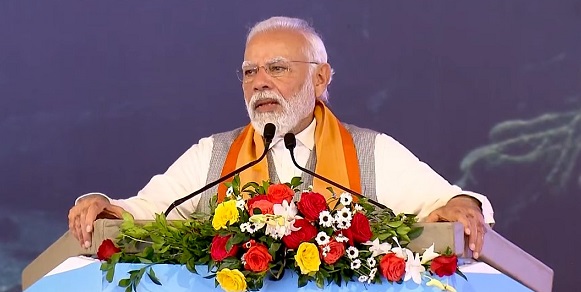
The Tamil Nadu assembly is going to the polls in April 2026. Prime Minister Narendra Modi had visited the poll-bound state on January 23, 2026. He unveiled the curtain of the political circus in the state, attacking the ruling DMK government, leveling charges of corruption, mafia, and crime.
PM Modi addressed multiple public meetings in the state with the purpose of discrediting the DMK rule and to shore up the chances of the Bhartiya Janata Party to emerge as a force to be reckoned with in the Dravidian homeland.
Prime Minister Modi attacked, saying Tamil Nadu must be freed from DMK’s chains. He said the DMK has turned the state into a drug-ridden space and has betrayed people’s trust, running the government based on corruption and crime.
PM Modi said the DMK made “heaps of promises” but delivered no development to the state, claiming that people are now referring to DMK rule as a “CMC rule,” which means “Corruption, Mafia and Crime.”
PM Modi then trained his gun at the dynastic politics in Tamil Nadu, saying the DMK government serves only one family, lacks democracy and accountability. He said the DMK government functions only for the benefit of one family.
In response, the Tamil Nadu Chief Minister MK Stalin mocked at PM Modi’s claims of “double-engine” model of governance, calling it the “dabba model”. He dismissed the much-touted double engine model as dummy model that will never succeed in Tamil Nadu.
MK Stalin sharply reacted to PM Modi’s remark that Tamil Nadu lacks in development. He said, the BJP-ruled states lag on several indexes of development and are far behind Tamil Nadu. Stalin said Tamil Nadu has achieved a historic growth rate despite what he described as obstacles created by the BJP-led Centre.
Drawing comparisons, Stalin argued that states ruled by non-BJP governments—Tamil Nadu, Kerala, Telangana, Karnataka, and West Bengal—are “soaring high in development,” unlike BJP-ruled states such as Uttar Pradesh, Madhya Pradesh, and Bihar.
Political Landscape of Tamil Nadu
The DMK leads the Secular Progressive Alliance (SPA), which includes the Congress, Left parties (CPI, CPI-M), VCK, MDMK, and IUML. The focus of the SPA is on social justice, regional identity, and welfare.
The AIADMK has traditionally led the National Democratic Alliance (NDA), though this alliance has been broken after the BJP was dumped in the 2024 Lok Sabha election. Now the BJP is seeking to expand its base in Tamil Nadu, often contesting independently or leading a smaller coalition after the exit of the AIADMK from the alliance.
Other political parties in Tamil Nadu include Pattali Makkal Katchi (PMK), Desiya Murpokku Dravida Kazhagam (DMDK), and Naam Tamilar Katchi (NTK), which often shift alliances or contest independently.
Political trend in Tamil Nadu

Tamil Nadu’s political landscape has long been dominated by a bipolar system centered on two major Dravidian parties, the DMK and the AIADMK. The two parties have alternatively come to power on strong welfare populism.
The key political trend in Tamil Nadu is that no party has won a majority on its own since 1996, making alliances with smaller caste-based or regional parties essential. Alliances with smaller regional parties are crucial for victory for the ruling party. The DMK-led Secular Progressive Alliance has several parties supporting it at the same time; the AIADMK, which led the NDA as its primary force, also has some parties supporting it in the state.
The other trend in Tamil Nadu is language and Tamil identity politics that opposes the Hindutva politics of northern India. Dravidian politics heavily rely on regional identity and opposition to perceived northern domination.
The political arena in Tamil Nadu used to be characterized by intense competition between the DMK and AIADMK, the two Dravidian parties. However, in the current situation, the AIADMK camp is a fragmented lot. It is unable to hold together its rank and file, and the party is reduced to a shadow of its former self.
The other trend in Tamil Nadu is that politics is it remains strongly connected to cinema, with major leaders having backgrounds in the film industry. Actor Vijay has launched the Tamilaga Vetri Kazhagam (TVK); actor Seeman’s Naam Tamilar Katchi has secured sufficient votes to gain recognition from the Election Commission; the Desiya Murpokku Dravida Kazhagam (DMDK), founded by actor Vijayakant and now led by his wife, Premalatha, remains in the fray of TN politics.
The Pattali Makkal Katchi (PMK), which represents the Vanayar community, stands divided right now between father and son. One faction is led by father Dr. S. Ramadoss and the other by his estranged son and former Union Minister, Dr Anbumani Ramadoss.
The political situation in Tamil Nadu today is a fractured political landscape where the Bharatiya Janata Party (BJP) is striving to establish a foothold. The BJP is attempting to create a “saffron space” in a traditionally Dravidian-dominated political landscape.
The BJP has tried all the tricks of the electoral trade to conquer the Dravidian heartland. The BJP did throw money like water in the Lok Sabha election in 2024. Its poster boy Annamali assured PM Modi that the sizeable contribution of MPS from Tamil Nadu will help the BJP form a stable government at the center. Alas, this did not happen; the Dravadian identity refused to be cowed down by the Saffron monster.
In Tamil Nadu, the BJP has its own set of rules to operate. It supported J. Jatalalitha-led AIADMK rule in the state; in turn, she assured sizable AIADMK MPs’ support to the BJP at the center. The BJP had kept J. Jayalaitha under leash not to pursue her corruption cases or ask the Enforcement Directorate to go after her, even though corruption under rule had hit its nadir.
After the demise of Jayalalitha, the shrubs and herbs of the AIADMK tried to pursue the same political culture, but the infighting in the party erupted due to the BJP’s support. They made the AIADMK realize that it can never come to power in Tamil Nadu, being the surrogate of the BJP. This prompted the AIADMK to leave the NDA alliance and rebuild the party from scratch.
Changing Strategy of the BJP- leaning on actor Vijay
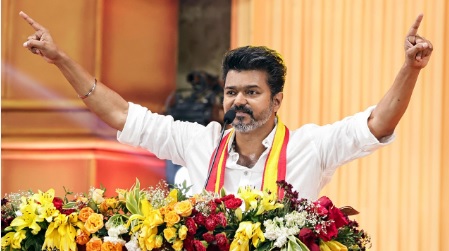
After the rebuff from the AIADMK, the BJP has changed its strategy and has put its money on actor Vijay, who has recently launched his political party, Tamilaga Vetri Kazhagam (TVK).
Vijay, a heartthrob of the masses, is cashing in on his celluloid popularity. The BJP has given him the bait that if he helps the saffron party, the latter will support him in his tough times. Vijay has visited Delhi several times to meet the BJP top leaders.
Actor Vijay can be compared with the aging superstar Rajnikant, who never contested the election in Tamil Nadu despite enjoying phenomenal popularity in the state. The BJP had urged the superstar several times to take a plunge in Tamil Nadu politics and provide a base to the saffron party, but the charismatic actor remained a reluctant political player.
In the same vein, actor Vijayakant, who called himself black MGR, formed the Desiya Murpokku Dravida Kazhagam (DMDK) and invested huge funds to challenge the supremacy of J. Jayalalitha, but could not make any dent in Tamil Nadu politics.
In this background, where does Vijay stand in Tamil Nadu politics? The social media is abuzz with the claim that actor Vijay has over twenty-five percent support of the Tamil Nadu voters. He can form the next government with the support of smaller parties like the AMMK (Amma People Progressive Federation) led by T. T. V. Dhinakaran, the BJP, and others. Such predictions are hypothetical, with no grass root evidences are available to support such a claim. On the contrary, the grapevine has it that actor Vijay may meet the same fate as the Psephologist, Prashant Kishor, tasted in Bihar.
To cut a long story short, in the ultimate analysis, the DMK has a free run in the 2026 assembly election. This is because of the fractured political landscape in the state and the fear that the BJP’s Hindutva will conquer the Dravidian homeland.
Based in Chennai, Syed Ali Mujtaba is a senior journalist and political analyst