
Last Updated on August 17, 2025 11:56 pm by INDIAN AWAAZ
As Bihar inches closer to elections, the Rahul-Tejashwi Padyatra marks a significant political experiment—a grassroots attempt to rebuild trust in democratic values and challenge a powerful ruling establishment.
By Andalib Akhter and Arun Srivastava
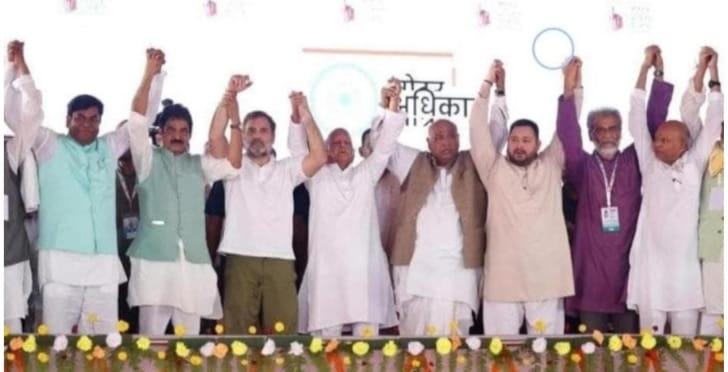
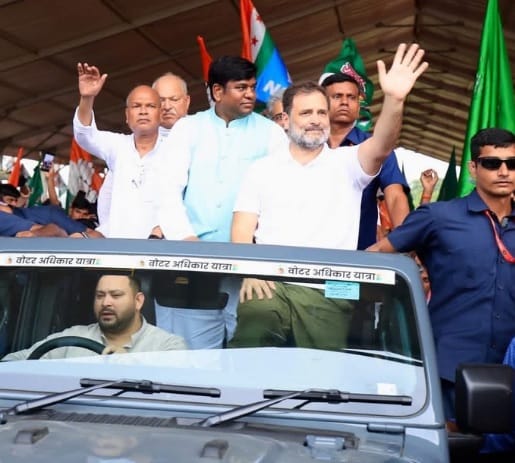
Bihar, a state known for its complex caste equations, shifting alliances, and unpredictable politics, is once again on the edge of transformation. As the countdown to the Assembly elections begins, two of the opposition’s most prominent faces—Congress leader Rahul Gandhi and RJD’s Tejashwi Yadav along with other INDIA partners —have taken a bold political step, a joint padyatra (foot march) that began this week from Sasaram, a historically and politically significant region in the state.
This march isn’t just symbolic. It’s a calculated move aimed at resetting the opposition narrative in Bihar, where the ruling NDA alliance led by Chief Minister Nitish Kumar (JD-U) and BJP currently holds power. The question now is: can this grassroots outreach campaign re-energize the fragmented opposition and change the game on the ground?
A March against ‘Vote Theft’
The joint padyatra, flagged off in a public rally attended by thousands, is part of a larger strategy that revolves around the issue of “vote theft.” Rahul and Tejashwi have accused the ruling establishment of manipulating elections through EVM tampering, administrative bias, and money-muscle power.
This message is being taken straight to the people, especially in rural and marginalized areas, in an attempt to stoke public sentiment around electoral injustice.
“We are not just walking for power; we are walking to reclaim democracy,” Rahul Gandhi said, addressing the gathering in Sasaram.
By centering their narrative around electoral integrity, the opposition hopes to not only energize their base but also appeal to undecided voters disillusioned with the current system.
Strategic Value of a Padyatra in Indian Politics
The padyatra has long been a trusted tool of Indian politicians seeking moral and popular legitimacy. From Mahatma Gandhi’s Dandi March to YS Rajasekhara Reddy’s 2003 padayatra in Andhra Pradesh, and Rahul Gandhi’s own Bharat Jodo Yatra, foot marches have often reshaped public perception and political narratives.
In Bihar, such efforts carry deep weight, especially among rural voters who remain the state’s electoral core. This joint march is not only about optics — it’s also about visibility, accessibility, and symbolism. It projects a united opposition in a state where alliances have historically been shaky.
Can the Rahul-Tejashwi Alliance Hold?
This is not the first time Bihar has seen attempts at opposition unity. However, such efforts have often been short-lived, collapsing under the weight of personality clashes, ego tussles, and regional ambitions.
That said, the current partnership between Rahul Gandhi and Tejashwi Yadav appears to be grounded in mutual need and generational synergy. Both leaders are trying to position themselves as the new face of Indian politics—progressive, youth-focused, and responsive to ground realities.
Tejashwi, who already enjoys strong support among young voters and backward caste groups, brings local credibility, while Rahul brings national visibility and media traction. Their combined force may just be what the opposition needs to punch through the NDA’s formidable electoral machinery.
A Challenge to Nitish-BJP Alliance?
The Nitish Kumar–BJP alliance, which returned to power in 2020, still rests on two pillars: administrative experience and organizational strength. Nitish’s image as a seasoned, development-focused leader and BJP’s grassroots machinery make for a potent combination.
However, the ground is shifting. Unemployment, agrarian distress, migrant issues, and law and order concerns remain unresolved. Public frustration has simmered post-COVID, and cracks in the NDA’s social coalition—particularly with the youth and backward communities—are beginning to show.
If Rahul and Tejashwi can convert this discontent into votes, the ruling alliance may find itself on shaky ground, especially in central and north Bihar where electoral margins are narrow.
The Real Test: Unity or Just Optics?
Yet, the road ahead for the opposition is riddled with challenges. Will this joint march translate into real political chemistry, joint campaigns, seat-sharing clarity, and policy cohesion? Or will it fizzle out as just another symbolic exercise?
Political analysts caution that without clear messaging, ground-level coordination, and consistent follow-through, even well-publicized alliances risk collapsing into confusion.
A Political Gamble With High Stakes
As Bihar inches closer to elections, the Rahul-Tejashwi padyatra marks a significant political experiment—a grassroots attempt to rebuild trust in democratic values and challenge a powerful ruling establishment.
Whether this experiment results in a strong opposition front or simply becomes another episode in Bihar’s long history of short-lived coalitions remains to be seen. But one thing is certain: the march has begun, and with it, Bihar’s politics has entered a new phase — unpredictable, energized, and intensely watchful.