
Last Updated on August 30, 2025 1:02 am by INDIAN AWAAZ
Aligarh
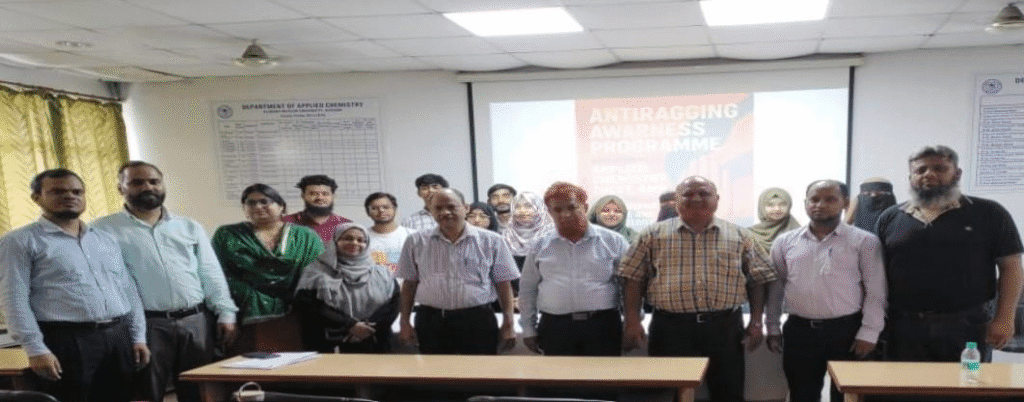
The Department of Applied Chemistry, Zakir Husain College of Engineering and Technology (ZHCET), Aligarh Muslim University (AMU), organized an Anti-Ragging Awareness Programme to sensitize students on the values of discipline, dignity, and mutual respect within the campus.
The event opened with a welcome address by Prof. Rais Ahmad, Chairman of the Department, who reminded students that ragging in any form is a punishable offence. He urged them to uphold AMU’s tradition of maintaining a safe and supportive academic atmosphere.
Prof. Shahabuddin underlined the collective responsibility of students in fostering harmony, inclusion, and mentorship, while Dr. Yasir Azeem delivered a presentation on the role of senior students as guides and detailed the rules and penalties for ragging-related violations. Dr. Mushir Ahmad elaborated on UGC and AMU guidelines, providing students with a clear understanding of the legal and disciplinary framework.
Conducting the session, Dr. Mohd Arsalan emphasized that anti-ragging awareness is not only about discipline but also about personal and academic growth, encouraging confidence, trust, and healthy teacher–student relationships.
In the concluding session, Dr. Musarrat delivered the Vote of Thanks, appreciating the enthusiastic participation of both students and faculty.
The programme conveyed a strong message: ragging has no place in AMU’s academic culture. Students were encouraged to strengthen an environment of mentorship, brotherhood, and respect in line with the university’s ethos of inclusivity and excellence.
India’s Linguistic Diversity is Immense and Serves as a Unifying Force – Prof. M J Warsi
Aligarh: Highlighting the significance of India’s linguistic plurality, Prof. M J Warsi, an eminent linguist and former Chairperson, Department of Linguistics, Aligarh Muslim University (AMU), delivered an invited lecture at the two-day national conference on “Bhartiya Bhasha Pariwar: Strengthening National Unity through Linguistic and Literary Exchange”. The event was jointly organised by the English and Foreign Languages University (EFLU), Shillong, and the Bharatiya Bhasha Samiti, Ministry of Education, Government of India, on August 28–29, 2025.
Prof. Warsi’s lecture, titled “Role of Linguistic and Literary Traditions in Sustaining Cohesion between Diverse Cultural Landscapes of India”, explored how linguistic and literary exchanges promotes empathy, nurture unity, and help in shaping a shared national vision.
“Language is the foundation of mutual understanding among diverse communities. Through translation, education, and intercultural dialogue, linguistic exchange builds bridges between regions, enabling people to appreciate one another’s heritage,” remarked Prof. Warsi.
He further emphasized that every Indian language embodies centuries of literature, philosophy, folklore, and oral traditions. Languages such as Sanskrit, Tamil, Kannada, Bengali, Hindi, Urdu, Malayalam, Telugu, Marathi, Punjabi, and hundreds of tribal tongues preserve India’s cultural wealth, connecting present generations with ancestral wisdom.
In his concluding address, Prof. Warsi emphasized that strengthening national unity through linguistic and literary exchange requires progressive policies, including the use of digital tools like the Bhashini Project, expansion of cultural initiatives such as Ek Bharat Shreshtha Bharat, promotion of multilingual education, and primary instruction in mother tongues as envisioned by the NEP 2020.