
Last Updated on August 18, 2025 8:12 pm by INDIAN AWAAZ
AMN / Lucknow
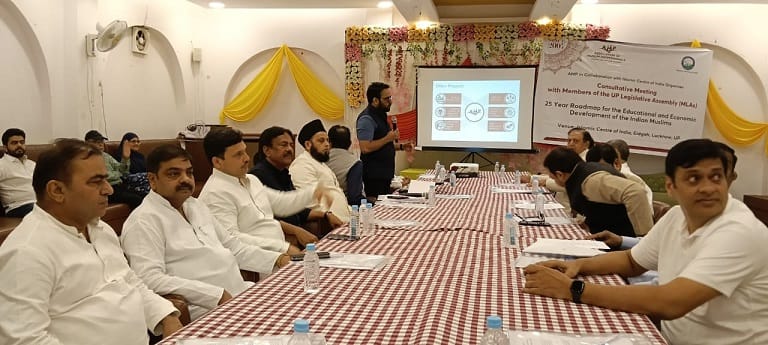
In a significant step toward long-term community upliftment, the Association of Muslim Professionals (AMP) organized a high-level consultative meeting with Members of the Legislative Assembly (MLAs) at the Islamic Centre of India, Lucknow, to deliberate on a 25-Year Roadmap focused on the educational and economic development of Indian Muslims.
AMP, a nationally recognized non-profit working in the fields of education and economic empowerment, brought together lawmakers, policy experts, and community leaders to engage in a dialogue around its ambitious vision of transforming 100 of the most backward and Muslim-concentrated districts across India.
A Strategic Vision Rooted in Data and Urgency
The roadmap—developed in collaboration with educators, economists, civil society organizations, and grassroots stakeholders—addresses systemic gaps in education, livelihood opportunities, skill development, access to financial and governmental resources, and local governance.
Despite accounting for over 14% of India’s population, the Muslim community continues to face persistent marginalization. According to AISHE 2020–21, Muslim representation in higher education has dropped to a troubling 4.6%, highlighting the urgency for targeted interventions. Additional challenges such as madarsa closures, reduced scholarship schemes, and social exclusion policies have only compounded the crisis.
Ground-Level Support from Lawmakers
Given that many of the targeted districts are located in Uttar Pradesh, the presence and participation of state MLAs were critical. Each attending legislator endorsed the initiative, acknowledging the issues highlighted in AMP’s roadmap and pledging their unconditional support to implement its recommendations within their constituencies.
Highlights from the Meeting
The session was chaired by Hazrat Maulana Khalid Rashid Farangimahali, Chairman of the Islamic Centre of India, who emphasized the need for urgent and coordinated implementation. He stressed that the roadmap could no longer be a future aspiration but must become an immediate action plan.
Aamir Edresy, President of AMP, presented the larger vision, positioning the roadmap as a tool not just for community advancement but for inclusive nation-building. He underscored the importance of collaboration between legislators, civil society, and policy institutions.
Dr. Abdul Ahad, National Core Team Member of AMP and Convener of the 25-Year Roadmap project, provided a comprehensive overview of AMP’s initiatives and achievements, framing the roadmap within the larger mission of empowering India’s marginalized communities through structured and sustainable development.
A Milestone for Muslim Development Policy
The consultative meeting marks a critical milestone in AMP’s journey to create a long-term, data-driven strategy for Muslim advancement in India. With political will beginning to align with grassroots urgency, the 25-Year Roadmap has the potential to reshape the future of millions of underserved citizens.
AMP’s efforts underscore a simple but powerful message: development and dignity must go hand in hand, and the path to a stronger India lies in ensuring no community is left behind.
Distinguished Guests in Attendance
1. Ashu Malik – MLA, Saharanpur
2. Nafees Ahmed– MLA, Azamgarh
3. Faheem Irfan – MLA, Bilari (Moradabad)
4. Mohd Hasan Roomi – MLA, Kanpur Cantt
5. Mohd Nasir Quraishi – MLA, Moradabad Rural
6. Rafeeq Ansari – MLA, Meerut
7. Arman Khan – MLA, Lucknow West
8. Moid Ahmad – Former Cabinet Minister, Uttar Pradesh
9. Asif Khan Babbu – Former MLA, Shahabad
10. Shakeel Nadvi – President, Samajwadi Minority Council, UP
11. Yameen Khan – Secretary, Samajwadi Minority Council (National)
In addition, political leaders from Samajwadi Party, Congress, Bahujan Samaj Party, Rashtriya Lok Dal (RLD), and ASP were also present.
The meeting was attended by ulema, educationists, philanthropists, and professionals from diverse fields, along with office bearers of AMP’s Uttar Pradesh team.
Key Outcomes & Suggestions
• MLAs and distinguished guests shared valuable insights to strengthen the roadmap.
• Suggestions will be incorporated into the final draft of the 25-Year Roadmap.
• Emphasis was laid on:
• Strengthening primary and secondary education in backward districts.
• Establishing skill development centres tailored to local employment needs.
• Improving access to scholarships and financial aid for poor students.
• Promoting entrepreneurship and microfinance initiatives.
• Encouraging NGO collaboration for district-level projects.
The meeting successfully brought together policymakers, community leaders, and professionals to discuss AMP’s visionary 25-Year Roadmap. The constructive engagement from MLAs underscored a shared commitment to address the educational and economic challenges of the Muslim community in Uttar Pradesh and beyond.