
Last Updated on November 8, 2025 3:16 pm by INDIAN AWAAZ
AMN / New Delhi
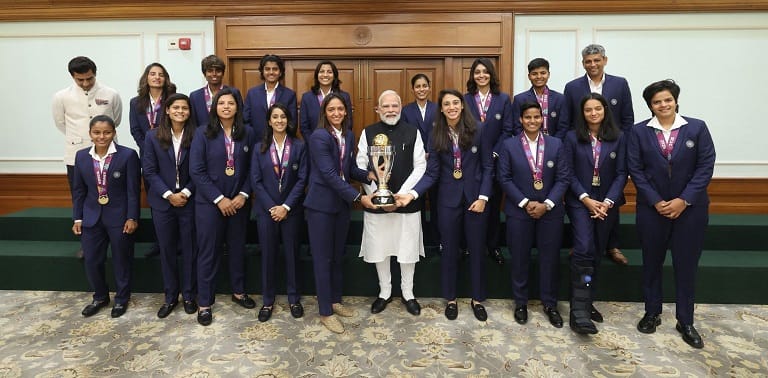
The All India Feminist Alliance (ALIFA–NAPM), a nationwide collective of feminist and grassroots organizations, has congratulated the Indian Women’s Cricket Team for its historic World Cup triumph — a victory that has not only brought glory to Indian sport but has also redefined leadership and resilience for women everywhere.
ALIFA hailed the win as “a collective reminder of what becomes possible when young women lead with integrity, courage, and care.” The organization said this triumph belongs to every girl who was ever told that “the field is not her place” or that leadership belongs elsewhere.
Unlike the often corporatized, star-driven world of professional sports, the Indian women cricketers reminded everyone of the joy, teamwork, and raw emotion that lie at the heart of sport. Captain Harmanpreet Kaur, vice-captain Smriti Mandhana, and semi-final hero Jemimah Rodrigues have become household names not merely for their outstanding performances but for the spirit of togetherness they embodied. As Mandhana said after the final, “The super strength of this team is playing for each other. We needed each other’s support.”
This solidarity, ALIFA noted, reflects a feminist model of leadership — one that uplifts rather than dominates, and proves that success need not imitate patriarchal notions of power. The win also honours generations of pioneers such as Diana Edulji, Shantha Rangaswamy, Mithali Raj, Jhulan Goswami, and Anjum Chopra, who carved space for women’s cricket against all odds and with minimal institutional support.
At the same time, ALIFA urged the nation to confront the deeply gendered, unequal, and corporatized nature of Indian sport. For decades, women athletes have fought for basic facilities, funding, and recognition while balancing family duties, enduring abuse, and facing social scrutiny. The alliance recalled tragic stories such as that of Haryana’s young tennis player Radhika Yadav, and the struggles of women wrestlers who dared to challenge sexual abuse in sporting bodies.
In this context, Jemimah Rodrigues’ calm response to religious trolling after her semi-final heroics was seen as a powerful statement of grace and strength. Her honesty about mental health and commitment to team spirit, ALIFA said, represent the kind of inclusive leadership India needs — ethical, empathetic, and unafraid.
The organization emphasized that the victory should spark broader reforms: equitable pay, safer sports infrastructure, representation of women in decision-making roles, and accountability in governance. It also called for recognizing intersectional realities — the barriers faced by athletes from Dalit, Adivasi, minority, queer, and trans communities — and ensuring their full participation in national sports.
“Each time a woman steps onto the field,” ALIFA stated, “she expands what is possible for all of us.” The alliance called the World Cup triumph a symbol of feminist solidarity — a moment that must inspire India to build sporting spaces grounded in equality, dignity, and collective care.
Zindabad to Every Indian Woman who Dares to Dream!
Endorsed by Members of All India Feminist Alliance (ALIFA – NAPM)
1. Bhanu Kalluri, Feminist Researcher and Activist, Telangana
2. Arundhati Ghosh, Independent Consultant, Bengaluru
3. Dr. Sanju, ALIFA, Churu, Rajasthan
4. Sharanya, Solidarity worker, Koraput, Odisha
5. Laxmi Murthy, journalist and researcher, Bengaluru
6. Chayanika Shah, Hasrat-e-Zindagi Mamuli, Mumbai
7. Adv Dr Shalu Nigam, Delhi NCR
8. Moumita Alam, Poet and essayist
9. Mallu Kumbar, Gender-sexual minorities and social activist, Karnataka
10. Bhuvana Balaji, Independent Researcher, Bengaluru
11. Albertina Almeida, Human Rights Lawyer, Goa
12. Gouthami, Feminist Researcher and Trainer, Goa
13. Sagari R Ramdas, Food Sovereignty Alliance, Hyderabad
14. Suneetha, ALIFA, Telangana, Hyderabad.
15. Deepthi, ALIFA, Telangana, Hyderabad.
16. Neetisha Xalxo, Feminist Academic and Activist, Jharkhand
17. Dr Preeti Edakunny, Feminist Academic, Bengaluru
18. Plaksha Srivastava, Student of Gender Studies, Delhi
19. Nisha Gulur, Gender-sexual minorities and human rights activist, Karnataka
20. Raynah Marise, Indian Christian Women’s Movement, Pune
21. Radhika Desai, Independent Researcher, Goa
22. Hasina Khan, Beebak Collective, Mumbai
23. Gabriele Dietrich, Penn Urimay Iyakkam & NAPM, Tamil Nadu
24. Meera Sanghamitra, ALIFA and NAPM Telangana