
Last Updated on May 16, 2026 12:02 am by INDIAN AWAAZ
By Our Business Correspondent
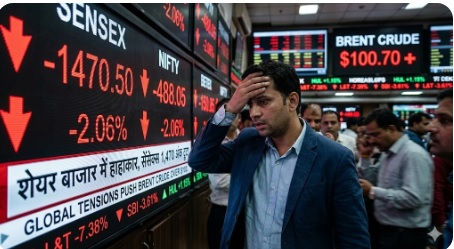
Domestic equity benchmarks ended moderately lower on Friday, snapping a two-session winning streak as investors turned cautious amid mounting inflationary pressures, a sharply weakening rupee and uncertainty surrounding the pace of global economic recovery. Profit booking in heavyweight sectors such as metals, oil & gas and public sector banks dragged the market lower, while selective buying in information technology stocks limited deeper losses.
Market sentiment remained fragile throughout the session as the Indian rupee breached the psychologically significant 96-per-dollar mark for the first time, reflecting persistent pressure from elevated crude oil prices, widening trade deficits and sustained foreign fund outflows. Rising fuel prices and fears of imported inflation also weighed heavily on investor confidence.
The benchmark S&P BSE Sensex declined 160.73 points, or 0.21 per cent, to close at 75,237.99, while the NSE Nifty 50 fell 46.10 points, or 0.19 per cent, to settle at 23,643.50. Despite Friday’s decline, the indices still ended the week with gains after advancing strongly over the previous two sessions. Over the past two trading days, the Sensex had risen 1.13 per cent and the Nifty had gained 1.33 per cent.
The Nifty slipped below the 23,650 level as selling pressure intensified in metal counters and PSU banking stocks. Among the major laggards were Hindalco Industries, which fell 3.47 per cent, Reliance Industries, down 1.67 per cent, and State Bank of India, which ended marginally lower.
Broader markets underperformed the frontline indices, indicating weakness in overall market breadth. The BSE MidCap index fell 0.48 per cent, while the SmallCap index declined 0.37 per cent. On the NSE, declining shares significantly outnumbered advancing ones, reflecting risk aversion among investors amid growing macroeconomic concerns.
Analysts said the market was caught between strong corporate earnings on one side and deteriorating macroeconomic indicators on the other. Rising inflation, higher fuel costs and concerns over global interest rates have begun overshadowing the optimism generated by recent quarterly earnings.
A major concern for investors was the sharp depreciation in the rupee. In the foreign exchange market, the partially convertible rupee weakened to 95.86 against the US dollar, after touching an all-time low of 96.14 during intra-day trade. Currency traders attributed the weakness to strong dollar demand from oil importers, rising crude prices and sustained capital outflows from emerging markets.
The weakness in the rupee has amplified fears of imported inflation at a time when wholesale prices are already accelerating. Market participants are increasingly worried that a weaker currency could make crude oil, industrial raw materials and electronic imports more expensive, thereby adding further pressure on domestic inflation.
Fuel prices added to these concerns after oil marketing companies raised petrol and diesel prices across the country by up to ₹3 per litre with immediate effect. In Mumbai, petrol prices climbed to ₹106.68 per litre while diesel rose to ₹93.14 per litre. LNG prices were also increased by ₹2 per kilogram. The hikes come amid rising global crude oil prices and a sharp acceleration in wholesale fuel inflation during April.
Brent crude futures for July 2026 delivery surged 2.76 per cent to $108.64 per barrel, intensifying concerns over India’s import bill and inflation outlook. Analysts warned that if crude prices remain elevated for an extended period, both the fiscal deficit and consumer inflation could face additional stress.
India’s macroeconomic data also reflected growing pressure on the external sector. The country’s trade deficit widened sharply to $28.38 billion in April compared with $20.67 billion in March, as imports rose faster than exports. Merchandise exports increased to $43.56 billion from $38.92 billion in the previous month, while imports jumped to $71.94 billion from $59.59 billion.
However, the Commerce Ministry pointed out that exports grew more than 13 per cent year-on-year in April, marking one of the strongest monthly performances in nearly a decade. Economists noted that while export growth remains encouraging, rising import costs — particularly crude oil and electronics — continue to widen the trade gap and pressure the rupee.
Bond markets also reflected inflation concerns. The yield on India’s benchmark 10-year government bond rose to 7.076 per cent from the previous close of 7.021 per cent, indicating expectations that interest rates may remain elevated for longer. Rising bond yields generally reduce the attractiveness of equities, especially in rate-sensitive sectors.
Gold prices, however, witnessed profit booking after recent record highs. MCX Gold futures for June delivery declined 1.79 per cent to ₹1,59,154 per 10 grams as investors booked gains amid a stronger US dollar.
Globally, market sentiment remained cautious despite overnight gains on Wall Street. European markets traded lower after fresh US inflation data reinforced expectations that the US Federal Reserve may maintain higher interest rates for a prolonged period. Political uncertainty in the United Kingdom also weighed on investor sentiment, with Prime Minister Keir Starmer reportedly facing growing internal pressure within the Labour Party.
Asian markets ended mostly lower as investors monitored the second day of high-level talks between US President Donald Trump and Chinese President Xi Jinping in Beijing. Media reports suggested that discussions focused on trade, technology access, Taiwan and geopolitical tensions in the Middle East, including the strategic importance of keeping the Strait of Hormuz open.
Overnight, US markets had closed firmly higher, supported by strong corporate earnings and optimism surrounding the US-China discussions. The Dow Jones Industrial Average reclaimed the 50,000 mark, while the S&P 500 and Nasdaq Composite touched fresh record highs. Shares of Cisco Systems surged after better-than-expected earnings, while Nvidia gained on reports that the US had approved exports of H200 chips to selected Chinese firms.
On the domestic corporate front, several stocks remained in focus following quarterly earnings announcements. Nazara Technologies rallied sharply after large block deals reportedly involving investor Nikhil Kamath and existing shareholder Axana Estates LLP. Hindustan Zinc declined amid weakness in silver prices following stronger-than-expected US inflation data.
United Spirits gained after reporting robust growth in quarterly profit, while Pearl Global Industries, Sheela Foam and Kalpataru Projects International also posted strong earnings-led gains. On the other hand, Dilip Buildcon and Indian Hume Pipe Company witnessed sharp declines after reporting weaker-than-expected financial performance.
Market experts believe volatility is likely to remain elevated in the near term as investors closely track inflation trends, currency movements, crude oil prices and signals from major central banks. Attention will also remain on the progress of the southwest monsoon after the India Meteorological Department forecast its onset over Kerala around May 26, slightly earlier than the usual schedule. A normal monsoon is considered critical for controlling food inflation and supporting rural demand.
With inflation concerns resurfacing globally and geopolitical tensions remaining unresolved, analysts expect investors to remain cautious despite strong domestic corporate earnings.
Stocks in the Spotlight: Q4 Corporate Earnings Breakdown
- Nazara Technologies: Surged 12.69% to Rs 300.10 following a massive block deal on the BSE involving over 4% of its total equity. Reports indicate Zerodha co-founder Nikhil Kamath and Axana Estates LLP were major accumulators, while founder Nitish Mittersain was the primary seller.
- Hindustan Zinc: Plunged 4.97% to lead the metal index declines, severely affected by a sharp downward correction in global spot silver prices tied to US monetary tightening expectations.
- United Spirits: Advanced 3.34% after declaring a robust 26.61% YoY jump in standalone net profit to Rs 571 crore for Q4 FY26, supported by a 3.39% growth in operational revenue (excluding excise duty) to Rs 3,046 crore.
- Pearl Global Industries: Rallied 9.89% on the back of a strong Q4 FY26 performance. Consolidated PAT improved 24.61% YoY to Rs 81 crore, while operational revenue increased 6.92% to Rs 1,314 crore.
- Sheela Foam: Rocketed 11.90% after posting a massive six-fold increase in consolidated net profit to Rs 91.28 crore for Q4 FY26, up from Rs 13.08 crore in Q4 FY25. Revenue expanded 23.59% YoY to Rs 1,050.06 crore, driven by robust volume expansions across both foam and mattress business units.
- Apollo Tyres: Slipped 1.75% despite booking a stellar 241.76% YoY surge in consolidated net profit to Rs 630.97 crore for the final quarter of FY26. Net revenue grew 14.19% YoY to Rs 7,335.67 crore, though institutional profit-taking limited equity gains.
- Kalpataru Projects International: Rallied 2.55% as its consolidated net profit for Q4 FY26 surged 92.63% YoY to Rs 434.21 crore. Operational revenue moved up 10.06% to settle at Rs 7,777.90 crore.
- Dilip Buildcon: Shed 6.44% following a weak earnings report; consolidated net profit for Q4 FY26 contracted 63.67% to Rs 62.05 crore, while operational revenues dropped 25.71% YoY to Rs 2,299.80 crore.
- Solara Active Pharma Sciences: Vaulted 13.66% after booking a consolidated net profit of Rs 9.60 crore in Q4 FY26, successfully reversing a net loss of Rs 2.10 crore recorded in Q4 FY25. Total revenue from operations expanded by an impressive 41.86% to Rs 387.29 crore.
- Indian Hume Pipe Company: Corrected 4.83% after reporting a 95.39% contraction in Q4 net profit to Rs 22.98 crore, amid a 10.40% decline in operational revenues to Rs 351.29 crore.
- Allcargo Logistics: Lost 2.54% following a 20% decline in Q4 FY26 consolidated net profit to Rs 20 crore, while total income dipped 1.31% YoY to Rs 525 crore.