
Last Updated on October 13, 2026 10:41 pm by INDIAN AWAAZ
Andalib Akhter / New Delhi
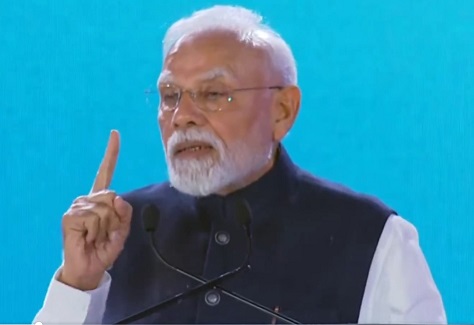
Prime Minister Narendra Modi on Tuesday presented India as a source of economic stability and a reliable partner for global businesses amid geopolitical tensions, supply-chain disruptions and growing uncertainty in international trade.
Addressing the Bloomberg New Economy Forum in New Delhi, PM highlighted the country’s economic growth, strong foreign exchange reserves, expanding digital infrastructure, renewable energy investments and continuing structural reforms as key pillars of its transformation.
Citing economic indicators, Modi said India recorded 7.8 per cent growth in the April-June quarter, while its current account deficit had narrowed to 0.61 per cent and foreign exchange reserves had crossed $700 billion. He also pointed to the strength of the domestic banking system, arguing that these fundamentals positioned India to withstand external shocks and offer greater predictability to investors.
The Prime Minister’s address centred on the idea of “Power to Empower”, which he described as a guiding principle for India’s economic development and international engagement. He argued that economic and technological power should not be concentrated in the hands of a few but should expand opportunities for businesses, households, entrepreneurs and communities.
“For us, reforms are not a compulsion. They are a conviction,” Modi said, underscoring the government’s approach to structural changes aimed at improving the business environment and strengthening the economy.
Global uncertainty raises the premium on reliable partners
Modi’s address came against the backdrop of successive global disruptions, including the Covid-19 pandemic, regional conflicts and interruptions to supply chains for energy, critical minerals and other essential goods. He warned that economic interdependence was increasingly being used as an instrument of geopolitical pressure, turning supply chains, technology and payment systems into potential vulnerabilities.
The Prime Minister said businesses and governments were looking for reliable partners that could maintain supply lines and honour commitments during periods of crisis. India, he argued, was seeking to distinguish itself through cooperation rather than economic expansion at the expense of other countries.
“We do not grow at anyone’s cost. We grow with the world, and for the world,” he said.
For global investors, the message was that India intends to combine domestic economic growth with deeper integration into international production, services and technology networks. The emphasis on reliability also reflects the growing importance of supply-chain diversification as companies seek to reduce excessive dependence on individual countries or regions.
Modi cited India’s role in supplying generic medicines, its digital identity infrastructure and the presence of more than 2,000 global capability centres (GCCs) as examples of the country’s contribution to the world economy.
The GCC ecosystem has become an important part of India’s services economy, with multinational companies using Indian centres for technology development, research, analytics, finance and other specialised functions. The Prime Minister presented this position as evidence that India’s growth is increasingly linked to global business operations rather than domestic demand alone.
Digital infrastructure expands economic participation
A major theme of the address was the use of digital technology to widen access to markets, financial services and public programmes.
Modi said that mobile connectivity and internet access had been relatively expensive and inaccessible to large sections of the population just over a decade ago. The reduction in data costs since 2014, he argued, had helped students, small-town entrepreneurs, shopkeepers and rural communities access information and economic opportunities.
He also highlighted the expansion of digital payments, noting that small street vendors and large commercial establishments could use the same technological infrastructure. The development, he said, demonstrated how digital public infrastructure could reduce barriers to participation in the formal economy.
The government’s broader digital inclusion strategy includes the JAM framework, linking Jan Dhan bank accounts, Aadhaar and mobile connectivity, alongside direct benefit transfers (DBT). According to Modi, these mechanisms have enabled government assistance to reach beneficiaries directly, reducing opportunities for leakage and making the delivery of welfare benefits more convenient.
The economic significance of these systems extends beyond payments. Digital access can lower transaction costs, improve the reach of public services and make it easier for small businesses to connect with customers and financial institutions. Their effectiveness, however, also depends on reliable connectivity, consumer protection, cybersecurity and the ability of less digitally equipped citizens to access services.
The Prime Minister said India’s digital capabilities were also being shared with partner countries, particularly in the Global South, to support the development of their own digital public infrastructure. He cited the CoWIN platform, developed for India’s Covid-19 vaccination programme, as an example of domestic technology with wider international applications.
Startups and financial inclusion drive innovation
Modi highlighted the expansion of India’s startup ecosystem, saying the number of startups had increased from a few hundred in 2014 to more than 2.5 lakh. He added that nearly half were based in smaller cities and more than 45 per cent had at least one woman director.
The figures, as presented by the Prime Minister, reflect the government’s emphasis on widening access to entrepreneurship beyond established business centres. Smaller cities can provide new sources of talent and local innovation, although the sustainability of startup growth will also depend on access to capital, market opportunities and the ability of young companies to scale up.
Modi linked this expansion to the broader principle that governance should equip citizens to become economically independent rather than create long-term dependence on the state. He said government initiatives had helped lift 25 crore people out of poverty over the past decade.
He also pointed to the use of direct benefit transfers as a way to establish a more direct relationship between the government and citizens. The focus on targeted transfers and digital delivery has become an important part of India’s public expenditure management, although the overall impact of welfare programmes must be assessed alongside income, employment and other development indicators.
Green energy emerges as a growth opportunity
The energy transition formed another important part of the Prime Minister’s presentation. Modi said India had exceeded its commitment under the 2015 Paris Agreement to achieve 40 per cent of installed electricity capacity from non-fossil-fuel sources by 2030, reaching the milestone in November 2021.
He also cited an increase in renewable energy capacity from about 75 gigawatts in 2014 to approximately 300 gigawatts at present, describing the expansion as a major change in India’s energy trajectory.
The figures refer to installed capacity, not the actual share of electricity generated from renewable sources. The distinction is important because power generation also depends on weather conditions, grid availability, storage capacity and the contribution of different energy sources.
Modi highlighted the PM Surya Ghar and PM-KUSUM schemes, which seek to encourage rooftop solar installations and solar power use in agriculture. He said these initiatives had added more than 30 gigawatts of capacity and were helping households and farmers reduce energy costs, while cutting annual carbon emissions by more than 30 million tonnes.
For businesses, the transition presents opportunities in solar manufacturing, project development, energy storage, transmission infrastructure and related technologies. At the same time, sustaining the expansion will require investment in grid modernisation, storage, financing and reliable power distribution.
The Prime Minister also referred to India’s international initiatives, including the International Solar Alliance, the Coalition for Disaster Resilient Infrastructure and the Global Biofuel Alliance. He said such platforms were intended to support cooperation on shared challenges rather than serve narrow national interests.
Reforms aim to strengthen the investment climate
Modi attributed India’s economic resilience to a series of structural reforms, including the Goods and Services Tax (GST), insolvency legislation, labour law consolidation and the decriminalisation of hundreds of minor business offences.
The GST, introduced in 2017, replaced a range of central and state indirect taxes with a common framework, helping create a more integrated national market. Its implementation has also involved continuing adjustments to rates, compliance requirements and revenue-sharing arrangements.
The Insolvency and Bankruptcy Code established a framework for resolving distressed businesses and recovering value from defaulting companies. The consolidation of 29 central labour laws into four labour codes was intended to simplify the regulatory framework, although the practical impact depends on implementation and the rules adopted by the Centre and states.
Decriminalising minor business-related offences is part of the broader effort to reduce compliance burdens and encourage entrepreneurship. For investors, the effectiveness of these measures will ultimately depend on predictable regulation, timely dispute resolution, contract enforcement and the ease of operating across states.
The Prime Minister said recent sovereign rating upgrades reflected the country’s structural strength and reform momentum. Such assessments, however, also depend on fiscal management, debt sustainability, inflation, external vulnerabilities and the medium-term growth outlook.
Manufacturing and global cooperation
Recalling India’s response to vaccine shortages during the pandemic, Modi said the country had supplied vaccines to more than 100 countries. He presented this as an example of how domestic manufacturing capabilities could also support international public health.
He also stressed that growing technological capabilities should be accompanied by responsibility, particularly in areas such as artificial intelligence, climate change, water management and emerging technologies. Referring to discussions at a recent AI Impact summit, he said the potential applications of artificial intelligence extended beyond human needs to areas such as animal welfare.
The address concluded with a call for a global economic order that combines innovation and competition with cooperation and shared responsibility. Modi invoked the principles of “One Sun, One World, One Grid”, “One Earth, One Family, One Future” and “One Earth, One Health” to underline India’s approach to international partnerships.
For the business community, the central message was that India seeks to position itself not only as a large and growing market but also as a source of technology, skilled talent, manufacturing capacity and digital infrastructure.
The challenge will be to translate strong headline growth and expanding infrastructure into sustained productivity gains, higher-quality employment, competitive manufacturing and wider household prosperity. India’s ability to maintain macroeconomic stability while addressing these structural priorities will remain critical to its ambition of becoming a more influential force in the global economy.