
Last Updated on September 29, 2026 9:26 pm by INDIAN AWAAZ
By Our Business Correspondent
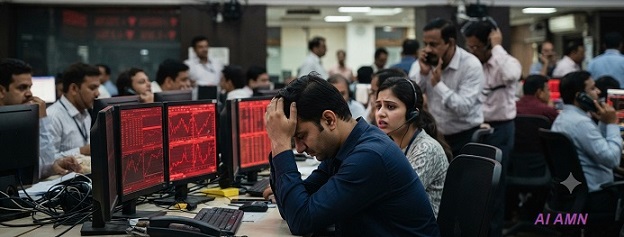
Indian equity markets closed lower for the second consecutive trading session on Tuesday as investors grappled with a combination of domestic and global uncertainties. Concerns surrounding the ongoing geopolitical tensions involving Iran, sustained foreign institutional investor (FII) selling, rising crude oil prices, weakness in the rupee and elevated global bond yields prompted investors to remain cautious. Volatility linked to the derivatives expiry session further added to market fluctuations, resulting in another day of losses for benchmark indices.
The domestic market witnessed broad-based selling pressure, particularly in information technology, consumer durables and automobile stocks. Although buying interest emerged in select metal and pharmaceutical counters, it was insufficient to offset weakness in heavyweight stocks and the broader market.
The BSE Sensex declined 242.65 points, or 0.33 per cent, to settle at 72,529.07, while the NSE Nifty 50 slipped 64.05 points, or 0.28 per cent, to close at 22,716.20, ending below the psychologically important 22,750 mark. Over the past two sessions, the Sensex and Nifty have fallen by nearly 1.85 per cent and 1.83 per cent respectively, reflecting growing investor nervousness.
Heavyweights Drag Market
Among frontline stocks, Titan Company emerged as one of the biggest laggards, falling nearly 3 per cent. Reliance Industries declined 1.30 per cent, while ICICI Bank lost 0.75 per cent, jointly contributing significantly to the benchmark indices’ decline.
Market participants observed that profit-booking in several large-cap counters continued as investors preferred to reduce exposure amid uncertainty in global markets.
While select commodity-linked stocks witnessed buying support, the broader tone of trading remained defensive, with investors shifting toward sectors perceived as relatively resilient during periods of uncertainty.
Broader Markets Underperform
The weakness was more pronounced beyond benchmark indices. The BSE MidCap Index lost 0.74 per cent, while the BSE SmallCap Index shed 0.49 per cent. The decline indicated that selling pressure extended across the market and was not confined to a handful of heavyweight stocks.
Market breadth remained decisively negative. On the National Stock Exchange, declining shares significantly outnumbered advancing stocks. Around 2,038 stocks closed lower, compared with 1,529 gainers, while 112 stocks remained unchanged.
The broader market’s underperformance suggested that investors were increasingly adopting a risk-averse stance amid uncertain global developments.
Volatility Indicator Eases
Despite the weak market sentiment, the India VIX, often referred to as the market’s fear gauge, eased by 2.32 per cent to 13.32. The decline indicated that while investors remained cautious, panic levels were largely contained.
Analysts noted that volatility levels continue to remain within a manageable range, though geopolitical developments and global macroeconomic indicators could trigger sharper moves in the coming sessions.
Global Factors Continue to Dominate Sentiment
International developments remained the key driver of investor behaviour. Concerns related to the ongoing Iran-related geopolitical crisis continued to dominate market discussions. Investors closely monitored developments surrounding the possibility of a peace agreement and the implications for energy supplies and global trade.
Rising crude oil prices have become a major concern for emerging markets, including India, which remains heavily dependent on energy imports. Higher oil prices raise inflationary pressures, increase import bills and potentially worsen fiscal and current-account balances.
Adding to concerns, the US Treasury market continued to witness elevated yields. Higher yields increase the attractiveness of American assets relative to emerging markets and often encourage foreign investors to pull money out of riskier markets.
Currency, Bond and Commodity Markets
In the currency market, the Indian rupee remained under pressure but managed a marginal recovery during the session. The partially convertible rupee traded around 95.95 against the US dollar, compared with 95.97 in the previous session.
Meanwhile, commodity markets provided mixed signals. Brent crude oil for November 2026 settlement traded around $105 per barrel, maintaining pressure on energy-importing economies despite a slight decline during the session.
Gold prices also edged lower. MCX Gold futures for October 2026 settlement declined 0.11 per cent to Rs 1,46,645 per 10 grams, reflecting a mixed response from investors assessing both safe-haven demand and interest-rate expectations.
The US Dollar Index, which measures the greenback against a basket of major currencies, strengthened to 101.43, highlighting continued demand for the US currency amid global uncertainty.
Global Markets Mixed
European markets traded higher, led by gains in technology shares. Investors in the region looked past inflation concerns after preliminary data showed that Spain’s annual inflation rate accelerated to 4.9 per cent in September from 4.3 per cent in August. The increase was largely attributed to rising fuel prices, reflecting the impact of energy market disruptions linked to Middle East tensions.
In contrast, Asian markets ended mostly lower, mirroring the weakness seen overnight on Wall Street. Higher oil prices, rising US bond yields and geopolitical uncertainty dampened investor appetite for risk assets across the region.
US markets had closed lower in the previous session. The Dow Jones Industrial Average fell 0.67 per cent, while the S&P 500 and Nasdaq Composite declined 0.77 per cent and 0.92 per cent respectively.
OpenAI Development Adds to Tech Concerns
Technology shares globally also remained under pressure following reports that OpenAI had paused training of some advanced artificial intelligence models. The development triggered concerns regarding the pace of AI-related investment and future demand for semiconductor and data-centre infrastructure.
This uncertainty contributed to weakness in global technology stocks and indirectly affected investor sentiment toward IT counters in India.
Focus on US Economic Data
Investors are now closely tracking upcoming US labour-market data, particularly the JOLTS job openings report, which could provide fresh clues regarding the direction of monetary policy. Market participants are also awaiting comments from Federal Reserve officials for signals on interest-rate expectations.
The prospect of additional US rate hikes remains one of the most significant risks for global equity markets, particularly emerging economies that rely heavily on foreign capital inflows.
Varmora Granito Makes Positive Debut
In the primary market, newly listed Varmora Granito delivered a modest but positive debut on the BSE. The stock listed at Rs 152, representing a premium of about 2.7 per cent over its issue price of Rs 148.
During the day’s trading, the stock touched a high of Rs 163.45 and a low of Rs 148 before ending near Rs 152.80, reflecting a listing gain of over 3 per cent. Trading activity remained strong, with more than 56 lakh shares changing hands.
Stocks in Spotlight
Among individual counters, PB Fintech emerged as one of the biggest losers, tumbling over 6 per cent and extending its four-day decline to nearly 43 per cent. The stock has remained under severe pressure following concerns surrounding proposed changes in insurance distribution regulations.
Azad Engineering gained more than 7 per cent after announcing the inauguration of two dedicated manufacturing facilities catering to GE Vernova’s Gas Power business. Investors welcomed the capacity expansion and the company’s strengthening relationship with a global industrial major.
Rays of Belief surged over 13 per cent after reporting a sharp turnaround in profitability during the first quarter of FY27, supported by strong growth in both domestic and US revenues.
Krsnaa Diagnostics climbed more than 4 per cent after its board approved the sale of selected diagnostic equipment worth up to Rs 120 crore.
Symbiotec Pharmalab advanced over 8 per cent after receiving an Establishment Inspection Report from the US Food and Drug Administration for its Madhya Pradesh manufacturing facility.
Meanwhile, Pashupati Cotspin hit the upper circuit limit after announcing that its board would consider a proposal for bonus shares.
IPO Market Remains Robust
Despite secondary market weakness, investor appetite for public issues remained exceptionally strong. Orient Cables (India) emerged as the standout offering, attracting subscriptions of nearly 92 times. German Green Steel and Power witnessed subscription of over 28 times, reflecting continued enthusiasm for quality offerings.
Other issues, including Runwal Enterprises, SRIT India and AceVector, also received healthy investor participation. Market observers noted that robust IPO demand indicates sustained liquidity and confidence in select growth-oriented businesses despite broader market volatility.
Outlook
Market experts believe investor sentiment is likely to remain influenced by global developments, especially crude oil prices, US bond yields and geopolitical events in the Middle East. The direction of foreign fund flows, movements in the rupee and upcoming economic data from the United States will be crucial in determining market trends. Until greater clarity emerges on these fronts, volatility is expected to remain elevated, keeping investors cautious in the near term.
Disclaimer: This article is only for journalistic reporting purposes. It is not investment advice. Readers are advised to consult certified financial professionals before making investment decisions.