
Last Updated on October 7, 2026 10:22 pm by INDIAN AWAAZ
By Our Business Correspondent
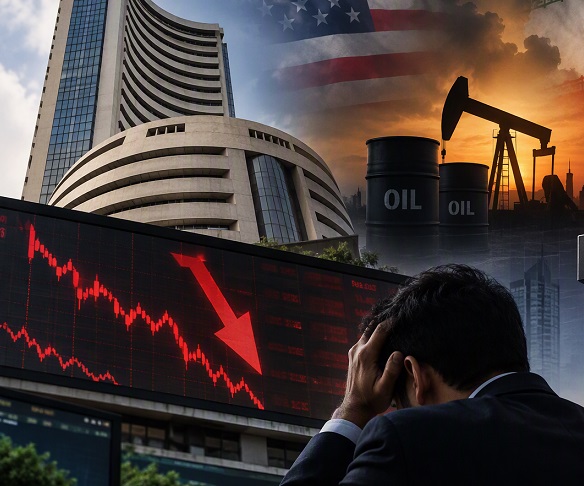
Indian equity markets ended sharply lower on Wednesday as investors reacted cautiously to the Reserve Bank of India’s decision to raise the policy repo rate by 25 basis points and shift its monetary policy stance toward calibrated tightening. The decline was further aggravated by weak global cues, rising bond yields, higher crude oil prices, and concerns surrounding geopolitical tensions in the Middle East.
After posting strong gains over the previous two sessions, benchmark indices witnessed profit booking across sectors, with information technology, infrastructure, metals and automobiles leading the downturn. Banking stocks offered limited support, preventing a steeper fall.
The BSE Sensex declined 429.11 points, or 0.59%, to close at 72,638.70, while the Nifty 50 fell 173.05 points, or 0.76%, to settle at 22,603.05, slipping below the important 22,650-mark. The correction comes after a strong rally during the last two trading sessions, when the Sensex and Nifty had gained over 1.6% each.
Market participants said investors chose to lock in profits after the RBI’s rate action, even though the move was largely in line with market expectations.
RBI Tightening Signals Higher Cost of Funds
The key trigger for market weakness was the outcome of the RBI’s Monetary Policy Committee (MPC) meeting. The central bank unanimously voted to raise the repo rate by 25 basis points to 5.50% from 5.25%, marking the first policy rate increase in nearly three years.
More importantly, the RBI changed its policy stance from “neutral” to “calibrated tightening”, indicating that controlling inflation and maintaining macroeconomic stability have become higher priorities amid evolving global risks.
The Standing Deposit Facility (SDF) rate was increased to 5.25%, while the Marginal Standing Facility (MSF) rate and Bank Rate were retained at 5.75%.
Market strategists believe that while the rate hike was anticipated, the shift in policy stance prompted investors to reassess expectations regarding future liquidity conditions and borrowing costs. Higher interest rates generally increase financing costs for businesses and can affect consumption and investment demand, particularly in interest-sensitive sectors.
Broader Markets Also Under Pressure
Selling pressure extended beyond frontline indices, highlighting a broad-based risk-off sentiment.
The BSE MidCap Index declined 0.64%, while the BSE SmallCap Index edged lower by 0.02%. Market breadth remained negative, underscoring weakness across a large section of listed stocks.
On the BSE, 2,360 shares ended lower, compared with 2,013 advancing stocks, while 248 shares remained unchanged.
Meanwhile, the India VIX, often referred to as the market’s fear gauge, rose 2.25% to 13.93, indicating higher expectations of near-term volatility.
IT, Infrastructure and Financial Stocks Drag Indices
Among the major index constituents, Infosys, Larsen & Toubro, and HDFC Bank emerged as the biggest contributors to the day’s losses.
Infosys fell 2.16% as investors booked profits in technology stocks after recent gains. L&T slipped 1.82%, while HDFC Bank lost 1.22%, weighing significantly on benchmark indices.
The metal and automobile sectors also witnessed notable selling pressure amid concerns over rising input costs and global economic uncertainties.
Global Factors Add to Investor Concerns
Apart from domestic monetary tightening, global developments also kept investors on edge.
Brent crude oil surged above the psychologically important $100 per barrel mark, reaching $101.93, amid concerns over supply disruptions linked to ongoing geopolitical tensions in the Middle East. Higher crude prices are a key concern for India, which imports a significant portion of its energy requirements. Rising oil prices generally increase inflationary pressures and widen the country’s trade deficit.
Adding to the caution, the yield on the benchmark US 10-year Treasury note climbed to 5.315%, reflecting expectations that global interest rates may remain elevated for longer. Bond yields move inversely to prices and often compete with equities for investor capital.
India’s benchmark 10-year government bond yield also moved higher to 7.222%, reflecting concerns over tighter financial conditions.
The foreign exchange market also reflected risk aversion, with the rupee weakening against the US dollar. The domestic currency hovered near 96.79 per dollar, compared with its previous close of 96.36.
Gold prices declined as the stronger dollar reduced the appeal of the precious metal. MCX Gold futures for December delivery slipped 0.40% to ₹1,51,800 per 10 grams.
The US Dollar Index (DXY) rose to 102.28, indicating continued strength in the greenback against major global currencies.
Global Markets End Mostly Lower
Asian markets ended in negative territory as investors weighed elevated bond yields, geopolitical uncertainties and rising oil prices. Chinese markets remained closed due to a public holiday.
European markets also traded lower after comments from IMF Managing Director Kristalina Georgieva highlighted the need for France to bring down its budget deficit to restore confidence in its fiscal credibility.
US stock futures pointed to a weak opening on Wall Street, with Dow futures falling more than 250 points during Asian trading hours.
Despite Wednesday’s weak sentiment, US markets had ended higher in the previous session. Both the S&P 500 and Nasdaq Composite closed at fresh record highs, supported by easing Treasury yields and sustained enthusiasm surrounding artificial intelligence-related investments.
Technology giants and semiconductor companies remained major drivers of the US rally, with investors continuing to bet on growing demand for AI infrastructure, data centres and advanced chips.
Corporate Earnings and Business Updates Drive Stock-Specific Action
Several stocks remained in focus following corporate announcements and quarterly business updates.
Titan Drops After Growth Moderation
Titan Company fell nearly 4% after its second-quarter business update indicated a slowdown in jewellery segment growth. Although the company reported overall consumer business growth of 25% year-on-year and added 78 stores during the quarter, investors appeared concerned about moderation in jewellery growth from 39% in the first quarter to around 21% in the second quarter.
Kalyan Jewellers Shines
In contrast, Kalyan Jewellers gained 3.8% after reporting consolidated revenue growth of more than 26% year-on-year. Strong same-store sales growth and sustained demand in key markets boosted investor confidence.
Airtel Gains on Tariff Increase
Bharti Airtel rose 1.29% after announcing revised postpaid plans with higher monthly rentals. Investors welcomed the move as another step toward improving average revenue per user (ARPU) and strengthening profitability in the telecom sector.
Strong Rally in Mid and Small Caps
Several mid-cap and small-cap stocks witnessed notable gains on the back of strong earnings and expansion announcements.
Transformer manufacturer Kanohar Electricals surged nearly 14% after reporting a sharp jump in profit and revenue.
Utkarsh Small Finance Bank gained 3.4% following robust growth in loan disbursements during the quarter.
ARCIL hit its upper circuit after reporting strong revenue and profit growth.
PTC Industries rallied over 7% after launching a qualified institutional placement (QIP), while Marsons gained more than 11% after announcing plans for a joint venture aimed at expanding transformer operations in North America.
Outlook: Markets Await Global Signals
Analysts believe investors will closely monitor upcoming global developments, including the US Federal Reserve’s meeting minutes, inflation trends, oil prices and the start of the third-quarter earnings season.
Domestically, market attention will remain focused on the impact of the RBI’s policy tightening cycle on economic growth, corporate earnings and financial market liquidity. While India’s macroeconomic fundamentals remain relatively strong, elevated crude oil prices, rising global yields and tighter monetary conditions could keep market volatility elevated in the near term.
For now, Wednesday’s decline suggests that investors are becoming more selective and cautious after the recent rally, with global uncertainties and higher interest rates emerging as the dominant themes influencing market direction.
Disclaimer: Stock market investments are subject to market risks. Please consult with a certified financial advisor before making any investment decisions.