
Last Updated on October 7, 2026 11:36 am by INDIAN AWAAZ

Monetary Policy Decisions
The Monetary Policy Committee (MPC) held its 63rd meeting from October 5 to 7, 2026, under the chairmanship of Shri Sanjay Malhotra, Governor, Reserve Bank of India. The MPC members Dr. Nagesh Kumar, Shri Saugata Bhattacharya, Prof. Ram Singh, Dr. Poonam Gupta and Shri Indranil Bhattacharyya attended the meeting.
2. After a detailed assessment of the evolving macroeconomic and financial developments and the outlook, the MPC voted unanimously to increase the policy repo rate under the liquidity adjustment facility (LAF) by 25 bps to 5.50 per cent. Consequently, the standing deposit facility (SDF) rate stands adjusted at 5.25 per cent and the marginal standing facility (MSF) rate and the Bank Rate at 5.75 per cent. The MPC also decided to change the stance to calibrated tightening.
Growth and Inflation Outlook
Global Outlook
3. Since the last MPC meeting in August 2026, the re-escalation of the conflict in West Asia and the consequent sharp volatility in crude oil prices has kept the global economy in a state of flux. Global growth has remained resilient. Acceleration of inflation in key economies has prompted a shift towards hawkish monetary policy. The US Fed hiked by 25 bps in September. The Fed commentary thereafter along with rate tightening by major systemically important central banks have reinforced expectations of higher global policy rates. Tighter global financial market conditions coupled with fiscal sustainability concerns in major economies are keeping global bond yields at record high levels. With a resolution of the West Asia conflict remaining elusive, significant downside risks to the global outlook remain, including further tightening of global financial conditions, continuing elevated AI-related asset valuations and high public debt.
Domestic Outlook
4. Notwithstanding these persisting global headwinds, the Indian economy has remained resilient. As per National Statistics Office (NSO) estimates, real GDP growth in Q1:2026-27 at 7.8 per cent was higher than expected. Strong private consumption and fixed investment, rebound in merchandise exports and sustained buoyancy in services exports supported growth. On the supply side, the manufacturing sector grew at a robust pace. Services sector activity strengthened further, owing to buoyant domestic and external demand.
5. In Q2, available high frequency indicators for July-August suggest sustained momentum in domestic economic activity. Domestic demand remains resilient and is well supported by robust external demand with merchandise exports registering double-digit growth.
6. Looking ahead, global economic uncertainty will continue to have some bearing on domestic economic activity. While energy prices and supply chain pressures have continued, their near-term trajectory remains uncertain amidst the lingering West Asia conflict. Their adverse impact is being contained with active diversification of supply sources. Deficient south-west monsoon and strong El Niño conditions pose risks to agriculture sector’s outlook and rural demand, although healthy buffer of foodgrains and proactive policy interventions by the government are expected to mitigate the impact. Furthermore, continuing momentum in services and broadly stable employment conditions are likely to support urban demand. Strong capacity utilisation, robust credit flows and the government’s thrust on infrastructure are expected to sustain investment activity. While services exports are expected to remain buoyant, bilateral trade agreements should boost merchandise exports.
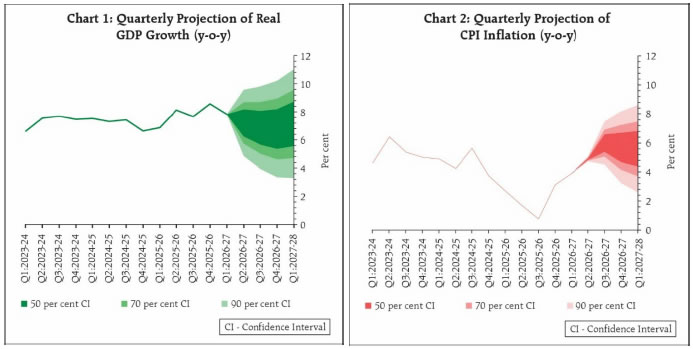
7. Taking all these factors into consideration, real GDP growth for 2026-27 is projected at 7.1 per cent, with Q2 at 7.2 per cent; Q3 at 6.9 per cent and Q4 at 6.8 per cent. Real GDP growth for Q1:2027-28 is projected at 7.1 per cent. The risks are evenly balanced (Chart 1).
8. CPI inflation increased to 4.8 per cent in August 2026 from 4.5 per cent in July. While the increase has been predominantly on account of higher inflation in food and fuel groups, core inflation has also picked up indicating some signs of widening price pressures. Food price increases have become more broad based along with notable spikes in certain items such as sugar and onion. The uptick in fuel inflation in August largely reflected unfavourable base effects. Core inflation increased to 4.2 per cent and core inflation, excluding precious metals, increased to 2.9 per cent in August. The weighted share of items in headline CPI recording inflation above 4 per cent increased steadily to about 37 per cent in August.
9. The near-term outlook on inflation points towards continued pressures from supply side on account of the deficient monsoon, ongoing El Niño conditions and high energy and other commodity prices, the pass through of which is still continuing. Considering all factors, CPI inflation is projected to be 5.2 per cent for 2026-27 with Q2 at 4.9 per cent; Q3 at 6.0 per cent; and Q4 at 5.7 per cent (Chart 2). Inflation for Q1:2027-28 is projected at 5.6 per cent with risks being evenly balanced. Core inflation is projected at 4.4 per cent for 2026-27.
Rationale for Monetary Policy Decisions
10. The MPC noted that the global context on account of geopolitical developments remains challenging. Nonetheless, the Indian economy has been strong. The economic momentum remains broad-based. The economy is expected to remain resilient.
11. In the light of available data, it is clear that inflation and its outlook are not benign as they were last year with headline CPI inflation expected to average almost 5.8 per cent in the next three quarters and core inflation projected at 4.4 per cent this year. In this milieu, recalibrating the policy rate is imperative.
12. As regards supply side inflation, monetary policy primarily acts by curtailing second round effects (inflation expectations and firm level pricing behaviour, etc.), which take time to manifest and are difficult to extract from available data. Apart from data related to inflation expectations and firm level pricing behaviour, indicators of generalisation of inflation like core inflation and diffusion indices are used for this purpose. It may, however, be kept in mind that it is difficult to distinguish between the second-round effects and the indirect impact of supply side pressures (in production cost through energy and other inputs) as both are present in these indicators. While there is some evidence of elevated inflation expectations and generalisation of inflation, there are only limited signs of supply side pressures getting embedded in pricing behaviour.
13. Similarly, while there is limited evidence of demand side pressures, risks in view of strong growth in monetary and credit aggregates exist.
14. Considering all these factors, the MPC unanimously voted to increase the policy repo rate by 25 basis points to 5.50 per cent. The MPC also decided to change the stance to calibrated tightening. It only signals that given the current conditions, rate cuts are off the table in the near term and policy action ahead can only be a rate hike or a pause, depending on the evolving conditions and the outlook. The duration and extent of rate hike cycle would be contingent on the actual growth-inflation developments and outlook, especially that of underlying inflation, the extent of broadening of price pressures and second round effects of the supply shock, as also the impact of demand impulses.
15. Two members – Dr. Nagesh Kumar and Prof. Ram Singh – were of the view that the stance be retained at neutral.
16. The MPC remains committed to its price stability mandate and will endeavour to progressively align inflation with its target.
17. The minutes of the MPC’s meeting will be published on October 21, 2026.
18. The next meeting of the MPC is scheduled for December 2 to 4, 2026.