
Last Updated on September 2, 2025 10:50 pm by INDIAN AWAAZ
By Arun Srivastava / Andalib Akhter
Rahul Gandhi’s “Vote Adhikar Rally” in Bihar has ignited a storm of political debate. Was it simply an outcry against alleged “vote rigging,” or a deeper strategy to reshape the state’s caste politics? Evidence points to the latter, with Gandhi aiming to reposition Congress as a meaningful player in Bihar’s fractured political landscape.
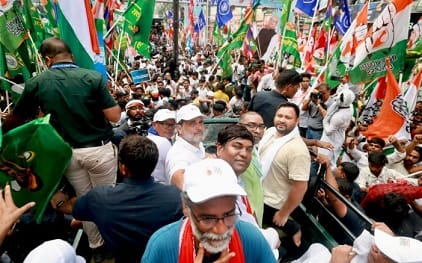
Rahul Gandhi’s recently concluded “Vote Adhikar Rally” in Bihar was more than just another stop in his ongoing political campaign. It was a calculated attempt to reset caste dynamics in the state, project opposition unity, and reposition Congress as a serious stakeholder in Bihar’s fiercely competitive politics. While the immediate headlines revolved around allegations of “vote rigging,” the underlying messaging and symbolism pointed to a deeper strategy—one that could potentially reshape alliances and voter alignments ahead of the 2025 Assembly and 2029 national elections.
Congress and Its Declining Base in Bihar
Bihar has traditionally been a stronghold of caste-based politics, with parties like the Rashtriya Janata Dal (RJD) and the Communist Party of India (Marxist–Leninist) [CPI(ML)] holding deep grassroots appeal. The RJD has long depended on the Muslim-Yadav (MY) vote bank, while CPI(ML) has successfully mobilized landless and left-leaning communities.
Congress, once the dominant force in Bihar politics, has steadily lost ground since the 1990s. Its vote share and organizational base have weakened considerably, a trend clearly reflected in the 2020 Assembly elections, where the party barely made a mark. To revive its presence, Congress needs not only alliances but also a fresh social base that extends beyond traditional voters.
Rahul Gandhi’s national outreach—especially his vocal advocacy for Scheduled Castes (SCs), Scheduled Tribes (STs), and Other Backward Classes (OBCs)—has helped the party regain some traction among marginalized groups. The Bihar rally was an extension of this effort, positioning Congress as a party ready to engage directly with caste equations rather than playing a secondary role to its allies.
Shifting Beyond the MY Equation
The most striking element of the rally was Gandhi’s deliberate effort to move beyond the Muslim-Yadav combine that forms RJD’s backbone. Instead, the Congress leader targeted Extremely Backward Classes (EBCs) and smaller caste communities that hold significant sway in Bihar’s politics.
A particularly symbolic gesture was his visit to makhana (fox nut) farmers—largely from the Mallah and Muslim communities. By highlighting their struggles, Gandhi drew attention to a caste group that often feels marginalized in mainstream political discourse. Interestingly, RJD’s Tejashwi Yadav was kept away from this visit, a move widely seen as a conscious attempt by Congress to reach out to non-Yadav OBCs without diluting RJD’s existing support.
This nuanced approach reflects Congress’s intent: while respecting the RJD’s MY vote base, it seeks to broaden the alliance’s appeal to castes that can swing outcomes in tightly contested seats.
Opposition Unity on Display
Equally significant was the rally’s strong emphasis on opposition unity under the INDIA alliance. Leaders such as Akhilesh Yadav of the Samajwadi Party and Tamil Nadu’s Chief Minister M.K. Stalin joined Rahul Gandhi on stage, sending out a clear message that despite differences, the alliance partners remain committed to presenting a united front against the BJP-JD(U) combine.
The optics were carefully managed. Gandhi’s entry on a bullet motorcycle, dressed in a plain T-shirt, was a clear attempt to connect with young voters and project energy, simplicity, and relatability. This contrasted with Prime Minister Narendra Modi’s image as a larger-than-life, authoritative leader, offering voters a different kind of political persona.
Women Voters in Focus
Another key subplot was the Congress’s outreach to women voters, who played a decisive role in ensuring Nitish Kumar’s return to power in 2020. To counter this advantage, the party showcased prominent women leaders, including Priyanka Gandhi Vadra and Rohini Acharya.
A viral video of Priyanka Gandhi riding pillion with Rahul Gandhi on a motorcycle added a personal, relatable touch to the campaign and helped boost the Congress’s appeal among young women. By placing women leaders at the center of its campaign narrative, Congress signaled a deliberate strategy to tap into this influential voter bloc.
Crowds vs. Ground Reality
The grand finale of the rally at Patna’s historic Gandhi Maidan was marked by an impressive turnout. Large crowds, however, do not automatically translate into votes. The real challenge lies in converting enthusiasm into electoral support, something the BJP has consistently excelled at through its disciplined organizational machinery and RSS-backed cadre network.
Congress, in contrast, continues to suffer from weak booth-level presence in Bihar. For this reason, RJD and CPI(ML) are expected to play the primary role in voter mobilization, leveraging their stronger grassroots networks. Without such organizational backing, Congress’s appeal risks remaining confined to optics rather than tangible votes.
The Road Ahead
The Vote Adhikar Rally was not just about electoral malpractice—it was about political positioning. Rahul Gandhi used the platform to demonstrate that Congress is no longer content to play second fiddle in Bihar. Instead, it wants to actively shape caste alignments, reach out to overlooked communities, and project itself as the binding force in the INDIA alliance.
Whether this strategy will succeed remains uncertain. Bihar’s caste politics are deeply entrenched, and the BJP-JD(U) alliance retains significant organizational strength. But Gandhi’s effort to broaden the alliance’s caste arithmetic and energize the opposition narrative has given Congress renewed relevance in a state where it was increasingly being written off.
Ultimately, Rahul Gandhi’s Bihar rally marked a shift in Congress’s approach—from reactive opposition to proactive strategy. By stepping beyond the traditional MY formula, amplifying the voices of marginalized communities, spotlighting women voters, and showcasing alliance unity, Gandhi has managed to reposition both himself and his party at the heart of Bihar’s political conversation.
The challenge now is execution: building grassroots structures, sustaining momentum, and ensuring that the symbolism of rallies is matched by real electoral gains. Only then will Congress’s renewed energy translate into meaningful results when Bihar goes to the polls.