
Last Updated on September 16, 2025 1:22 am by INDIAN AWAAZ
AMN / Doha
In an extraordinary move, Gulf Cooperation Council (GCC) leaders on Monday announced urgent joint defense measures in response to an unprecedented Israeli strike on Doha. Meeting under the chairmanship of the Amir of Qatar, HH Sheikh Tamim bin Hamad Al-Thani, the GCC Supreme Council agreed that the attack on Qatar was not only a violation of its sovereignty but also a direct threat to collective Gulf security.
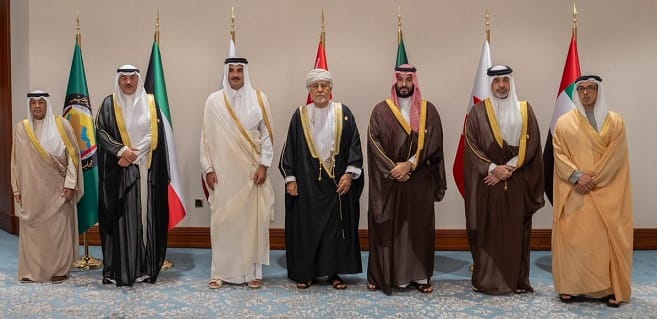
The high-level session in Doha gathered senior leaders from across the Gulf, including Saudi Crown Prince and Prime Minister Mohammed bin Salman, UAE Vice President Sheikh Mansour bin Zayed Al Nahyan, Bahrain’s Sheikh Abdullah bin Hamad Al Khalifa, Oman’s Deputy Prime Minister for Defense Affairs Sheikh Shihab bin Tarik, and Kuwait’s Crown Prince Sheikh Sabah Khaled Al-Sabah, alongside GCC Secretary-General Jasem Mohamed Albudaiwi.
At the core of the Council’s response was a directive for the GCC Joint Defense Council to hold an urgent meeting in Doha, preceded by the Higher Military Committee, to assess defense posture and activate collective deterrence capabilities. The Unified Military Command was tasked with preparing executive measures to ensure readiness in the face of further threats. Leaders stressed that under the GCC Basic Statute and Joint Defense Agreement, an attack on one member constitutes an attack on all, making Qatar’s security inseparable from that of the entire bloc.
The summit came in the wake of an Israeli airstrike on a residential area in Doha that killed Badr Saad Mohammed Al Humaidi Al Dosari, a Qatari security officer, and caused civilian injuries. The targeted site housed members of the Hamas political bureau engaged in ceasefire negotiations mediated by Qatar. The Council noted that the strike endangered civilians, as it occurred near schools, diplomatic missions, and kindergartens.
Leaders condemned the attack in the strongest terms, describing it as a dangerous escalation and a flagrant breach of international law and the UN Charter. They warned that continued Israeli actions could destabilize the Gulf, derail peace efforts, and undermine regional agreements. The Council called on the United Nations Security Council and the wider international community to impose sanctions and deter further violations.
While commending the swift response of Qatari civil defense and security authorities, the GCC warned that the attack obstructs Doha’s ongoing mediation role in Gaza, including efforts to negotiate a ceasefire, secure humanitarian access, and arrange the release of hostages and detainees. Such obstruction, they noted, only deepens regional instability.
The Council also reaffirmed broader principles of sovereignty, non-interference, and peaceful dispute resolution, urging Arab, Islamic, and friendly nations to stand firmly with Qatar. They highlighted Israel’s continuing violations in Gaza—displacement, starvation, and targeting of humanitarian workers—as part of a broader pattern requiring global accountability.
Concluding the session, the leaders pledged to harness all military, political, and diplomatic capabilities to defend Qatar and preserve regional security. They underscored that unity and collective defense remain the Gulf’s strongest safeguard against external aggression.