
Last Updated on July 27, 2025 5:39 pm by INDIAN AWAAZ
Staff Reporter / New Delhi
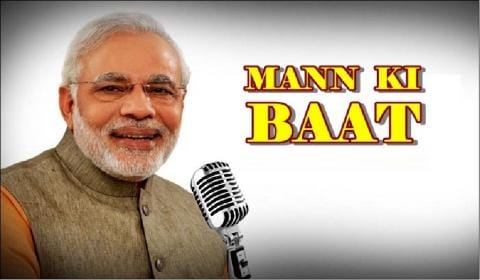
Prime Minister Narendra Modi, in the latest edition of his monthly radio program Mann Ki Baat, spoke at length on a wide range of subjects, celebrating India’s progress in science and technology, the resurgence of indigenous traditions, cultural preservation, and the nation’s growing global presence in sports and innovation.
The Prime Minister began by expressing immense pride at the strides India has made in space science. Referring to Indian Air Force Group Captain Shubhanshu Shukla’s return from space, he said the entire nation felt proud and inspired. “There was a wave of happiness when our astronaut landed safely,” he said, adding that such milestones encourage children to dream of becoming space scientists.
He recalled the landmark success of Chandrayaan-3’s landing in August 2023, which ignited a passion for space and scientific curiosity among students. In that spirit, he highlighted the INSPIRE-MANAK Abhiyan, a campaign that selects five innovative students from each school to present new ideas. “Lakhs of children have participated so far,” he said, noting the surge in space start-ups — from fewer than 50 five years ago to over 200 today.
Touching upon education and excellence, Mr. Modi celebrated the achievements of Indian students in global competitions. At the International Chemistry Olympiad held in Dubai, Devesh Pankaj, Sandeep Kuchi, Debdutt Priyadarshi, and Ujjwal Kesari won honors for India. Similarly, at the International Mathematical Olympiad in Australia, Indian students secured three golds, two silvers, and one bronze. He proudly noted that India is now making its mark in both the Olympics and Olympiads.
The Prime Minister announced that Mumbai will host the Astronomy and Astrophysics Olympiad next month, with participation from over 60 countries, making it the largest such event ever.
On the heritage front, PM Modi announced that UNESCO has granted World Heritage status to 12 Maratha forts — eleven in Maharashtra and one in Tamil Nadu. “Each fort narrates history, from Shivneri, where Chhatrapati Shivaji Maharaj was born, to Salher, where the Mughals were defeated,” he noted. He also referenced forts like Chittorgarh, Kumbhalgarh, Amer, Jhansi, and Kalinjar, urging citizens to visit them and engage with India’s rich historical legacy.
Linking the month of August to India’s revolutionary spirit, Modi paid homage to Khudiram Bose, who faced the gallows at age 18 with a smile. He also remembered Lokmanya Tilak on his death anniversary (1st August), the Quit India Movement (8th August), and the solemn occasion of Partition Horrors Remembrance Day (14th August), stating that Independence came through immense sacrifice.
The Prime Minister also spoke about the Swadeshi Movement of 1905 and its connection to the National Handloom Day celebrated on 7th August. This year marks the 10th anniversary of Handloom Day, and PM Modi praised the resilience and growth of the textile sector. He shared inspiring stories, including that of Kavita Dhawale from Maharashtra, who now sells her handmade Paithani sarees after receiving government support. Similarly, in Odisha’s Mayurbhanj district, over 650 tribal women have revived the Santhali saree tradition and are now earning a stable income.
“These women are not just making garments; they are weaving their identities,” the PM said. He also mentioned Naveen Kumar from Nalanda, whose family has preserved the art of handloom weaving for generations, and whose children now study handloom technology professionally.
With over 3,000 textile start-ups active in India, many promoting Indian handlooms globally, Mr. Modi asserted that the path to a developed India in 2047 depends on self-reliance. “We must be vocal for local and resolve to support Made-in-India products,” he said.
He also spoke about the cultural strength of India’s folk songs and devotional traditions. Highlighting the efforts of the Radhakrishna Sankirtan Mandali in Odisha’s Keonjhar district, he praised their creative campaign for forest fire awareness through adapted traditional songs.
On knowledge preservation, the Prime Minister emphasized the importance of ancient manuscripts. Citing Mani Maran of Tamil Nadu, who teaches people to read Tamil palm leaf manuscripts, he lauded efforts to connect the youth with India’s intellectual traditions. He announced the launch of the Gyan Bharatam Mission, which will digitize ancient texts and create a National Digital Repository for global access.
The PM also shed light on India’s biodiversity. He praised the first-ever Grassland Bird Census in Assam’s Kaziranga National Park, where more than 40 species were identified through tech-driven sound mapping.
Among other notable stories, he spoke of Om Prakash Sahu from Jharkhand’s Gumla district, who left the path of violence to become a fish farmer under the Pradhan Mantri Matsya Sampada Yojana. “Today, over 150 families in Basia block have joined fish farming. Many ex-Naxalites have become job creators,” he said.
Celebrating India’s performance at the World Police and Fire Games in the U.S., Modi revealed that Indian contingents won around 609 medals, ranking among the top three out of 71 countries. The next edition of the Games will be hosted by India in 2029.
PM Modi also acknowledged the public response to the Khelo Bharat Niti 2025, aimed at transforming India into a sporting powerhouse, especially with a focus on youth, girls, and rural talent.
He appreciated the upcoming completion of 11 years of the Swachh Bharat Mission, noting its transformation into a mass movement. He cited examples from Kirtinagar (Uttarakhand), Mangaluru, Roing (Arunachal Pradesh), Karad, and Ahmedabad for innovative waste and water management. Notably, he praised the “Sakaratmak Soch” group of 200 women in Bhopal for their weekly park cleaning drives, and similar efforts by citizen groups in Lucknow, Bilha (Chhattisgarh), and Panaji (Goa).
In his concluding remarks, the Prime Minister extended greetings on Hariyali Teej, and upcoming festivals including Nag Panchami, Raksha Bandhan, and Janmashtami, saying these occasions reflect India’s spiritual and emotional richness.