
Last Updated on May 17, 2026 6:20 pm by INDIAN AWAAZ
Staff Reporter / New Delhi
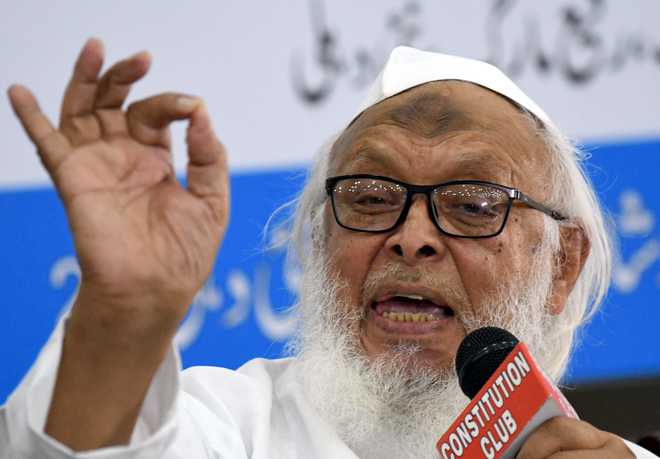
Jamiat Ulama-i-Hind president Maulana Arshad Madani on Sunday alleged that India is witnessing a dangerous shift from “politics of hatred” to “politics of intimidation,” where, according to him not only Muslims are being threatened but Islam is also being trageted.
Speaking at the Working Committee meeting of Jamiat Ulama-i-Hind in New Delhi, Maulana Madani said that while Muslims had faced riots, discrimination and social marginalisation under previous governments as well, the situation today was fundamentally different because “earlier Muslims were the target, but now Islam itself has become the target.” Madani alleged that laws introduced after 2014 and the current political discourse were aimed not only at isolating Muslims socially and politically, but also at weakening Islamic identity, religious institutions and constitutional protections linked to religious freedom.
Madani said the present atmosphere raises serious concerns over the supremacy of the Constitution and rule of law.
He claimed that efforts are being made to create fear among Muslims by conveying the message that they can live in the country only under “certain conditions,” while dissent or resistance could lead to legal action and imprisonment.
“The politics of fear and intimidation cannot sustain a democracy. Governments run through justice and fairness, not through threats,” he said.
Madani alleged that provocative speeches targeting Muslims were openly delivered during recent Assembly elections in states such as West Bengal and Assam. He criticized statements allegedly made by newly elected political leaders suggesting that governments would not work for communities that did not vote for them, calling such remarks contrary to constitutional values and democratic principles.
Referring to recent political and legal developments, the Jamiat chief alleged that constitutional institutions were failing to prevent attempts to transform India into an “ideological state.” He cited the implementation of the Uniform Civil Code in some states, proposals for similar legislation in Assam, and official decisions regarding the compulsory recitation of “Vande Mataram” in government and educational institutions.
Madani said mosques, shrines and madrasas were increasingly being declared illegal and demolished, while educational institutions associated with Muslims were facing constant scrutiny. He announced that Jamiat Ulama-i-Hind would establish madrasa boards at both central and state levels to coordinate and address issues concerning religious seminaries.
The organization also strongly opposed the Union Cabinet’s reported decision granting “Vande Mataram” a status equal to the national anthem “Jana Gana Mana” and making its recitation compulsory before official programs. Madani stated that the organization considers the move inconsistent with constitutional guarantees of religious freedom and secularism and would challenge it legally if required.
Expressing concern over the Special Intensive Revision (SIR) of electoral rolls, Madani alleged that the exercise was being used to target Muslims under the guise of voter verification. Referring to reports from West Bengal, he claimed that nearly 2.7 million voters had been marked as “doubtful,” with Muslims allegedly forming a large section of those affected.
He urged Muslims to remain alert, maintain proper documentation and fill official forms carefully to avoid legal complications. Volunteers of Jamiat Ulama-i-Hind, he said, would assist people during the verification process.
“It is not that previous governments did not discriminate against Muslims. Muslims faced riots and social, political and economic marginalisation earlier as well. But the difference now is that earlier Muslims were the target; today Islam itself has become the target,” he said.
According to him, laws introduced after 2014 and recent political discourse indicate attempts not only to isolate Muslims but also to weaken Islamic identity and institutions.
Madani also linked these developments to what he described as a broader global trend of hostility toward Islam. He claimed that the growing spread of Islam worldwide had alarmed anti-Islam forces, resulting in large-scale propaganda campaigns against the religion.
Drawing a historical comparison, Madani referred to the former Soviet Union, where, he said, communist authorities had once tried to eliminate Islam by shutting down mosques and religious institutions. Despite years of suppression, he noted, Islam survived while the Soviet Union itself eventually disintegrated, leading to the emergence of several Muslim-majority nations from its former territories.
“Those who attempted to erase Islam disappeared themselves, but Islam survived,” he remarked.
Madani asserted that Indian Muslims are patriotic citizens who have repeatedly proved their loyalty to the nation despite constant questioning of their nationalism. He said Muslims would never accept the status of second-class citizens and would continue to claim the constitutional rights guaranteed to them.
Concluding his address, the Jamiat chief said that oppression and injustice could not last forever and expressed hope that India would once again emerge as a country guided by justice, harmony and brotherhood.