
Last Updated on December 28, 2025 1:28 pm by INDIAN AWAAZ
A Akhter / New Delhi
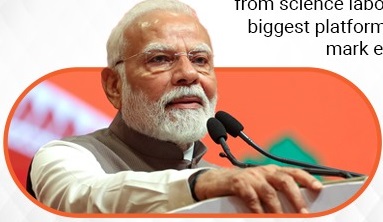
Prime Minister Narendra Modi, in his year-end edition of Mann Ki Baat on Akashvani, reflected on 2025 as a year that strengthened India’s confidence and global standing, while placing special emphasis on the promotion of Indian languages, particularly Tamil and Kannada, as symbols of the country’s rich cultural heritage.
Addressing the nation, the Prime Minister said that India left a strong imprint across diverse fields — from national security and sports to science, space and cultural revival. He noted that the year offered countless moments that filled every Indian with pride. Citing ‘Operation Sindoor’ as a defining moment, Mr Modi said it became a symbol of India’s resolve and demonstrated to the world that the nation does not compromise on its security.
He also recalled the nationwide enthusiasm for the 150th anniversary of Vande Mataram, appreciating citizens for their participation in the campaign launched with the hashtag #VandeMataram150. According to him, the spirit shown by people reflected India’s deep emotional bond with its freedom struggle and national symbols.
The Prime Minister said 2025 would also be remembered as a golden year for Indian sports. The men’s cricket team clinched the ICC Champions Trophy, while the women’s team created history by winning their first World Cup. He lauded India’s daughters for their remarkable victory in the Women’s Blind T20 World Cup and praised the para-athletes who brought home several medals from the World Championship. He added that the tricolour also flew high at the Asia Cup T20, reinforcing India’s growing sporting stature.
In science and space, Mr Modi highlighted a major milestone with Group Captain Shubhanshu Shukla becoming the first Indian to reach the International Space Station. He said India’s achievements in innovation and technology have impressed the world and strengthened global faith in the country’s capabilities.
Turning to culture and heritage, the Prime Minister said 2025 saw faith, tradition and history come together. The Prayagraj Mahakumbh at the beginning of the year drew global attention, while the Dhwajarohan ceremony at the Ram Mandir in Ayodhya towards the year’s end filled the nation with pride. He also spoke of growing public enthusiasm for Swadeshi, noting that people are increasingly choosing products that carry the “sweat of Indian workers and the fragrance of Indian soil.”
A key focus of the address was the promotion of Indian languages, especially Tamil and Kannada, which Mr Modi described as living bridges connecting India’s past with its future. He praised efforts in Fiji to reconnect the younger generation with the Tamil language and culture. Recalling that Tamil Day was celebrated for the first time in a school in Raki-Raki last month, he said children recited poems, delivered speeches in Tamil and confidently showcased their heritage on stage. He termed it a proud moment for Indians worldwide and evidence of Tamil’s enduring global influence.
Within India too, Mr Modi said sustained work is being done to promote Tamil. He referred to the fourth Kashi Tamil Sangamam held recently in Varanasi, aimed at strengthening cultural bonds between Tamil Nadu and Kashi. Audio clips of children from Kashi speaking in Tamil were played during the programme, reflecting growing interest among the youth. He said special campaigns under the theme “Learn Tamil – Tamil Karakalam” were run in more than 50 schools in Varanasi, adding that Tamil, one of the world’s oldest languages, possesses a rich and timeless literary tradition.
The Prime Minister also highlighted the inspiring efforts to preserve Kannada among the Indian diaspora. He spoke about Kannada Pathshale in Dubai, where children are taught to read, write and speak Kannada. What began as a small initiative has now grown into a vibrant learning centre with over a thousand children associated with it. Mr Modi said such efforts show how Indians abroad are staying rooted in their language and culture while embracing modern life.
“These initiatives remind us that language is not just a means of communication, but the soul of our culture,” he said, adding that the next generation is adopting new ideas while holding firmly to India’s civilisational roots.
On youth empowerment, Mr Modi announced that the second edition of the Viksit Bharat Young Leaders Dialogue will be held on National Youth Day next month, coinciding with Swami Vivekananda’s birth anniversary. He said he would participate in the programme and welcomed the enthusiastic response from young Indians. Over 50 lakh youth took part in a related quiz competition, while essay contests saw students share ideas on diverse topics. Tamil Nadu topped the participation list, followed by Uttar Pradesh.
He also lauded the Smart India Hackathon 2025, where students worked on real-life challenges ranging from traffic management and financial frauds to cyber security in rural digital banking. Over 13 lakh students from more than 6,000 institutes have participated in the initiative over the years, transforming ideas into actionable solutions.
Mr Modi further spoke about cultural revival on campuses, citing Geetanjali IISc at the Indian Institute of Science, Bengaluru, which has grown from a small music class into a vibrant cultural centre promoting Hindustani classical music and folk traditions.
Touching upon history, he mentioned archaeological findings in Baramulla, Jammu and Kashmir, where ancient human-made structures and Buddhist stupas dating back nearly two thousand years have been identified, revealing Kashmir’s rich past.
As the nation prepares to celebrate its 77th Republic Day, the Prime Minister paid tribute to unsung freedom fighters, especially Parvati Giri of Odisha, whose birth centenary will be observed in January 2026. He urged people to visit the “Unsung Heroes” section on a special government website to learn about such inspiring lives.
He also cautioned against the indiscriminate use of antibiotics, citing an ICMR report warning of rising resistance in diseases like pneumonia and UTIs. He urged citizens to use medicines only on doctors’ advice.
Concluding his address, Mr Modi expressed confidence that India is ready to move into 2026 with new hopes and resolutions on the path to Viksit Bharat. He reminded citizens to stay fit and actively participate in the Fit India Movement, saying winter is an ideal season for exercise.
Wishing everyone a happy and hopeful 2026, the Prime Minister said the world is looking at India with great expectations — and the energy of its youth, along with pride in its languages and culture, will be the driving force of the nation’s journey ahead.