
Last Updated on June 2, 2025 6:41 pm by INDIAN AWAAZ
Maulana Arshad Madani voices strong defense of madrassas, condemns discrimination and urges legal, democratic resistance
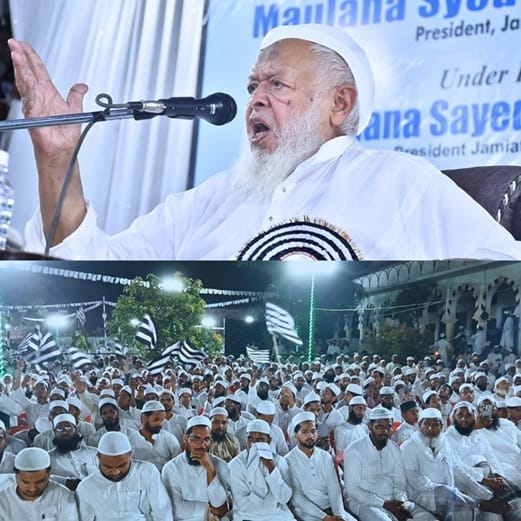
Staff Reporter / Azamgarh
In a powerful address at the Tahaffuz-e-Madaris (Protection of Madrassas) Conference held in Saraimeer, Azamgarh on June 1, Maulana Arshad Madani, President of Jamiat Ulama-i-Hind, firmly stated that “Madrassas are not just institutions — they are our identity, and we will not allow this identity to be erased.”
The conference, convened amid growing concerns over state actions against madrassas in several parts of India, brought together leaders and clerics from diverse Islamic schools of thought, making it a rare and significant show of unity within the community.
Maulana Madani highlighted the critical role madrassas have historically played—not just in religious education but also in India’s freedom movement. He reminded the audience of historical instances, such as Shah Abdul Aziz Dehlvi’s declaration of jihad against colonial rule from Madrasa Rahimiyyah in 1803, and the tragic loss of over 32,000 Islamic scholars during the 1857 uprising, many of whom were connected to madrassas.
Warning Against Erasure of History
“The same institutions that once led the charge against British rule are today being wrongly labeled as illegal or extremist,” Maulana Madani asserted, criticizing what he termed as a systematic attempt to distort history and marginalize religious institutions under the guise of legality and security.
He warned of a broader ideological effort to divide communities, saying, “Discrimination based on religion in a secular, democratic country is unacceptable. Actions targeting madrassas and mosques purely on religious lines violate the very spirit of the Constitution.”
Legal and Democratic Struggle to Continue
Reaffirming Jamiat Ulama-i-Hind’s commitment to constitutional and democratic processes, Maulana Madani stated that the organization has already initiated a legal battle to challenge what he described as the unjust closures of madrassas. “This campaign is not against the people, but against governmental policies that undermine our rights,” he said.
The Jamiat also announced new support mechanisms, including legal and architectural panels to assist madrassa officials in securing land permissions and dealing with administrative challenges. Maulana Madani urged madrassa administrators to ensure that land for religious institutions is lawfully acquired and preferably donated as waqf to avoid future disputes.
Call for Unity and Courage
The event’s tone was one of unity, resilience, and cautious optimism. “No matter how difficult the situation becomes, we must not lose hope,” Maulana Madani said. “We will face every challenge with courage, legality, and faith.”
The conference was chaired by Maulana Ashhad Rashidi, President of Jamiat Ulama-i-Uttar Pradesh, and moderated by Vice President Mufti Ashfaq Azmi. Other key figures included Mufti Syed Masoom Saqib, General Secretary of Jamiat Ulama-i-Hind, and Maulana Kaab Rashidi, Legal Advisor of the state unit.