
Last Updated on November 29, 2025 11:41 pm by INDIAN AWAAZ
Staff Reporter / New Delhi
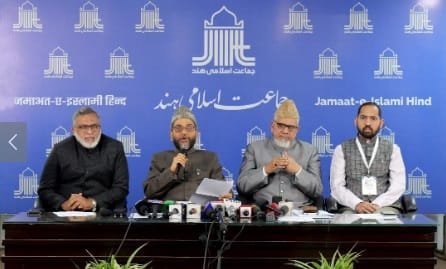
The Jamaat-e-Islami Hind (JIH) has urged the government to immediately extend the Waqf registration deadline and resolve the persistent technical faults on the UMEED Portal. Addressing a press conference at the JIH headquarters, JIH President Syed Sadatullah Husaini said that no Waqf property should be lost due to system failures or lack of technical support.
Husaini highlighted JIH’s on-ground initiatives—such as a central Waqf Help Desk, state-level Waqf Cells, and nearly 150 trained volunteers—working through workshops, helplines and field assistance to help mutawallis complete registrations. He reiterated JIH’s firm opposition to the Waqf Amendment Act, arguing that the current amendments undermine constitutional morality and violate minority rights.
Concerns Over Special Intensive Revision (SIR)
Moving to electoral issues, Husaini raised serious concern over the Special Intensive Revision (SIR) exercise, warning of its human cost. He cited excessive workload on BLOs, reports of stress and even deaths, and procedural opacity. JIH demanded that the Election Commission:
- publicly clarify that SIR is not a citizenship-verification drive,
- extend timelines and increase manpower,
- provide medical and mental-health support for field workers, and
- establish transparent grievance-redressal mechanisms with independent oversight.
Condemnation of Radicalisation and Security Lapses
Husaini reiterated JIH’s unequivocal condemnation of all forms of radicalisation, extremism and violence. Speaking on the recent Delhi blast, he denounced the attack as “a brutal act that violated every principle of human dignity and civilisation.” He also flagged serious concerns over repeated security lapses—from the Red Fort explosion to the Nowgam police station ammunition blast in Srinagar—highlighting vulnerabilities in the security apparatus.
He further criticised media narratives that stereotype entire communities, cautioning that such portrayals fuel division and indirectly serve extremist agendas.
Call for Long-Term Clean Air Policy
On the air pollution crisis, the JIH President urged the government to adopt a science-based, nationwide, year-round clean air policy, rather than episodic measures. He stressed the need for coordinated central–state action, stricter enforcement of industrial and vehicular norms, farmer-friendly crop-residue solutions, and wider clean public transport to safeguard health and livelihoods.
JIH Vice President Prof. Salim Engineer and Malik Motasim Khan also addressed the media.