
Last Updated on March 4, 2026 12:40 am by INDIAN AWAAZ
Zakir Hossain from Dhaka
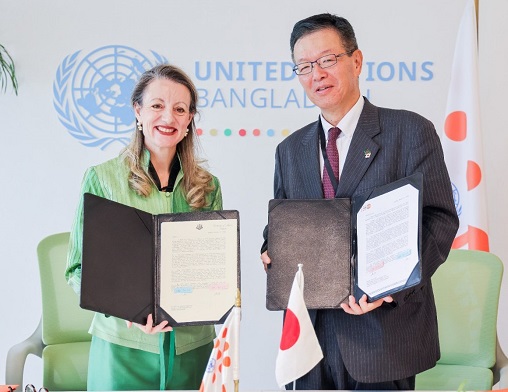
The government of Japan has approved a total of $4.6 million in aid to support Rohingya refugees in Bangladesh. This includes $3.2 million to the United Nations Population Fund (UNFPA) and $1.4 million to Unicef.
The two-year UNFPA project will focus on protecting the health and rights of women and adolescents in Cox’s Bazar and Bhasan Char, sustaining life-saving sexual and reproductive health services, gender-based violence (GBV) case management, and mental health support for around 1,80,000 beneficiaries. Catherine Breen Kamkong, UNFPA representative in Bangladesh, said, “This funding will allow UNFPA to sustain life-saving services that protect the health and dignity of women and adolescents who would otherwise face devastating gaps in care.”
Since 2024, around 1,50,000 new arrivals, over half women and girls, have increased pressure on overcrowded settlements. Funding shortages have already forced the closure of six government-run health facilities, a 16% reduction in midwives, and over 50% cut in GBV case managers. Japan’s support builds on earlier initiatives, which helped 38,000 women and girls access essential services and operationalized a 20-bed hospital on Bhasan Char, maintaining low maternal mortality rates.
Meanwhile, the $1.4 million Unicef grant will benefit over 56,500 refugees, including 36,000 children, supporting education, WASH (water, sanitation, hygiene), nutrition, and health. Unicef Representative Rana Flowers said, “The support from the Government of Japan will help keep children healthy and in learning, promote skills development, and give families the tools to care for their youngest children.” The programme will expand access to the Myanmar curriculum, provide skills training for adolescents, and strengthen WASH facilities to curb disease outbreaks.
Since 2017, Japan has contributed over $250 million to the Rohingya humanitarian response in Bangladesh. Japanese Ambassador Saida Shinichi reaffirmed the country’s commitment, saying, “Japan remains firmly committed to protecting the most vulnerable, particularly women and adolescents affected by displacement. Through our partnership with UNFPA and Unicef, we aim to ensure continued access to essential health and protection services.”