
Last Updated on January 1, 2026 9:40 pm by INDIAN AWAAZ
R. Suryamurthy
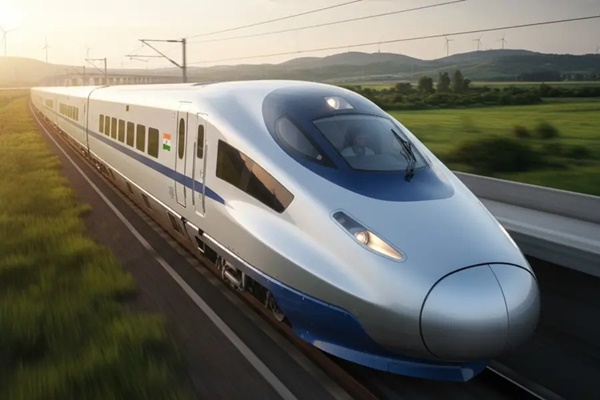
India’s first bullet train will begin operations on August 15, 2027, with services rolled out in phases along the Mumbai–Ahmedabad High-Speed Rail corridor, Union Railways Minister Ashwini Vaishnaw said on Thursday.

Speaking to reporters, Vaishnaw said the initial operational stretch will be between Surat and Bilimora in Gujarat. This will be followed by the opening of the Vapi–Surat section, then Vapi–Ahmedabad, after which services will extend from Thane to Ahmedabad. The final phase will connect Mumbai to Ahmedabad, completing the full corridor.
“On Independence Day in 2027, people will be able to buy a ticket for India’s first bullet train,” the minister said.
The Mumbai–Ahmedabad High-Speed Rail project spans 508 km and is being developed using Japanese Shinkansen technology. Trains on the corridor are designed to run at speeds of up to 320 kmph, reducing travel time between Mumbai and Ahmedabad to about two hours once the entire route is operational.
The corridor passes through Gujarat, Dadra and Nagar Haveli, and Maharashtra, with around 352 km in Gujarat and Dadra and Nagar Haveli and 156 km in Maharashtra. It will connect major cities including Ahmedabad, Vadodara, Bharuch, Surat, Vapi, Thane and Mumbai.
According to the National High-Speed Rail Corporation Limited (NHSRCL), more than 85% of the corridor is being built on elevated viaducts. Over 326 km of elevated structures have been completed, and 17 of the 25 planned river bridges are in place. The 47-km Surat–Bilimora stretch is among the most advanced sections, with major civil works and track-bed preparation completed.
Prime Minister Narendra Modi reviewed progress on the project during a visit to Gujarat in November, inspecting the under-construction Surat bullet train station. The station, inspired by the city’s diamond industry, has completed structural work, with interior finishing and passenger amenities currently under installation.
The bullet train project was launched in 2017 and was originally scheduled for completion by December 2023. Delays related to land acquisition and execution challenges led to a revision of timelines. The project is being implemented with technical and financial assistance from the Japanese government.
Vaishnaw also highlighted the success of the Vande Bharat Express trains, saying their popularity has strengthened confidence in railway modernisation. He said Vande Bharat Sleeper trains for overnight journeys will offer similar standards of comfort and safety and are expected to be introduced soon.