
Last Updated on August 28, 2026 12:49 am by INDIAN AWAAZ
Our Correspondent / New Delhi
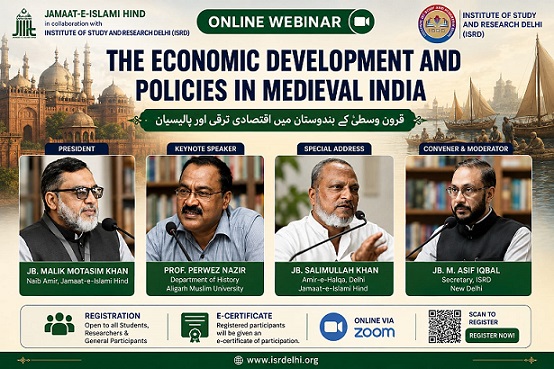
India’s economic history during the medieval period continues to fascinate scholars, with experts emphasizing that the subcontinent was among the world’s foremost economic powers of its time. Agriculture, trade, and industry formed the backbone of this prosperity, sustaining a vibrant economy that influenced global commerce. This perspective was highlighted at a recent webinar titled “Economic Development and Policies in Medieval India”, organized by the Institute of Study and Research Delhi (ISRD).
The session brought together historians and economists to examine the structural foundations of medieval India’s economy. Discussions ranged from the role of agriculture and irrigation in sustaining rural livelihoods, to the flourishing of textiles, handicrafts, and metallurgy that positioned India as a hub of artisanal excellence. The speakers also delved into the intricacies of trade networks, both inland and maritime, which connected Indian markets to Central Asia, the Middle East, and beyond.
Professor Pervez Nazir of the Department of History, Aligarh Muslim University, noted that India was known as the “Golden Bird” due to its economic strength. He identified agriculture, trade, and industry as the three principal pillars of the medieval economy, with agriculture providing both state revenue and raw materials for trade and manufacturing.
Discussing economic policies during the Sultanate period, Prof. Nazir highlighted several important initiatives. He described Alauddin Khalji’s rationing system and public distribution arrangements as significant developments. He also explained the distinctive features of Muhammad bin Tughlaq’s establishment of a separate department for agriculture and discussed Firoz Shah Tughlaq’s urbanization initiatives, explaining how the expansion and development of urban centers contributed to economic growth and greater stability for both the state and the people.
He also examined Sher Shah Suri’s land-classification system, revenue policies, and taxation arrangements, explaining how these measures helped lay the foundations for economic development in India.
Referring to the Mughal period, Prof. Nazir stated that widely cited historical estimates suggest India accounted for around 25 percent of global GDP during Aurangzeb’s reign.
Prof. Nazir described Tipu Sultan as an “enterprising ruler” who drew upon earlier Indian experience and sought to develop agriculture, trade, and industry on more systematic and scientific lines.
He cited Mysore’s silk industry as an example, noting that Mysore remains renowned for silk textiles.
Under Tipu Sultan, sericulture was promoted under state supervision. Farmers were encouraged to cultivate mulberry trees with state support and financial assistance, while large workshops were established for silk production.
Tipu Sultan also developed trade infrastructure. Professor Nazir referred to trading factories and commercial establishments in the Gulf and the Middle East, including Oman, where goods could be stored and preserved for procurement. He also mentioned systems for quality assurance and price fixing, arguing that these measures reflected an organized approach to economic management during Muslim rule.
Referring to Dadabhai Naoroji’s “Drain of Wealth” theory, Prof. Nazir said the continuing transfer of India’s wealth under British rule contributed to its economic impoverishment.
Jamaat-e-Islami Hind (JIH) Vice President Malik Moatasim Khan reiterated that agriculture was the most important component of the medieval economy.
He noted that India produced abundant grain, cotton, sugarcane, and other crops, while canals, ponds, and other water resources supported agricultural production during the medieval period. He also highlighted textiles, handicrafts, and metallurgy as important sectors.
The JIH VP stated that while the Muslim rulers of pre-British India had political objectives such as expanding their territories, public welfare and service were also important considerations. He said, “the foundation behind all this was their inspiration from Islam.”
Moatasim Khan urged people to learn from history rather than use historical conflicts to justify hostility towards present-day Muslims. He said, “We have to connect ourselves with the past in order to build the real future.”
He called upon Muslims to strengthen themselves economically, create wealth, and use it for the welfare of weaker sections and the development of the country.
JIH Delhi President Saleemullah Khan said that history should focus more on those who contributed to building and developing society than on those who caused destruction.
Referring to the present state of agriculture, he noted that the sector provides employment to nearly half of India’s workforce while accounting for a much smaller share of national GVA. He remarked, “If a sector provides employment to nearly half the people but contributes only around 18 percent to national GVA, that is something we need to think about very seriously.”
ISRD Secretary and convenor of the webinar, Asif Iqbal, stated that studying India’s economic history from the eighth to the eighteenth century helps in understanding its agricultural systems, trading networks, handicrafts, and financial policies. He highlighted revenue administration under the Delhi Sultanate and Mughal Empire, royal patronage, and expanding trade as important factors in economic development.
The webinar was attended by students, history and economics scholars, and other interested participants. Speakers stressed that studying India’s economic history is relevant not only for understanding the past but also for drawing lessons for economic self-reliance, social prosperity, and inclusive national development today.