
Last Updated on August 28, 2026 12:13 am by INDIAN AWAAZ

Our Correspondent / NEW DELHI
The Communist Party of India (CPI) has intensified its nationwide ‘Badlaav Zaroori Hai’ (Change is Necessary) campaign, accusing the Narendra Modi-led BJP government of failing to address what it described as a deepening economic, social and democratic crisis in the country.
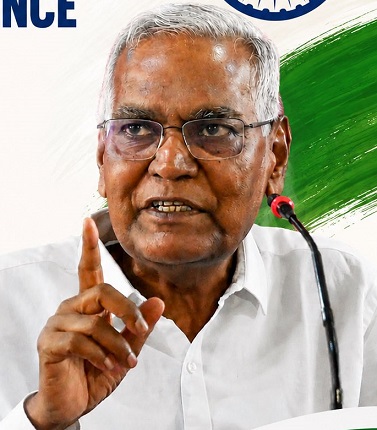
Addressing a press conference on Thursday, CPI General Secretary D. Raja said the campaign was aimed at mobilising people around issues including unemployment, price rise, declining purchasing power, farmers’ demands for a legal guarantee for minimum support price (MSP), workers’ rights, public education and healthcare, social justice and the protection of democratic institutions.
The CPI has announced a major rally at Ramlila Maidan in New Delhi on September 1, which the party said would bring together workers, farmers, students, youth, women and representatives of marginalised and democratic sections from across the country.
Raja alleged that the government had failed to adequately respond to economic pressures, including weak employment generation, rising prices, declining purchasing power and concerns over investment and capital outflows. He also accused the government of allowing inequalities to widen while public education and healthcare systems faced increasing pressure.
According to the CPI, the campaign seeks to turn these concerns into a broader political movement for a change in the direction of governance.
CPI highlights unemployment, inflation and farmers’ concerns
The CPI’s campaign has placed economic distress at the centre of its political mobilisation. The party has argued that ordinary households are facing increasing pressure from the cost of living, while employment opportunities have not expanded sufficiently to meet the aspirations of India’s growing working-age population.
The party has also renewed its support for farmers demanding a statutory or legal guarantee for MSP. It said agricultural communities continued to face uncertainty over income and market prices and that a legal framework for MSP remained an important demand of farmers’ organisations.
Workers’ rights and employment security are another major component of the campaign. The CPI said workers were facing increasing insecurity and called for stronger social protection, decent wages and greater employment security.
The party has simultaneously raised concerns over the state of public education and healthcare, arguing that weakening public institutions could further widen existing social and economic inequalities.
Opposition to government policies and institutional changes
The CPI has also criticised the government’s approach to electoral and constitutional issues. It expressed concern over proposals relating to delimitation and ‘One Nation, One Election’, arguing that such measures could have implications for India’s federal structure and the balance between the Centre and the states.
The party further alleged that political interference and pressure on opposition parties were weakening democratic institutions.
Raja accused the RSS-BJP establishment of increasingly relying on communal polarisation, repression and the use of state institutions against political dissent. These allegations form a central part of the CPI’s argument for a broader political alternative.
The party said its campaign was not limited to electoral politics but was intended to build public awareness around constitutional rights, federalism, social justice and democratic accountability.
Nationwide padayatras held
As part of the mobilisation, the CPI organised nationwide padayatras from August 6 to August 15, with several continuing beyond the scheduled period.
The marches were intended to take the campaign directly to communities and highlight issues such as inflation, unemployment, education, healthcare, MSP, workers’ rights, electoral reform and social justice.
CPI units in different states have also been mobilising supporters for the September 1 rally. The party expects participation from youth and students, women, workers, farmers and sections of civil society and the democratic movement.
The campaign has also included a political education programme through the publication and distribution of booklets dealing with a range of political and social issues.
Among the publications released so far are ‘Badlaav Zaroori Hai: Writings of D. Raja’, ‘Electoral Reforms’, ‘Women Reservation’, ‘Workers’ Rights Are Human Rights’ by Amarjeet Kaur, ‘BJP’s Great Betrayal: Legal Guarantee of MSP’ and ‘Ram Temple Donation Theft: Running from 1949 Till Today’.
The party said the publications involved contributions and participation from several public figures and academics, including former Chief Election Commissioner Dr S.Y. Quraishi, Prof Nandita Narain, Aam Aadmi Party MP Sanjay Singh and former Kerala Revenue Minister K. Rajan, besides workers and CPI leaders.
The CPI said two additional publications focusing on discrimination against Dalits and other marginalised communities and on tribal rights, forest resources and alleged corporate control over forests would be released on Friday.
The publications are intended for political discussion, reading and distribution among the public, the party said.
Concerns over mobilisation from Kerala and Tamil Nadu
The CPI also raised concerns over arrangements being made for supporters travelling to Delhi for the September 1 rally. According to the party, special trains booked from Kerala and Tamil Nadu were cancelled, prompting concerns among its leaders and supporters about whether the movement of participants was being obstructed.
The CPI also alleged that in BJP-ruled Uttar Pradesh, police personnel had contacted party workers and visited their homes, including at night, in what it described as an attempt to discourage participation in the Delhi mobilisation.
A broad coalition of demands
The September 1 rally is being projected by the CPI as a platform bringing together groups with different but overlapping grievances.
Students and young people are expected to raise issues relating to employment and affordable education. Workers are being mobilised around job security, wages and dignity at the workplace, while farmers are expected to focus on the demand for a legal guarantee for MSP.
Women are being mobilised around equality and political representation, while Dalits and Adivasis are expected to raise issues concerning social discrimination, constitutional safeguards and access to resources.
The CPI also said minorities were demanding security and equal citizenship, while democratic sections of society were concerned about the independence and functioning of key institutions.
The party believes these demands can be brought together under a broader political call for a change in the country’s governance priorities.
Call for stronger Parliament and federalism
The CPI has called for restoring Parliament’s role as an institution of accountability and strengthening India’s federal structure.
It also wants greater investment in public education and healthcare, stronger protection for workers and farmers, and measures aimed at achieving social and economic justice.
The party further called for safeguarding constitutional rights and ensuring that institutions of the state function independently and without communal or political influence.
According to the CPI, these issues are not isolated grievances but part of a larger debate over the future direction of Indian democracy and governance.
September 1 rally to test CPI’s mobilisation strength
The September 1 gathering at Ramlila Maidan will provide the CPI with an opportunity to demonstrate its organisational reach beyond its traditional pockets of influence.
The party is seeking to use the campaign to connect economic issues with broader questions of democracy, federalism and social justice. Its emphasis on unemployment, inflation, farmers’ demands and workers’ insecurity also reflects issues that have featured prominently in opposition politics and public movements across several states.
At the same time, the rally will test the CPI’s ability to mobilise participants from different regions and social groups around a common political platform.
The party has framed the campaign as an effort to create a political alternative to the present BJP-led government. It argues that economic grievances, social inequalities and concerns over democratic institutions have created the conditions for a wider political mobilisation.
The CPI has called upon its state and district units to intensify outreach ahead of the rally and take the ‘Badlaav Zaroori Hai’ message to more sections of society.
The September 1 rally is expected to be the most visible expression so far of the CPI’s ‘Badlaav Zaroori Hai’ campaign and its call for a wider political alternative.