
Last Updated on August 28, 2026 1:01 am by INDIAN AWAAZ
AMN / KATHMANDU
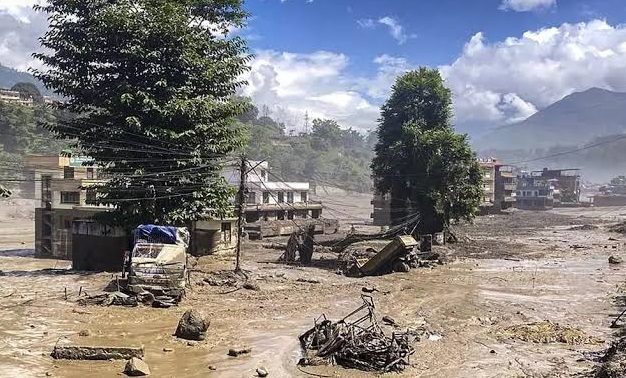
Nepal has declined offers from several countries to deploy search-and-rescue teams following the devastating Bhotekoshi floods, saying its own security agencies are capable of managing the ongoing operation even as 517 foreign nationals remain missing or out of contact.
According to The Kathmandu Post, the Nepal government has instead asked friendly countries and international partners to provide financial assistance through a single-window mechanism, with officials indicating that additional international support may be sought during the rehabilitation and reconstruction phase.
The decision comes amid growing international concern over the scale of the disaster and the fate of hundreds of foreign nationals believed to have been in the flood-affected areas.
Nepal has received requests from India, China, the United States, the United Kingdom, Japan, South Korea, Sri Lanka and Bangladesh, among others, to send specialised search-and-rescue teams to assist local authorities.
However, Kathmandu has chosen to rely on the Nepali Army and Nepal Police, which recommended that the operation be handled domestically.
Hundreds of foreign nationals unaccounted for
The extent of the crisis has emerged through figures compiled by the Nepal Police and information provided by foreign governments.
Nepal Police said 178 Indian nationals, 65 Americans, 51 Malaysians, 53 Ukrainians, 33 Britons, 35 Australians and 25 Canadians were among those reported missing since Wednesday’s floods. Nationals from around three dozen other countries are also unaccounted for.
Chinese authorities have separately reported that at least 100 Chinese nationals are out of contact in Nepal.
India’s Ministry of External Affairs, meanwhile, said more than 200 Indian nationals were seeking evacuation after being stranded in flood-affected areas.
The figures remain subject to verification as communication networks, roads and other infrastructure have been disrupted by the disaster.
Nepal cites lessons from 2015 earthquake
A senior Nepali foreign ministry official said the government had received multiple official and unofficial requests from foreign governments and organisations seeking permission to send their own rescue personnel.
But Kathmandu decided against accepting the offers after considering the experience of the 2015 earthquake, when the arrival of large numbers of international search-and-rescue teams created substantial coordination and logistical difficulties.
According to the official, competition among foreign teams at that time added to the challenges faced by Nepalese authorities in managing the massive emergency response.
The current decision was reportedly taken following recommendations from the Nepali Army and Nepal Police, which believe domestic security agencies have the capacity to conduct the search-and-rescue operation.
“We received similar requests from China and other countries too, but we had to turn down the request,” the foreign ministry official said, according to The Kathmandu Post.
India sought permission to deploy NDRF
India was among the countries that sought permission to assist directly on the ground. Following reports that hundreds of Indian nationals had gone missing or lost contact with their families after the floods, the Indian government requested permission to deploy personnel from the National Disaster Response Force (NDRF) to Nepal.
Kathmandu seeks financial assistance instead
While Nepal has rejected the deployment of foreign rescue teams, it has not closed the door on international assistance.
Officials said the government would prefer financial contributions through a one-door mechanism, allowing assistance to be coordinated centrally rather than through multiple agencies and foreign teams operating independently.
Several countries have already announced financial assistance, while others have expressed willingness to support Nepal’s wider response.
The government is expected to seek further international assistance as the immediate rescue operation gives way to rehabilitation, reconstruction and recovery.
The approach reflects Kathmandu’s attempt to maintain greater control over the disaster response while ensuring that international assistance can still be mobilised.
Emergency Response Team set up for foreigners
Meanwhile, Nepal’s Ministry of Foreign Affairs has established an Emergency Response Team (ERT) to coordinate assistance to foreign nationals affected by the floods.
The ministry said the ERT would act as its central coordinating body for search and rescue, verification of information and consular assistance concerning foreign nationals who are missing, affected by or otherwise connected to the flood disaster.
The team is being led by an under-secretary of the Ministry of Foreign Affairs.
The mechanism is expected to work with diplomatic missions and relevant Nepalese agencies to verify reports of missing foreigners, facilitate communication with families and coordinate consular assistance.
International concern grows as rescue operation continues
The continuing uncertainty over hundreds of foreign nationals has added an international dimension to what is already a major humanitarian emergency in Nepal.
For families abroad, the lack of communication with relatives in the affected areas has heightened anxiety. Diplomatic missions are working with Nepalese authorities to establish the whereabouts of their citizens and assist those seeking evacuation.
The disaster has also placed Nepal’s emergency response system under considerable pressure, particularly in areas where floods have damaged roads, bridges and communications.
The government’s decision to rely on its own security agencies means the effectiveness and speed of the domestic response will remain under close scrutiny in the coming days.
At the same time, Nepal will need substantial resources for the longer-term recovery effort. Financial assistance from foreign governments and international organisations could become increasingly important as authorities assess damage to homes, roads, bridges, public infrastructure and local economies.
Focus shifts from rescue to reconstruction
Nepal’s decision underscores a delicate balance facing the government: maintaining operational control over a complex rescue mission while securing the international assistance needed to cope with the scale of the disaster.
For now, Kathmandu is insisting that its own army and police forces can manage the search operation. But with hundreds of foreign nationals still missing and large numbers of people requiring evacuation and assistance, pressure on authorities is likely to remain high.
As The Kathmandu Post reported, Nepal’s government has turned down requests from several countries to deploy rescue teams, citing the capability of its own security agencies and the coordination problems experienced after the 2015 earthquake.