
Last Updated on September 4, 2025 12:02 am by INDIAN AWAAZ
Reduction of GST from 12% OR 18% to 5% on almost all of the food items such as packaged namkeens, Bhujia, Sauces, Pasta, Instant Noodles, Chocolates, Coffee, Preserved Meat, Cornflakes, Butter, Ghee, etc.
ANDALIB AKHTER / NEW DELHI
Finance Minister Nirmala Sitharaman on Wednesday announced a sweeping overhaul of the Goods and Services Tax (GST) regime, merging the 12% and 18% slabs into a simplified dual structure of 5% and 18%, while retaining a 40% “sin tax” on luxury and demerit goods.
The Finance Minister termed the reform as “Next-Generation GST”, saying it aims to enhance affordability, stimulate consumption, and improve economic efficiency while easing compliance for businesses.
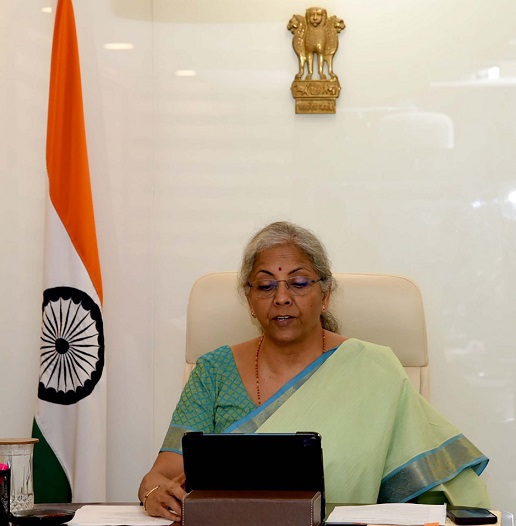
Briefing the media in New Delhi today, Finance Minister Nirmala Sitharaman said that GST on common man and middle-class items has been reduced from 18 per cent or 12 per cent to 5 per cent. The Finance Minister informed that items such as hair oil, toilet soap, soap bars, shampoos, toothbrushes, toothpaste, bicycles, tableware, kitchenware, and other household articles will now have only 5 per cent GST.
She further said that GST on ultra-high temperature milk, chena and paneer has been reduced to zero from 5 per cent, while all Indian breads will now see a nil rate. Ms. Sitharaman also announced that GST on food items such as namkeen, bhujia, sauces, pasta, instant noodles, chocolates, coffee, preserved meat, cornflakes, butter and ghee has been reduced from 12 per cent or 18 per cent to 5 per cent.
The Minister added that the GST slab on items like air-conditioning machines, televisions above 32 inches, all types of TVs, dishwashing machines, small cars and motorcycles has been lowered to 18 per cent from 28 per cent. She said that labour-intensive industries have given strong support, while farmers and the agriculture sector will also benefit from today’s decisions. The Minister said, GST on all agricultural equipment has been reduced from 12 per cent to 5 per cent.
Relief for the Common Man
Daily-use products such as hair oil, soap, shampoo, toothbrushes, toothpaste, bicycles, and kitchenware will now attract only 5% GST. Ultra-high temperature milk, paneer, chena, and Indian breads like roti and paratha will be fully exempt.
Packaged food products including namkeen, bhujia, sauces, pasta, noodles, chocolates, coffee, cornflakes, butter, and ghee have also been shifted to the 5% bracket, offering consumers significant relief.
Consumer Durables & Automobiles
High-value items have also seen a tax cut:
- Air-conditioners, dishwashers, and small cars: down from 28% to 18%.
- Motorcycles (up to 350 cc): revised to 18%.
The move is expected to spur demand in consumer durables and automobile segments, while supporting manufacturing and job creation.
Boost to Key Sectors
Sitharaman highlighted that labour-intensive industries, agriculture, and healthcare would gain substantially from rationalised rates and lower input costs. “Every tax on the common man’s daily use items has been reviewed, and in most cases reduced,” she stressed.
Simplification & Stability
The reforms also tackle long-pending issues of inverted duty structures and classification disputes, creating a stable framework for businesses. Measures have been rolled out to simplify registration, return filing, and refund processes, reducing compliance costs for MSMEs and local vendors.
Political & Economic Context
The announcement aligns with Prime Minister Narendra Modi’s Independence Day assurance that GST rationalisation would be implemented by Diwali. Experts say the move strengthens the government’s push for a “citizen-friendly economy” while ensuring predictability for industry.
The recommendations made by the 56th GST Council are as below:
A. CHANGES IN GST RATES OF GOODS AND SERVICES
- Recommendations relating to GST rates on goods
- Changes in GST rates of goods
The HSN wise rate changes are at Annexure -I and sector wise rate changes are at Annexure -II
- Other changes relating to goods
- It has been decided that the GST will be levied on Retail Sale Price (RSP) instead of transaction value on Pan Masala, Gutkha, Cigarettes, Unmanufactured tobacco, Chewing tobacco like Zarda.
- It has been decided to grant ad hoc IGST and compensation cess exemption on new armoured sedan Car imported by the President’s Secretariat for the President of India.
- Recommendations relating to GST rates on services
- Changes in GST rates of services
The HSN wise rate changes are at Annexure -III and Sector wise rate changes are at Annexure -IV.
- Other changes relating to services
- The Council has recommended to add Explanations to the definition of ‘specified premises’ in the context of taxability of restaurant services in order to clarify the position that a stand-alone restaurant cannot declare itself as a ‘specified premises’ and consequently cannot avail the option of paying GST at the rate of 18% with ITC.
- The Council has recommended to align the valuation rules with the change in the tax rate applicable to lottery tickets, certain amendments in the GST Valuation rules are being carried out.
- Recommendation relating to date of implementation
The Council was of the view that the changes in GST rates of goods and services need to be implemented with effect from 22nd September 2025. However, keeping in view the requirement of funds to fulfill the obligation under the compensation cess account, the Council decided that the changes in GST rates may be implemented in a phased manner as follows:
- The changes in GST rates on services will be implemented with effect from 22nd September 2025.
- The changes in GST rates of all goods except pan masala, gutkha, cigarettes, chewing tobacco products like zarda, unmanufactured tobacco and bidi, will be implemented with effect from 22nd September 2025.
- Pan Masala, gutkha, cigarettes, chewing tobacco products like zarda, unmanufactured tobacco and bidi will continue at the existing rates of GST and compensation cess where applicable, till loan and interest payment obligations under the compensation cess account are completely discharged.
- Based on c) above, Union Finance Minister and Chairperson of the GST Council may decide the actual date of transition to the revised rates of GST approved by the Council for the above-mentioned goods.
- Pending requisite amendments in CGST Act, 2017, Central Board of Indirect Taxes and Customs (CBIC) shall administratively start implementation of the revised system of grant of 90% provisional refunds arising out of Inverted Duty structure on the basis of data analysis and risk evaluation done by the system, as in the case of risk based provisional refunds on account of zero-rated supplies.
B. MEASURES FOR FACILITATION OF TRADE
- Process Reforms
- GST Council has taken various decisions and recommended various measures to facilitate trade. The process reforms and other measures related to GST law and Procedure are at Annexure -V. The date of implementation of these process reforms will be notified in due course.
- Operationalization of the Goods and Services Tax Appellate Tribunal (GSTAT)
The Goods and Services Tax Appellate Tribunal (GSTAT) will be made operational for accepting appeals before end of September and will commence hearing before end of December this year. The Council also recommended the date of 30.06.2026 for limitation of filing of backlog appeals. The Principal Bench of the GSTAT will also serve as the National Appellate Authority for Advance Ruling. These measures will significantly strengthen the institutional framework of GST by providing a robust mechanism for dispute resolution, ensuring consistency in advance rulings, and offering greater certainty to taxpayers. This will further enhance trust, transparency, and ease of doing business under the GST regime.