
Last Updated on September 4, 2026 4:19 pm by INDIAN AWAAZ
By Bibhudatta Pradhan / New Delhi
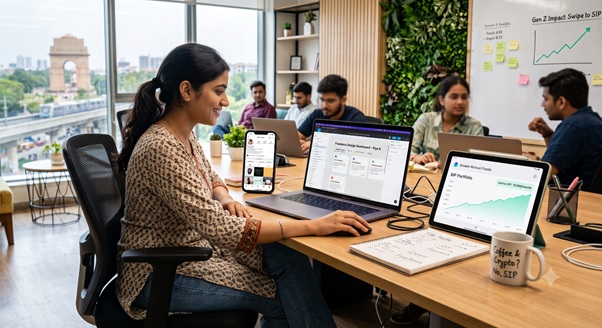
— In a quiet corner of a Delhi co-working space, 22-year-old Riya Sharma switches between three screens. One shows her freelance design dashboard, another tracks her mutual fund SIPs, and the third is a live feed of her Instagram analytics. “I don’t want just a job,” she says. “I want options.”
Riya is not an outlier. She belongs to India’s Generation Z — the country’s largest young adult population, with close to 400 million people born between 1997 and 2012, making up about 28% of India’s 1.4 billion population.
Like Riya, most Gen Z Indians have never known a world without a smartphone. They grew up swiping, scrolling, and streaming. Social media is their playground; technology, their constant companion.
That same digital fluency now spills into politics and the economy. Recent student-led protests have made one thing clear: Gen Z is a constituency that political parties cannot ignore. But their influence goes far beyond the ballot box. Their spending, saving, and career choices are helping define India’s economic future.
[AI-generated Image]
$2 trillion question
Already, Gen Z accounts for about 46% of India’s consumer spending — roughly $860 billion. By 2035, their spending power is projected to touch $2 trillion, according to a Boston Consulting Group–Snap Inc. report. In plain terms: by the mid-2030s, every second rupee spent in key consumer categories will come from a Gen Z wallet.
This is not just a story about shopping habits. Gen Z’s preferences are reshaping industries, investment patterns, workplace norms, and even policy priorities. Their demand for speed, transparency, and value is forcing brands to rethink everything from product design to marketing. Their early entry into investing is altering the mutual fund and stock market landscape. And their comfort with gig work is changing how companies think about talent.
For policymakers, the stakes are equally high. A generation this large cannot be ignored. Their financial security, career paths, and aspirations will determine whether India’s growth story remains inclusive or fractures under pressure from inflation, job mismatches, and rising living costs.
Spending on experiences, not things
Gen Z’s spending is distinct. They prioritise experiences — travel, entertainment, dining out — over ownership. A 2026 Redseer report notes that by 2030, Gen Z will command $1.3 trillion in consumption, with a strong tilt toward digital convenience and sustainability.
UPI, credit-on-app, and buy-now-pay-later schemes have made spending frictionless, especially for travel and entertainment, which saw sharp growth in the first half of 2026.
Brands are taking note. E-commerce giants like Amazon and Flipkart are tailoring interfaces for mobile-first users. Fashion and electronics companies are leaning into influencer partnerships and short-form video. Traditional marketing is losing ground — one 2026 industry analysis found reaching Gen Z via conventional channels is 16% more expensive than digital-first approaches.
Investors before they’re fully settled
Perhaps the biggest shift is financial. Gen Z is entering markets earlier than previous generations. A World Economic Forum survey suggests 30% of Gen Z started investing during university or early adulthood, compared with 15% of millennials.
Mutual funds, especially via SIPs, are the preferred entry point. Data from PhonePe’s Share.Market platform shows that between August 2024 and July 2025, nearly half (48%) of its mutual fund investors were aged 18–30, and 92% of them used SIPs, averaging about ₹1,000 a month.
Equity markets tell a similar story. NSE data shows Gen Z now makes up 40% of registered investors, up from 25% in FY20.
Gig economy and the search for stability
Work, for Gen Z, is plural. Side hustles are common — freelancing, content creation, ride-sharing, tutoring. Reports have noted around 35% of Indian Gen Z are involved in some form of gig or business activity, with over half expressing interest in freelance work.
But there’s a flip side. A Deloitte survey found 55% of Indian Gen Z live paycheck to paycheck, with high exposure to fintech loans and rising costs of housing, education, and tech.
Why this matters for India’s next decade
Gen Z is not waiting for a handover. They are already here — spending, investing, working, and demanding better. Their preferences are pushing companies toward personalisation, affordability, and ethical branding. Their investment habits are democratising wealth creation. Their career choices are nudging employers toward flexibility.
For now, the trajectory is clear. India’s Gen Z is not just the future. They are the present — and they are writing the next chapter of the economy, one swipe, one SIP, one side hustle at a time.