
Last Updated on September 24, 2026 8:35 pm by INDIAN AWAAZ
Warns nationwide agitation if demands not met
Sudhir Kumar / New Delhi
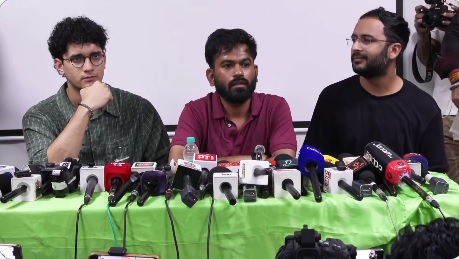
Launching its nationwide “Election Commission Thik Karo” campaign, the Cockroach Janta Party (CJP) today gave a 48 hours ultimatum to Chief Election Commissioner Gyanesh Kumar to resign over the ongoing Special Intensive Revision (SIR) of electoral rolls, warning that failure to do so would trigger a nationwide agitation followed by an indefinite sit-in in Delhi.
CJP National Convenor Abhijeet Dipke, and Co-convenors Saurav Das and Ashutosh Ranka said the campaign would focus on the exclusion of more than 13 crore names from draft electoral rolls across 30 States and Union Territories during the SIR exercise. The figure represents roughly 13–14% of the electorate affected at the draft-roll stage.
“If Gyanesh Kumar does not resign within 48 hours, we will take this campaign to the streets,” Ranka said. “The Election Commission must answer the country. We will continue the agitation until there is transparency, accountability and a credible process for restoring every eligible voter who has been wrongly excluded.”
The party cited exclusions reported across several states, including more than 2 crore names in Maharashtra, more than 2 crore in Uttar Pradesh, around 1 crore in Karnataka, 97 lakh in Tamil Nadu, 90 lakh in West Bengal, 73 lakh in Telangana, 47 lakh in Delhi and 24 lakh in Kerala.
“Democracy means that people choose their government. This is not democracy, this is autocracy. Under Gyanesh Kumar, we are seeing an electoral system in which the Election Commission is deciding who remains on the voter rolls and who does not. When millions of names can disappear from draft rolls, the burden is on the Commission to establish that every exclusion is lawful, transparent and subject to meaningful review,” said CJP National Convenor Abhijeet Dipke.
The CJP’s ultimatum comes a day after an Indian Express investigation reported that Election Commissioners Sukhbir Singh Sandhu and Vivek Joshi had formally recorded objections at least 14 times over 10 months to decisions and orders concerning voter additions, deletions, changes to Form 6 and the centralisation of electoral-roll data. The Commissioners reportedly described some of these steps as “unauthorised” and “illegal” and raised concerns over the centralisation of the voter database.
“Two of the three Election Commissioners formally objected to decisions being taken without their knowledge or approval. The Election Commission must publicly explain how these objections were dealt with and who authorised the decisions in question,” Dipke said.
CJP Co-convenor Saurav Das identified three areas that the party said require immediate scrutiny:
1. Blocking first-time voters: The Election Commission introduced an additional declaration into the online Form 6 process requiring new applicants to provide information about their own or their parents’ presence in earlier SIR rolls. The Indian Express reported that although the section was not formally marked mandatory, applicants could not proceed without answering it. The two Election Commissioners had objected to the change, calling it unauthorised and warning that it could create difficulties for young, first-time voters.
2. Questions over the handling of Bengal appeals: CJP demanded transparency over the Election Commission’s handling of cases arising from the West Bengal SIR, including appeals concerning excluded voters and the Commission’s legal actions in the matter. The party said all records relating to these proceedings should be placed in the public domain and examined independently.
3. Centralisation of electoral-roll data: The Indian Express investigation reported that the dissenting Commissioners had raised concerns over the gradual centralisation of the electoral-roll database and the role of centralised software in overriding or restricting access available to state-level election officials.
Das said, “The Election Commission cannot ask citizens to trust a system while refusing to explain how major changes to voter registration, deletion and data access are being authorised. Every decision affecting a citizen’s right to vote must have a clear legal basis, an identifiable decision-maker and a transparent record.”
CJP Co-convenor Ashutosh Ranka said the consequences of exclusion could extend beyond elections where voter records are used for administrative verification.
“Who authorised the removal of citizens from electoral rolls without first ensuring a transparent and accessible remedy? The right to vote is a constitutional right protected through the electoral framework under Article 326. The Commission must answer to the citizens whose names have been excluded,” Ranka said.
CJP’s three demands
1. Resignation and investigation: CJP demanded the immediate resignation of CEC Gyanesh Kumar and an independent investigation into decisions taken during the SIR, including identification of the officials who authorised disputed changes and directions.
2. Halt SIR-related exclusions and secure the records: CJP demanded an immediate halt to further SIR-related exclusions, restoration of the January 2025 electoral rolls pending verification, and the transfer of all relevant SIR records and files to the Supreme Court or an independent judicially supervised inquiry.
3. Reform the appointment framework: CJP demanded repeal of the 2023 law governing the appointment of the Chief Election Commissioner and other Election Commissioners and its replacement with a framework involving wider institutional and civil-society participation.
CJP also demanded that Election Commissioners Sukhbir Singh Sandhu and Vivek Joshi publicly clarify their recorded objections and that the Election Commission publish the relevant objection notes and responses. The Election Commission has disputed the characterisation of the reported objections, saying the notes were part of the Commission’s decision-making process and maintaining that decisions taken during the period were unanimous. CJP said the Commission should make the underlying records public so that the competing claims can be independently examined.