
Last Updated on September 24, 2026 9:22 pm by INDIAN AWAAZ
By Our Business Correspondent
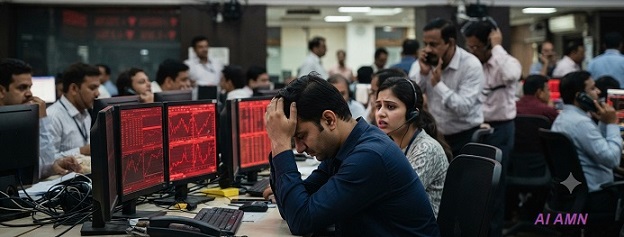
Domestic equity markets came under heavy selling pressure on Thursday as a sharp rise in US Treasury yields, escalating crude oil prices and renewed concerns over the global interest-rate outlook combined to weigh on investor sentiment. The sell-off was broad-based, with banking, financial services and several heavyweight stocks leading the decline.
The S&P BSE Sensex plunged 1,247.71 points, or 1.67 per cent, to close at 73,580.54, while the Nifty 50 fell 383.70 points, or 1.64 per cent, to settle at 23,063.10. The Nifty closed below the psychologically important 23,100 mark as investors reassessed the outlook for interest rates, inflation and corporate earnings amid a less favourable global macroeconomic environment.
A combination of higher global bond yields and rising crude prices put additional pressure on Indian equities. The US 10-year Treasury yield climbed to its highest level since 2007, while Brent crude moved above $102 a barrel. The combination is significant for an oil-importing economy such as India because higher crude prices can affect inflation, the external balance and corporate cost structures.
The rupee also weakened against the US dollar, adding to concerns over imported inflation and external-sector pressures.
Banks, financial stocks bear the brunt
Financial stocks were among the biggest casualties during Thursday’s session. Bajaj Finance dropped 5.87 per cent, making it one of the biggest drags on the Nifty. Axis Bank declined 4.56 per cent, while Reliance Industries fell 2.31 per cent.
The weakness in major financial stocks had a disproportionate impact on the headline indices because of their significant weight in the benchmarks. The broader market also witnessed substantial selling, indicating that the decline was not restricted to a handful of large-cap stocks.
The BSE MidCap index fell 2.07 per cent, while the BSE SmallCap index declined 1.28 per cent. The market breadth reflected the extent of the pressure. On the BSE, 2,884 stocks ended lower against 1,473 stocks that advanced, while 227 remained unchanged.
Market volatility also increased sharply. The NSE India VIX, which measures expected near-term volatility in the equity market, jumped 22.08 per cent to 12.63.
US yields emerge as key pressure point
The rise in US Treasury yields was one of the principal factors influencing global markets. The US 10-year Treasury yield rose 0.20 percentage point to 5.128 per cent.
The move followed stronger-than-expected US economic data and renewed concerns about inflationary pressures. The report said US private-sector output expanded at its fastest pace in more than five years in September, while price pressures also increased.
The S&P Global Flash US Composite PMI rose to 58.4 in September from 56.0 in August, marking its highest level in more than five years. The stronger activity data reinforced expectations that US interest rates could remain elevated for longer and increased market expectations of another Federal Reserve rate hike.
A weak response to a $70 billion five-year US Treasury auction also contributed to the rise in yields. Higher Treasury yields tend to make dollar-denominated fixed-income assets relatively more attractive and can tighten global financial conditions, putting pressure on emerging-market equities and currencies.
The dollar remained close to its strongest level since late July. The US Dollar Index rose 0.10 per cent to 101.24.
Crude adds to India’s concerns
The rise in crude oil prices provided another major source of pressure for Indian markets. Brent crude for November 2026 delivery climbed $1.65, or 1.60 per cent, to $104.73 a barrel.
Renewed US-Iran tensions contributed to concerns over energy supplies and pushed crude prices higher. For India, sustained increases in crude prices have wider economic implications because higher import costs can influence inflation, the current account balance, the rupee and the profitability of fuel-intensive industries.
The increase in global oil prices also complicates the monetary policy environment. If higher energy costs translate into broader inflationary pressure, expectations regarding the future trajectory of interest rates can change, affecting both equity and bond markets.
The yield on India’s 10-year benchmark government security increased 0.89 per cent to 7.111 per cent, compared with the previous close of 7.048 per cent.
Rupee weakens further
The Indian rupee remained under pressure against the US dollar. The partially convertible rupee was hovering at 95.9700 to the dollar, compared with its previous close of 95.7300.
The combination of higher crude prices, a stronger dollar and elevated US Treasury yields can create pressure on emerging-market currencies. For Indian companies dependent on imported inputs, a weaker rupee can increase costs, although exporters may benefit from improved rupee realisations on overseas revenues.
The currency movement therefore has differing implications across sectors and companies depending on their exposure to imports, exports and foreign-currency liabilities.
Global markets remain cautious
The weakness in Indian equities came against a cautious global backdrop. US stock futures pointed to a lower opening on Thursday, with Dow Jones futures down 149 points.
Most European shares also declined as Brent crude prices surged. In Switzerland, the central bank kept its key interest rate unchanged at 0 per cent, even as several major central banks have moved towards tighter monetary settings.
Asian markets ended mixed as investors assessed continuing Middle East tensions and awaited closely watched talks between the United States and China.
Wall Street had already ended lower on Wednesday. The Nasdaq Composite fell 1.1 per cent after recording two consecutive record closes earlier in the week. The Dow Jones Industrial Average declined 0.7 per cent, while the S&P 500 dropped 0.8 per cent.
US-China talks in focus
Investors were also monitoring developments between Washington and Beijing. Chinese President Xi Jinping arrived in Washington for a three-day state visit and was scheduled to hold talks with US President Donald Trump, with trade and artificial intelligence among the issues in focus.
US Treasury Secretary Scott Bessent met Chinese Vice Premier He Lifeng ahead of the summit. According to the report, Washington and Beijing had agreed to extend their trade truce by two months, to January 10, 2027.
For global investors, any developments on US-China trade relations remain important because of their potential implications for supply chains, technology companies, manufacturing activity and global economic growth.
Insurance stocks plunge after IRDAI proposals
Insurance-related stocks witnessed particularly sharp selling following proposed changes by the Insurance Regulatory and Development Authority of India (IRDAI) relating to insurance distribution.
The proposals include lower Expenses of Management limits, tighter controls on commissions and greater transparency for policyholders.
PB Fintech, which operates the online insurance marketplace Policybazaar, crashed 36 per cent to Rs 1,207.20. Turtlemint Fintech Solutions, another insurance distributor, fell 20 per cent to Rs 109.10.
A foreign brokerage said the proposed changes could pose risks to PB Fintech and Turtlemint. It estimated that a 10 per cent reduction in new-business commission rates could translate into a 10-12 per cent decline in earnings.
Insurance companies also came under pressure. HDFC Life Insurance Company fell 6.16 per cent, New India Assurance declined 5.65 per cent, Niva Bupa Health Insurance Company dropped 5.15 per cent and ICICI Prudential Life Insurance Company slipped 4.13 per cent.
General Insurance Corporation of India declined 1.38 per cent, while Star Health and Allied Insurance Company fell 0.40 per cent. Life Insurance Corporation of India slipped 0.37 per cent and Canara HSBC Life Insurance Company declined 0.09 per cent.
Stocks in spotlight
Several individual stocks moved sharply on company-specific developments despite the broader market sell-off.
IOL Chemicals & Pharmaceuticals declined 2.27 per cent after announcing that it had received registration for its product Triacetin under the applicable EU REACH framework.
Max Estates gained 1.55 per cent after announcing that it had entered into a binding memorandum of understanding for a proposed joint development agreement involving an approximately 9.76-acre land parcel in Ghaziabad. The capital-light project has a super built-up development potential of nearly 1.5 million square feet and an estimated gross development value of Rs 2,500-3,000 crore.
Vikran Engineering jumped 9.03 per cent after securing a new order worth approximately Rs 153.76 crore from Power Grid Corporation of India for a 400 kV AIS Extension Substation Package.
Jagsonpal Pharmaceuticals rallied 9.47 per cent after entering into a business transfer agreement with Group Pharmaceuticals to acquire its wellness portfolio on a going-concern basis through a slump sale.
The initial consideration under the transaction is Rs 23.7 crore, with an additional consideration of up to Rs 23 crore linked to sales achieved during FY2027-28. The total consideration could therefore reach Rs 46.7 crore. The transaction is expected to be completed on or before November 1, 2026.
Genesys International Corporation rose 0.49 per cent after securing a Rs 283 crore World Bank-funded contract to develop a 3D digital map and spatial intelligence platform for Ahmedabad. The project will cover around 625 square kilometres and map land parcels, properties, roads, water networks, sewerage systems, stormwater drainage infrastructure and other civic assets.
NSE shares make market debut
Shares of National Stock Exchange of India ended at Rs 1,818 on the BSE, representing a premium of 1.85 per cent over the issue price of Rs 1,785.
The stock made its debut at Rs 1,800, a premium of 0.84 per cent. During the session, it touched a high of Rs 1,878 and a low of Rs 1,800. More than 5.15 crore shares were traded on the BSE.
Sonaselection India also made a positive debut. Its shares ended at Rs 107.09, an 8.17 per cent premium over the issue price of Rs 99. The stock opened at Rs 102, representing a 3.03 per cent premium, and touched a high and low of Rs 107.09 and Rs 102 respectively. More than 2.54 lakh shares changed hands on the BSE.
IPO activity remains strong
Despite the sharp fall in the secondary market, activity in the primary market remained mixed.
A-One Steels India received bids for 42,22,958 shares against 73,84,934 shares on offer by 4:48 pm on September 24, translating into a subscription of 0.57 times. The IPO opened on September 24 and will close on September 28. Its price band is Rs 385-405 per share, with a minimum bid of 37 shares.
Moneyview received bids for 32,35,61,700 shares against 23,25,24,175 shares on offer, resulting in subscription of 1.39 times. Its price band is Rs 32-34 per share and the minimum bid is 441 shares. The issue closes on September 28.
Elevate Campuses, which opened on September 23 and closes on September 25, had received bids for 76,90,657 shares against 3,36,73,468 shares on offer, representing subscription of 0.23 times. The price band is Rs 343-362 per share, with a minimum bid of 41 shares.
Adroit Industries (India) remained the most heavily subscribed among the issues listed in the report. It received bids for 14,02,26,522 shares against 78,72,900 shares on offer, representing subscription of 17.81 times. The price band is Rs 126-134 per share, with a minimum bid of 111 shares. The issue closes on September 25.
Swastika Infra received bids for 1,03,08,951 shares against 63,35,001 shares on offer, translating into subscription of 1.63 times. Its price band is Rs 175-185 per share and the minimum bid is 81 shares.
ArMee Infotech received bids for 85,91,680 shares against 74,30,356 shares on offer, representing subscription of 1.16 times. The issue carries a price band of Rs 350-375 per share, with a minimum bid of 40 shares, and closes on September 25.
Varmora Granito, which opened on September 22 and closes on September 24, received bids for 5,33,07,295 shares against 3,39,02,899 shares on offer. The issue was subscribed 1.57 times, with a price band of Rs 140-148 per share and a minimum bid of 101 shares.
Outlook remains sensitive to global cues
Thursday’s sell-off highlighted the sensitivity of Indian equities to movements in global bond yields, crude oil prices, currencies and expectations surrounding US monetary policy.
The combination of a US 10-year yield above 5 per cent, Brent crude above $104 a barrel and a weaker rupee created a challenging backdrop for domestic equities. At the same time, the sharp rise in India VIX and weak market breadth indicated a broad increase in risk aversion during the session.
For investors and companies, the immediate focus remains on developments in global interest rates, energy markets, US-China relations and geopolitical tensions, alongside domestic corporate announcements and regulatory changes. The movement of crude, the rupee and government bond yields will remain important variables for the domestic equity market as investors assess the balance between economic growth, inflation and financing costs.
Disclaimer: Stock market investments are subject to market risks. Please consult with a certified financial advisor before making any investment decisions.